


What is tile adhesive? is a combination of materials that are used to attach a tile firmly to the floor, wall, or other appropriate surface.
When used correctly, it can provide the bond between the tile and the surface below, and thus minimize the potential for loose tiles.
Whether you are a homeowner, contractor, or tile installer in Karachi, it is important to understand what a tile adhesive is and how it can be used in your home, be it in your kitchen, bathroom, living room, or outdoors.
Many of the newer tile adhesives are made up of cement, graded fillers, and special additives that enhance workability and bonding characteristics compared to the traditional cement and sand formulation.
But not all adhesives work for all tiles and surfaces. It will depend on the type of tile, size, mounting surface, exposure to moisture, and manufacturer’s guidelines.
This guide offers a basic overview of the working principle of tile adhesive, the various types of tile adhesive, the benefits of using it, and some factors to consider when using it in a tiling project.
What Is Tile Adhesive?
Adhesive for Ceramic, Porcelain, stone, and other compatible tiles that is specially formulated to attach tiles to prepared surfaces.
It can be cement-based, ready-mixed, or from a resin-based mix. Each type has its own uses and limitations.
Typical ingredients in cement-based tile adhesive include cement, fine aggregates, and additives that are used to improve the performance of the adhesive. The ingredients assist in spreading the adhesive over the surface and in curing the adhesive.
Others provide increased flexibility, water resistance, or bond to specific substrates.
For instance, a homeowner installing ceramic tiles on his inner wall may require a different tile adhesive than a contractor setting large porcelain tiles on a tiled floor.
Opting for the right type of product can enhance installation quality and long-term durability.
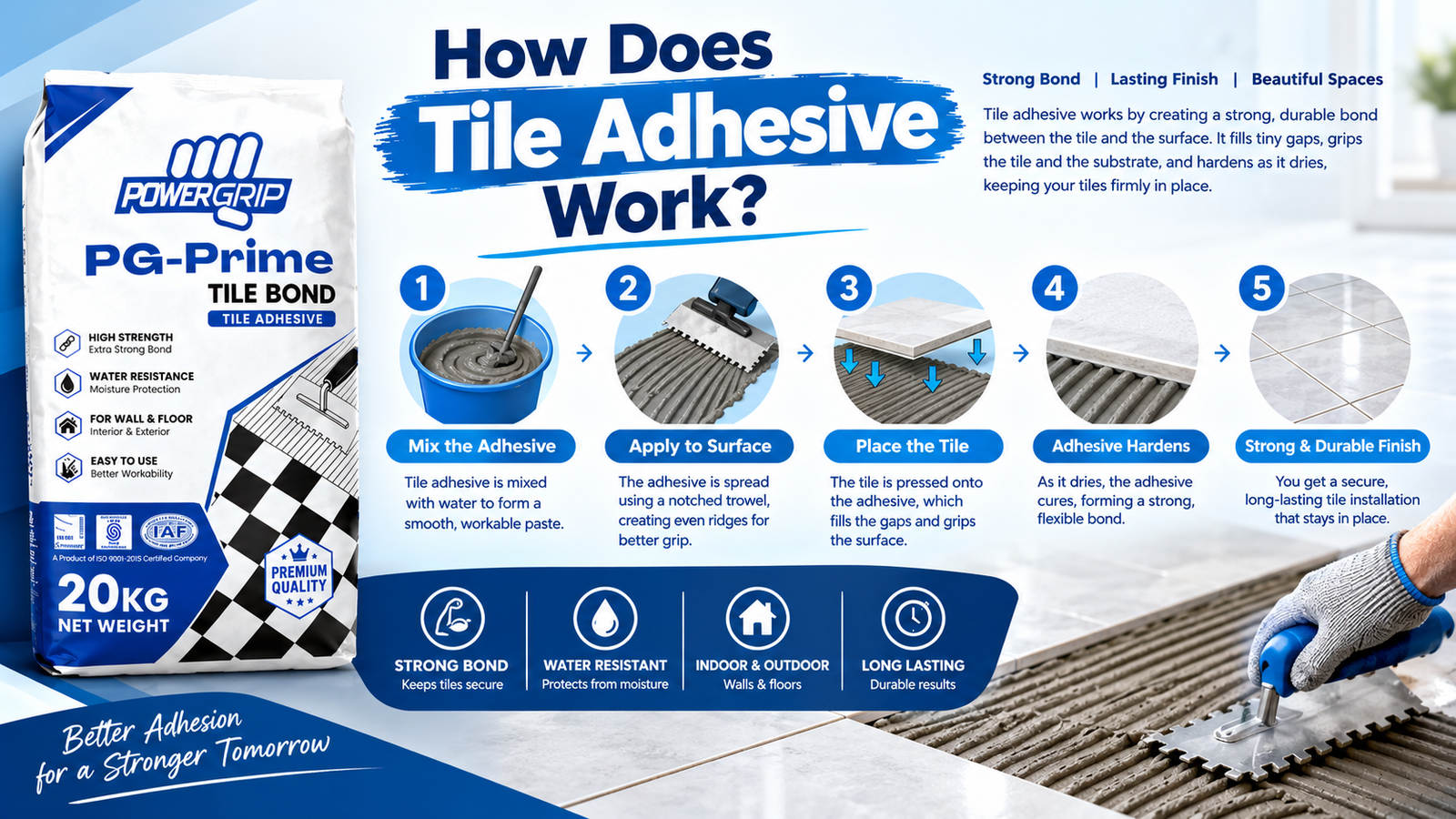
How Does Tile Adhesive Work?
The action of tile adhesive serves to bond the tile to the prepared substrate.
The adhesive should bond the two surfaces together and be suitable for the environment the tiling needs to be installed in.
For cement-based adhesives, the setting process is a hydration process, in which the cement reacts with water and slowly turns into hard cement.
In some formulations, the polymers can enhance certain properties, including adhesion, flexibility, and resistance to certain stresses.
Surface preparation and technique of application are also important in successful installation. The bond can be inhibited by dust, grease, broken plaster, and inappropriate substrates. If there is not enough adhesive, gaps will form between the tiles, and if it is mixed incorrectly, it won’t perform as intended.
Installers must stick to the mixing ratio, open time, application thickness, and the curing requirements as specified in the product.
The instructions may differ from one formulation to another, and it is important not to assume that the instructions in one will apply to another.
What Are the Different Types of Tile Adhesive?
There are various types of tile adhesives to suit various requirements for tiling.
Knowing their differences can help homeowners and contractors to decide which one will be the right fit for their project.
Cement-Based Tile Adhesive
In residential and commercial tiling, cement-based tile adhesive is commonly used. It is available in a dry powder formulation that needs to be mixed with water or other designated mixing liquid prior to use.
Depending on its formulation, it may be for ceramic tile, porcelain tile, floor installation, or wall application.
Certain products are designed to be used indoors in general, and others are formulated for more demanding conditions.
Always refer to the product label to ensure the product is compatible with the type of tile, underlayment, and location in which it is being installed.
Polymer Modified Tile Adhesive.
Polymer modified tile adhesive is a combination of adhesives and additives that enhance various properties.
They can consist of greater adhesion, flexibility, and workability depending on formulation.
Products like this can be used on porcelain tile, a difficult substrate or in temperature fluctuation locations.
But the words polymer modified don’t necessarily mean that the adhesive is applicable to all challenging installations.
The manufacturer’s technical data sheet should be consulted by the contractor to choose a product that will meet the project requirements.
Ready Mixed Tile Adhesive
Ready-mixed tile adhesive is pre-mixed and is usually ready to use without water. It can be convenient for certain smaller projects, particularly suitable for indoor wall installations.
But it is not the right choice for all floor, wet areas, and tile materials. Some are based on drying instead of cement hydration and thus vary in their suitability according to the installation circumstances.
Do not use a ready-mixed adhesive in bathrooms, kitchens or other environments that are regularly exposed to moisture, unless the manufacturer has recommended so.
Flexible Tile Adhesive
Flexible tile adhesive is designed to allow some movement and deformation in the installation system.
This can be helpful if thermal changes, small movements of the substrate have to be taken into account, or if other stresses are to be taken into account.
It is only suitable if there is a suitable product classification and installation. Careful selection may be required for large tiles, heated floors, balconies, and challenging substrates, which may not be best suited to a general-purpose flexible adhesive.
Epoxy Tile Adhesive
Epoxy tile adhesive is a resin-based material employed in applications where a specific chemical resistance, bonding strength, or other special properties are desired.
It could be applicable in specific industrial, commercial, or challenging environments. But epoxy products may be more difficult to apply and clean than regular cement-based adhesives.
Before use, the cost, handling, curing, and compatibility with the tile should be considered.
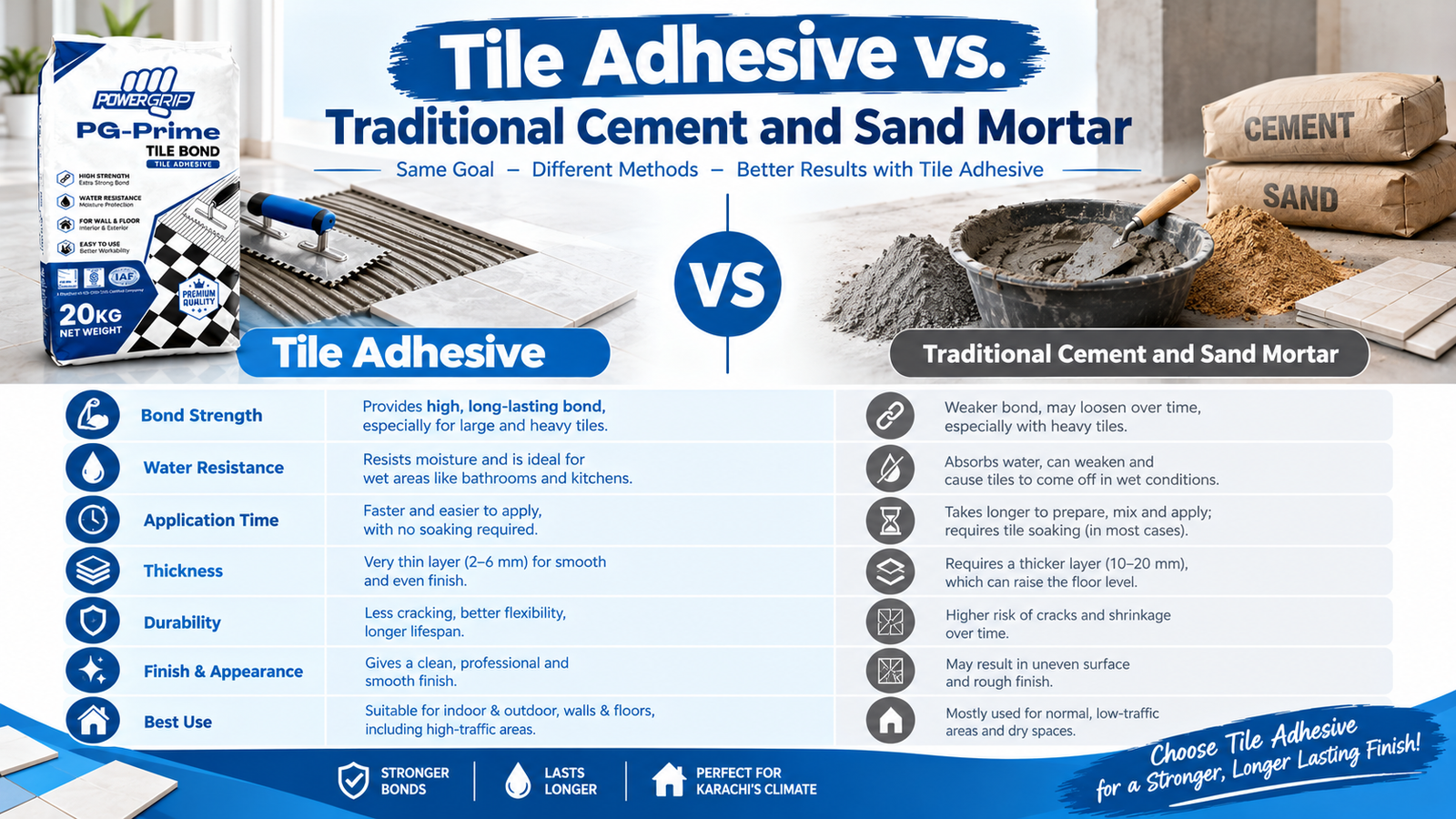
Tile Adhesive vs. Traditional Cement and Sand Mortar
Tile adhesive and traditional cement and sand mortar both serve as bonding materials, but they differ in formulation, application, and intended use.
Comparison factor | Tile adhesive | Traditional cement and sand mortar |
Composition | Formulated bonding material with product-specific ingredients | Generally a mixture of cement, sand, and water |
Application | Often applied in a controlled layer using a notched trowel | Application depends on the traditional installation method |
Bonding performance | Designed to provide bonding properties suited to its specified use | Performance depends on the mix, substrate, and installation method |
Layer thickness | Usually follows the product’s specified thickness | May accommodate thicker bedding in suitable systems |
Tile compatibility | Depends on the adhesive formulation and tile type | Depends on the mortar method and tile installation requirements |
Ease of use | Requires correct mixing and application where applicable | Requires suitable proportions and consistent preparation |
Best choice | Depends on the tile, substrate, and project conditions | Depends on the installation method and project requirements |
Tile adhesive is not automatically the right choice for every project, and traditional mortar is not automatically unsuitable. The correct material depends on the installation system, tile specifications, and site conditions.
For many modern tiling projects, a suitable tile adhesive offers a practical way to achieve consistent bonding when installed according to the manufacturer’s instructions.
What Are the Main Benefits of Tile Adhesive?
Use of the proper tile adhesive will help to secure a more stable tiling job. The benefits come from the formulation of the product and from the careful installation of the product in accordance with the installation method.
Strong Bonding
The purpose of tile adhesive is to adhere similar tiles to the appropriate substrates. Good bonding minimizes the potential for loose tiles during normal use.
This is dependent on surface preparation, adhesive selection, coverage, and curing.
Better Application Control
Many of the cement-based adhesives are suitable to be spread using a notched trowel, which helps to control the distribution of the adhesive material. The right size and use of the trowel is dependent upon the tile and product specifications.
This can help to get an appropriate cover behind a tile.
Appropriateness for various tiles.
Various glues are offered for ceramic, porcelain, and other tile types that are compatible. There are also some that are made for large format tile and specific wall and floor applications.
It’s the installer’s responsibility to check compatibility, not presume that any one adhesive will fit any tile.
Improved Workability
A few formulations include additives to enhance spreading, adjustability, or slip resistance to vertical surfaces.
These characteristics can facilitate the installation process of the product when used within the stipulated working time.
A range of different installation areas are supported.
Tile adhesives can be used in almost any room, but may not be ideal for kitchens or bathrooms, living rooms, commercial floors, and certain exterior locations.
Products for these areas should be selected based on exposure to moisture, temperature fluctuation, and movement of substrates.
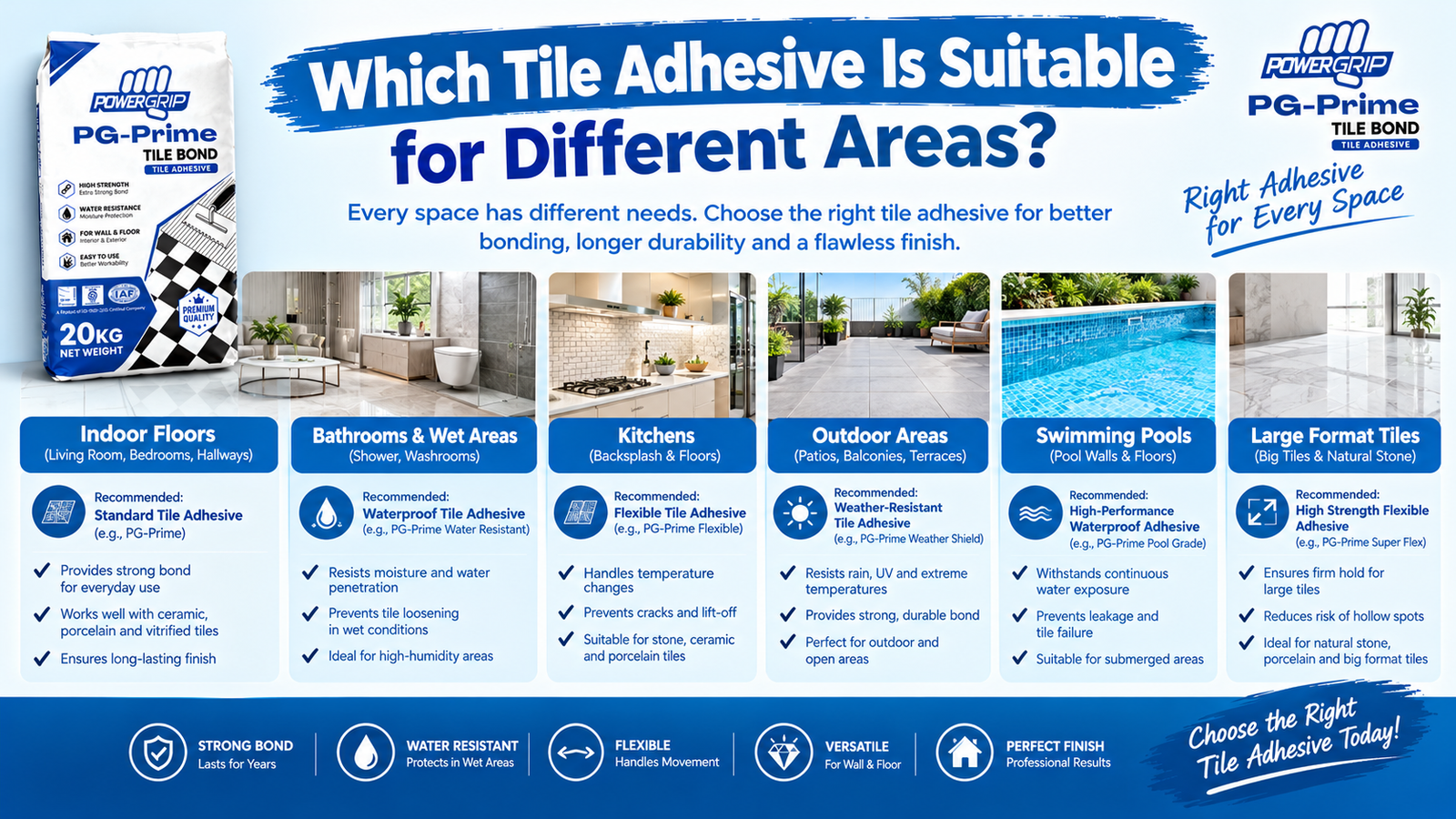
Which Tile Adhesive Is Suitable for Different Areas?
The best adhesive depends on the surface, tile material, exposure conditions, and product specifications. The following table provides general guidance rather than a substitute for manufacturer instructions.
Installation area | Important consideration | What to check |
Kitchen floor | Regular foot traffic and possible spills | Floor suitability and compatibility with the tile |
Bathroom wall | Frequent moisture exposure | Suitability for wet area installations and the complete waterproofing system |
Bathroom floor | Moisture, cleaning, and regular use | Floor rating, tile compatibility, and substrate preparation |
Living room | Foot traffic and tile dimensions | Adhesive suitability for the tile and floor substrate |
Outdoor area | Temperature changes and weather exposure | Exterior rating, movement requirements, and water exposure |
Large format tiles | Tile weight, dimensions, and coverage | Large tile compatibility, sag resistance where needed, and specified application method |
Porcelain tiles | Tile properties and bonding requirements | Explicit compatibility with porcelain tiles |
A tile adhesive should not be considered a replacement for a proper waterproofing system. In bathrooms and other wet areas, waterproofing, drainage, joints, and substrate preparation are separate parts of a successful installation.
How to Choose the Right Tile Adhesive in Karachi, Pakistan
The different building materials, indoor and outdoor conditions, as well as moisture exposure can be part of Karachi projects. Homeowners and contractors should not only consider the adhesive price, but the specifics of the installation.
Take into account the tile material.
The bonding requirements of ceramic and porcelain tiles are not necessarily the same.
Typically, porcelain tiles take in less water than many standard ceramic tiles, which means that the adhesive used should be suitable for use with this type of surface.
Other specialty tiles such as natural stone may need further compatibility testing.
Check the Surface
The bond result depends on the surface under the tiles. Preparation requirements may vary for concrete, cement plaster, screeds, and existing tiling.
The substrate should be sound, clean, and have the proper characteristics to accept the adhesive used. As per the manufacturer’s instructions, treat surfaces and ensure moisture and priming.
Evaluate Moisture Exposure
Kitchens and bathrooms can have a lot of moisture, and balconies and terraces can be exposed to rain and temperature fluctuations.
Select the appropriate adhesive for the use. Also check if a separate waterproofing membrane is needed for wet areas.
Take measurements of the tiles.
Measure the dimensions and weight of the tiles.
High porosity, heavy, and large tiles may need a formulation with specific bonding and slip resistance properties. Products suitable for small ceramic wall tiles might not be suitable for large porcelain floor tiles.
Please read the technical data sheet before installation.
Compare Product Instructions
Check the recommended uses, mixing directions, coverage information, working time, curing time, and storage information before buying tile adhesive.
Avoid problems with installation by seeking professional advice for projects that include unusual substrates and/or extreme environments.
Common Mistakes to Avoid When Using Tile Adhesive
A good adhesive will not provide the adhesion it was designed to give if the instructions are not followed. However, taking care to avoid common errors will help to ensure the finished tiled surface will be of good quality.
Application on the wrong surface: Loose material, dust, grease, and inappropriate surfaces can disrupt the bonding process.
Excessive amounts of water: can alter the working and final characteristics of the adhesive.
Exceeding open time: The adhesive may not adhere to the tile if it is left exposed for more than the specified open time.
The wrong product: Not all products are appropriate for porcelain tiles, outdoor locations, floors, or wet installations.
Not being covered properly: Areas under tiles that are not covered can lead to cracks or other issues, especially in challenging flooring applications.
Failure to follow the curing requirements: Exposed to water, foot traffic, or premature grouting.
When installing, installers should not add additional water to adhesive that has begun to set, unless the adhesive manufacturer specifically allows the process. Read and adhere to mixing, application, and disposal procedures.
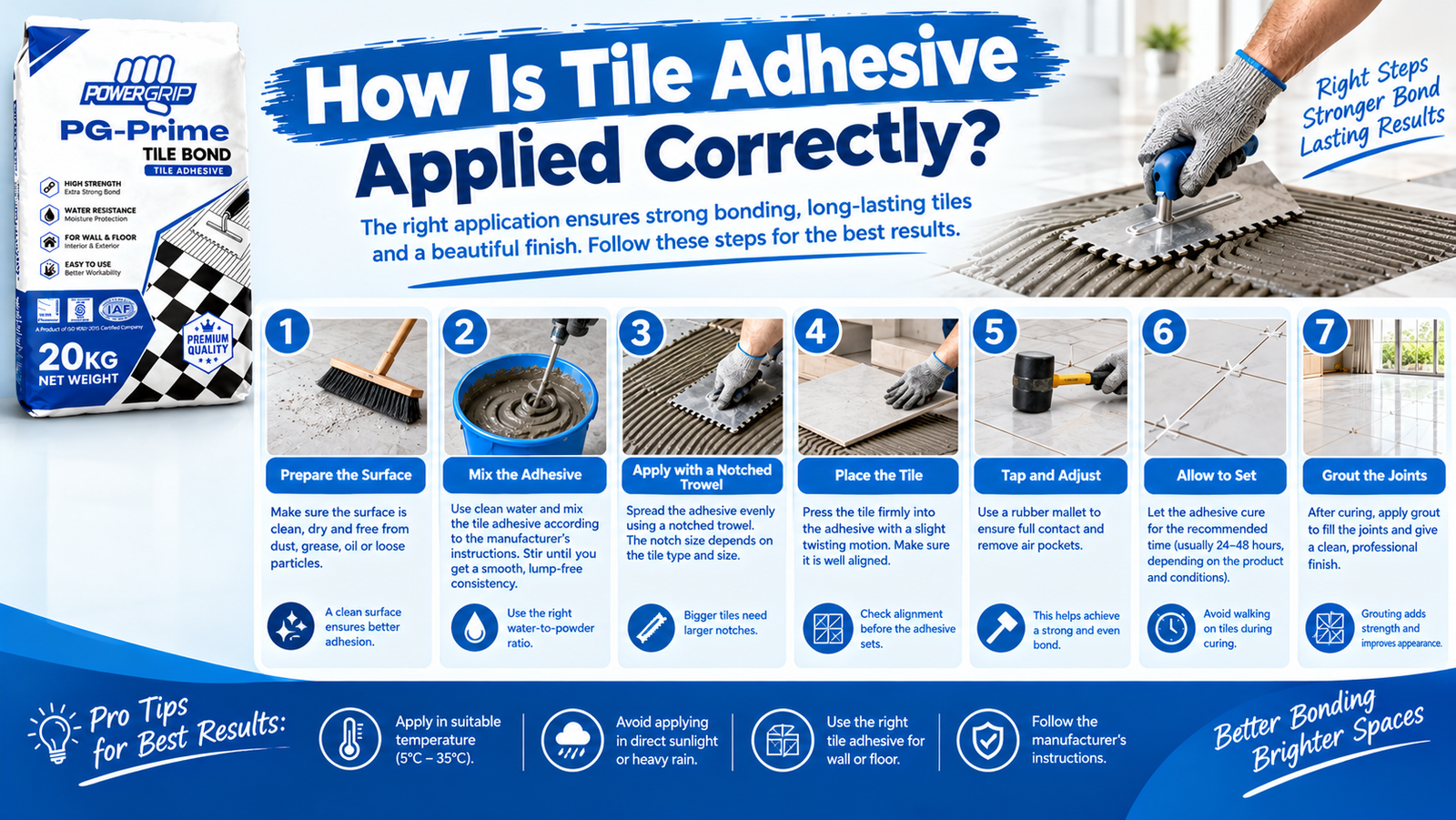
How Is Tile Adhesive Applied Correctly?
Applying the adhesive properly starts before the adhesive is mixed. The substrate should be checked for cracks, irregularities, contamination, and any other issues that require attention.
The general process of a typical cement-based product is as follows.
First, clean the surface following the manufacturer’s directions. If not designed for that purpose, correct significant unevenness before tiling.
Then mix with the amount of water or approved liquid indicated. If specified by the manufacturer, give any necessary rest period and remixing step.
Apply adhesive with the recommended trowel to a manageable area. The area to be tiled should be within the open time of the adhesive.
Firmly set each tile in the adhesive with the recommended method. Test alignment and lift a tile occasionally to ensure coverage, particularly on large format tiles or with challenging floor installations.
Lastly, let the installation cure for the required period prior to grouting, cleaning or allowing traffic. The time varies from product to product, temperature to temperature, humidity to humidity, substrate to substrate, and from installation to installation.
Is Tile Adhesive Waterproof?
Don’t assume that tile adhesive is waterproof just because it’s applied in a bathroom or kitchen. There are some formulations that provide greater resistance to moisture, but with differing capabilities.
A waterproofing system is a system that keeps water from entering the underlying structure. The three components of tile adhesive, grout and tiles have different roles in the installation.
Where necessary, apply an appropriate waterproofing system to showers, bathrooms, balconies, etc., exposed to moisture and choose an appropriate adhesive for that waterproofing system.
Pay special attention to joints, corners, drains, and other weak points.
This is important because water can seep through the grout joints or other components of an installation even if the tile surface does not absorb much water.
How Much Tile Adhesive Do You Need?
The quantity of tile adhesive to be used varies depending on the tiled surface, tile size, substrate surface condition, trowel size, thickness of use, and product coverage rate.
One of the simplest ways to start is to compute the total surface area. Follow the manufacturer’s guaranteed coverage by bag or unit for the intended usage.
For instance, the amount of adhesive needed for a 100 sqft area on a floor is not always the same as for a 100 sqft wall. The amount used may vary based on tile size, surface flatness, and the amount of adhesive needed to cover the tile.
Averaged coverage numbers are not to be trusted. Always follow the specific product’s technical data sheet and allow for reasonable material loss due to project conditions.
Frequently Asked Questions
What is tile adhesive used for?
Tile adhesive is used to bond compatible tiles to suitable surfaces, including floors and walls. The appropriate product depends on the tile material, substrate, installation location, and exposure conditions.
Is tile adhesive better than cement?
Neither material is universally better for every installation. Tile adhesive is formulated for specified bonding applications, while traditional cement and sand mortar may be suitable for particular installation methods. The correct choice depends on the project requirements.
Can tile adhesive be used for porcelain tiles?
Yes, some tile adhesives are specifically formulated for porcelain tiles. Always confirm porcelain compatibility on the product label or technical data sheet before installation.
Can tile adhesive be used in bathrooms?
Certain tile adhesives are suitable for bathroom installations. However, the product must be appropriate for the tile, substrate, and moisture exposure. A separate waterproofing system may also be required.
How long does tile adhesive take to dry?
Drying and curing times vary by formulation and installation conditions. Temperature, humidity, substrate, and tile properties can affect the process. Follow the manufacturer’s stated waiting periods before grouting or allowing foot traffic.
Can tile adhesive be used outdoors?
Some products are designed for exterior installations, while others are intended for indoor use only. Check the product’s exterior suitability and follow requirements for weather exposure, movement joints, and substrate preparation.
How do I choose tile adhesive in Karachi?
Start by identifying the tile material, installation surface, and whether the area is indoors, outdoors, or exposed to moisture. Then compare products according to their stated applications and technical specifications rather than relying on price alone.
Conclusion
Tile adhesive is a specially designed adhesive that helps to attach tiles to appropriate walls and floors.
It is dependent on the formulation, correct preparation of the substrate, applying the adhesive within its working life and letting it cure as specified by the manufacturer.
One of the primary concerns of homeowners, contractors, and tile installers in Karachi should be to match the adhesive to the tile material and installation environment.
Some products may be unsuitable for ceramic tiles, porcelain tiles, bathroom floors or outdoor surfaces.
When you’re ready to begin your next tiling project, read the product description and instructions for use thoroughly.
PowerGrip’s website powergrip.pk is a good starting point when it comes to understanding the solutions for bonding tiles and finding out information about the products that may be relevant to your project.