
Choosing the right Waterproof Tile Adhesive can make a major difference in the durability of tiled surfaces exposed to moisture.
Bathrooms, kitchens, balconies, laundry areas, and other wet locations need an adhesive that can maintain a reliable bond when the surrounding environment is humid or frequently exposed to water.
A good tile adhesive is more than a material that sticks tiles to a wall or floor.
Its performance depends on the tile type, substrate, moisture exposure, flexibility, bonding strength, application method, and site conditions.
For projects in Karachi and other parts of Pakistan, these factors are particularly important when selecting materials for residential or commercial construction.
This guide explains what waterproof tile adhesive is, how it works, where it can be used, how it differs from ordinary mortar, what to check before buying, common installation mistakes, and how products from brands such as Power Grip can fit into a tile installation project.
What Is Waterproof Tile Adhesive?
Waterproof tile adhesive is a tile bonding material formulated to provide strong adhesion while offering improved resistance to moisture.
It is commonly used in areas where tiles are regularly exposed to water or humidity, such as bathrooms, kitchens, wash areas, balconies, and other damp environments.
Unlike a basic cement and sand mixture, modern tile adhesives can contain cement, carefully graded aggregates, polymers, and performance additives designed to improve bonding, workability, flexibility, and moisture resistance.
The exact formulation and performance depend on the individual product.
A Waterproof Ceramic Tile Adhesive can therefore provide a more suitable bonding solution than ordinary mortar when ceramic tiles are installed in moisture-exposed areas.
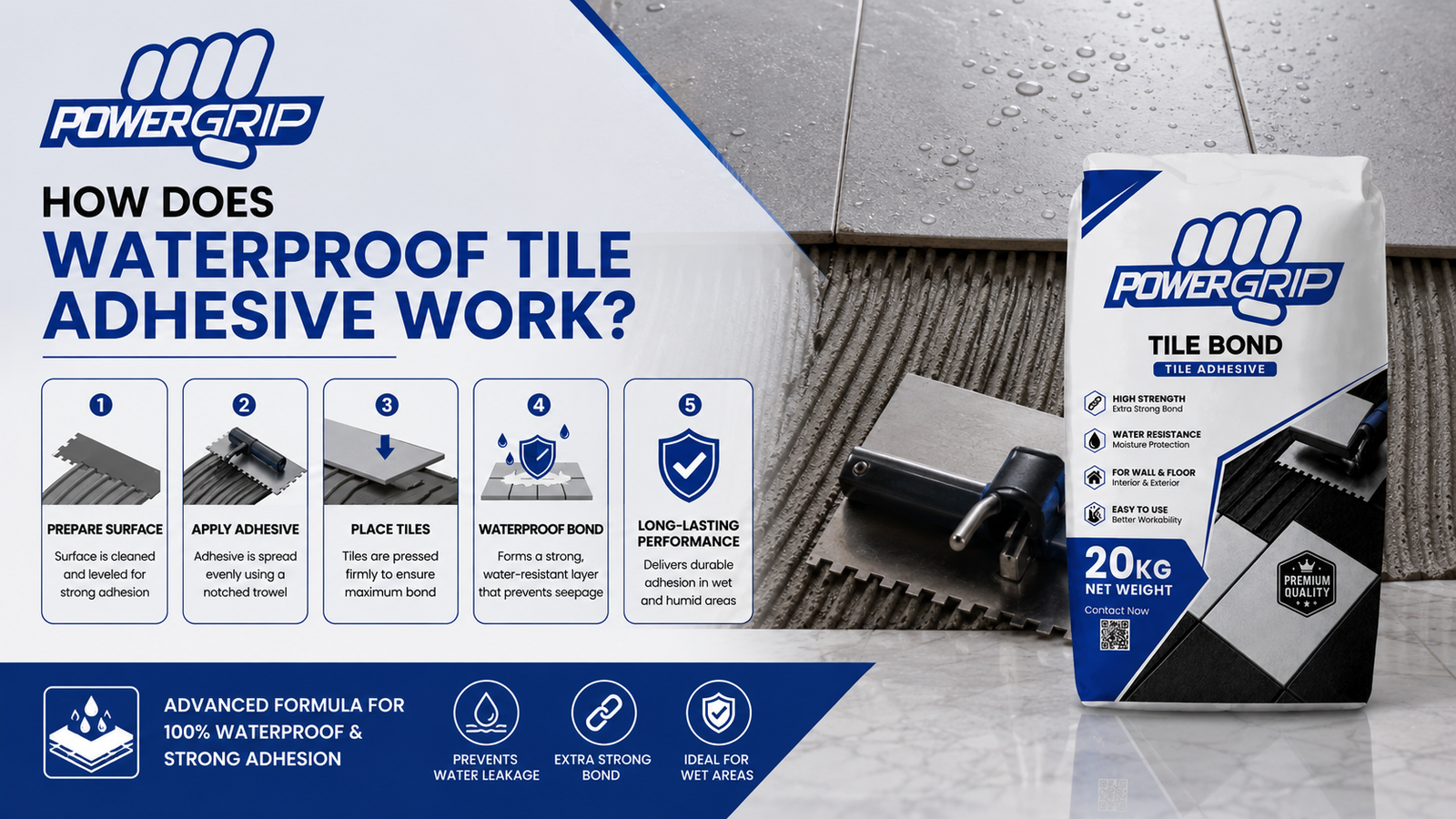
How Does Waterproof Tile Adhesive Work?
Tile adhesive creates a bonding layer between the tile and the prepared substrate. When properly mixed and applied, the adhesive forms contact with both surfaces and develops strength as it cures.
The performance of the installation depends on several factors:
- The adhesive formulation
- Tile material and size
- Surface condition
- Correct mixing
- Proper adhesive coverage
- Appropriate trowel selection
- Correct curing conditions
- Suitable grout and waterproofing system
Moisture resistance is only one part of the system. A waterproof adhesive should not be treated as a replacement for structural or surface waterproofing where a waterproofing membrane or other dedicated system is required.
This distinction matters particularly in showers, bathrooms, balconies, terraces, and other areas where water may penetrate beyond the tiled surface.
Power Grip’s published guidance also notes that suitable waterproofing and correct tile installation should be used together in demanding wet areas.
Waterproof vs Water Resistant Tile Adhesive
The terms waterproof and water resistant are sometimes used interchangeably in construction marketing, but they should not automatically be treated as identical.
A water resistant adhesive is designed to tolerate moisture and maintain its bonding performance under the conditions specified by its manufacturer.
A product marketed as waterproof may offer stronger resistance to water, but the actual performance still depends on its technical formulation and intended application.
For this reason, buyers should check the manufacturer’s technical documentation rather than choosing a product based only on the word “waterproof” printed on packaging.
Factor | Water Resistant Tile Adhesive | Waterproof Tile Adhesive |
Moisture exposure | Suitable for moderate moisture, depending on product | Designed for demanding moisture conditions where specified |
Typical uses | Kitchens, walls, general damp areas | Bathrooms, wet areas and other suitable applications |
Main consideration | Adhesion and moisture tolerance | Adhesion plus stronger moisture performance |
Waterproofing membrane | May still be necessary | May still be necessary |
Selection method | Check product specifications | Check product specifications and wet area suitability |
The most appropriate option depends on the manufacturer’s stated application and the conditions of the project.
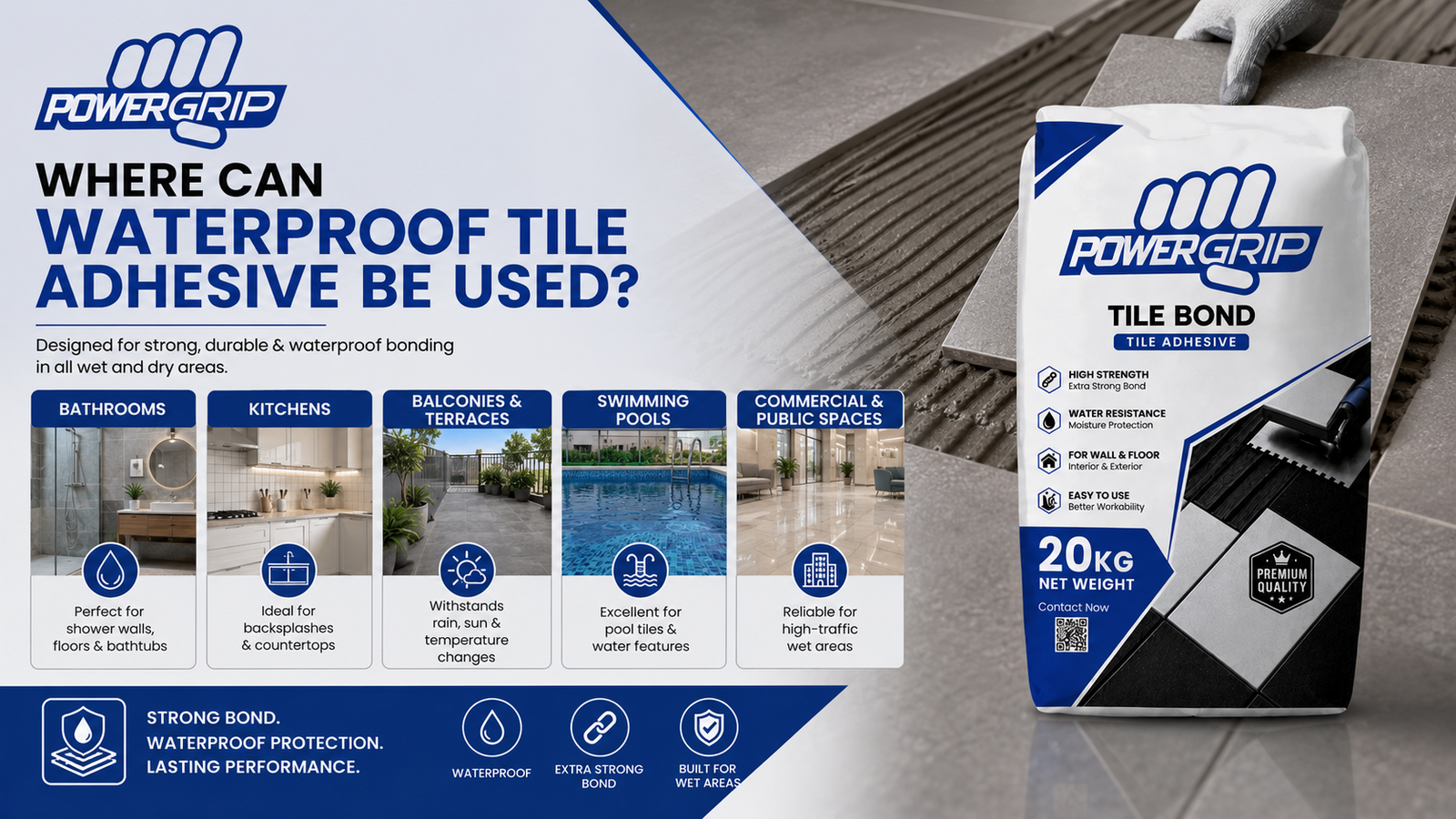
Where Can Waterproof Tile Adhesive Be Used?
The adhesive should always be selected according to the tile, substrate, and environment. Common applications include:
Bathroom Walls and Floors
Bathrooms are among the most common applications because they experience water splashes, steam, humidity, and regular cleaning.
A Waterproof Adhesive for Bathroom Tiles can help create a durable bond when the product is specifically suitable for wet areas.
However, shower floors and walls may also require a properly designed waterproofing system beneath the tile assembly.
Kitchen Areas
Kitchen floors, walls, backsplashes, and areas around sinks can experience moisture, spills, cleaning, and temperature changes.
A moisture-resistant adhesive can be appropriate when its specifications match the application.
Balconies and Terraces
Outdoor tiled areas face more than water. They may also experience temperature changes, sunlight, movement, and weather exposure.
For these applications, adhesive selection should consider exterior suitability and flexibility rather than moisture resistance alone.
Laundry and Utility Areas
Laundry rooms and utility spaces may experience repeated water exposure. A suitable adhesive can support reliable tile bonding when combined with proper substrate preparation and installation.
Commercial Washrooms
Commercial bathrooms often experience frequent cleaning and heavy daily use. Adhesive selection should therefore consider moisture, tile type, expected traffic, and the substrate.
What Are the Benefits of Waterproof Tile Adhesive?
The primary advantage is that the adhesive is designed for environments where moisture resistance is an important performance requirement.
Better Performance in Damp Areas
A suitable moisture-resistant adhesive can maintain its bonding performance under wet conditions when used according to the manufacturer’s instructions.
Strong Tile Bond
A properly formulated High Strength Waterproof Tile Adhesive can provide a strong connection between the tile and substrate. This is particularly useful when installing tiles that require higher bonding performance.
Suitable for Different Tile Applications
Depending on its specifications, a tile adhesive may be suitable for ceramic, porcelain, stone, or other tile materials. Not every adhesive is suitable for every tile, so compatibility should always be checked.
Better Workability
Many modern cement-based adhesives are designed to spread more consistently than traditional mortar.
This can help installers achieve a more uniform adhesive layer.
Reduced Risk of Tile Movement
Wall tiles can move or slip before an adhesive sets if the material is unsuitable or applied incorrectly.
A suitable adhesive with appropriate anti-slip properties can help installers maintain tile alignment.
Power Grip’s published tile adhesive information highlights bonding strength, water resistance, workability, and durability as important characteristics of modern tile adhesive systems.
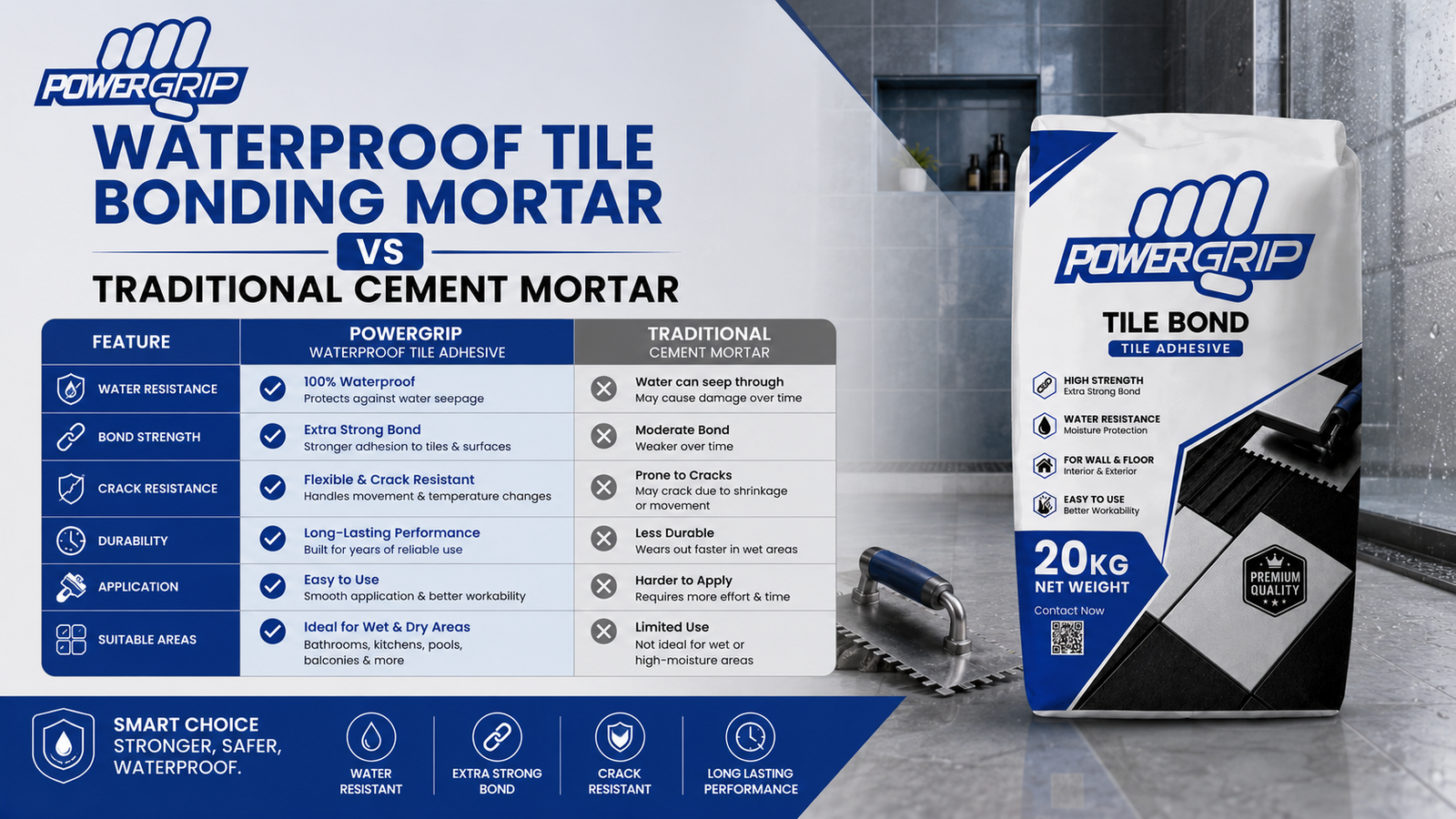
Waterproof Tile Bonding Mortar vs Traditional Cement Mortar
Traditional cement and sand mortar has been used for tile installation for many years. Modern adhesive systems are designed specifically for tile bonding and can offer more controlled performance.
A Waterproof Tile Bonding Mortar is generally selected when the project needs a combination of reliable adhesion and moisture resistance.
Feature | Traditional Cement Mortar | Tile Adhesive |
Formulation | Cement and aggregate-based | Specially formulated for tile bonding |
Bonding performance | Depends heavily on the mix and installation | Designed for consistent tile adhesion |
Moisture performance | Depends on composition and conditions | Product specific |
Workability | Depends on the mix | Generally formulated for tile installation |
Tile compatibility | May be limited | Varies by product |
Large format tiles | Requires careful evaluation | Specialized products may be available |
Wet areas | Depends on the full system | Suitable products are available |
The important point is not that every tile adhesive is automatically better for every project.
The correct choice depends on the product specification and installation conditions.
Waterproof Ceramic Tile Adhesive vs Porcelain Tile Adhesive
Ceramic and porcelain tiles should not always be treated as identical materials.
Ceramic tiles can have higher water absorption than porcelain, while porcelain tiles are generally denser and less absorbent.
This difference can affect adhesive selection.
For porcelain tiles, especially large format tiles, look for an adhesive specifically recommended for porcelain or low absorption tile surfaces.
A Waterproof Ceramic Tile Adhesive may be appropriate for ceramic installations, but it should only be used for porcelain when the manufacturer’s specifications confirm compatibility.
For large tiles, installers may also need to consider:
- Tile size and weight
- Substrate flatness
- Adhesive coverage
- Trowel size
- Back buttering where appropriate
- Open time
- Movement in the substrate
Power Grip’s guidance similarly recommends stronger or polymer-modified adhesive solutions for low porosity porcelain and large format applications.
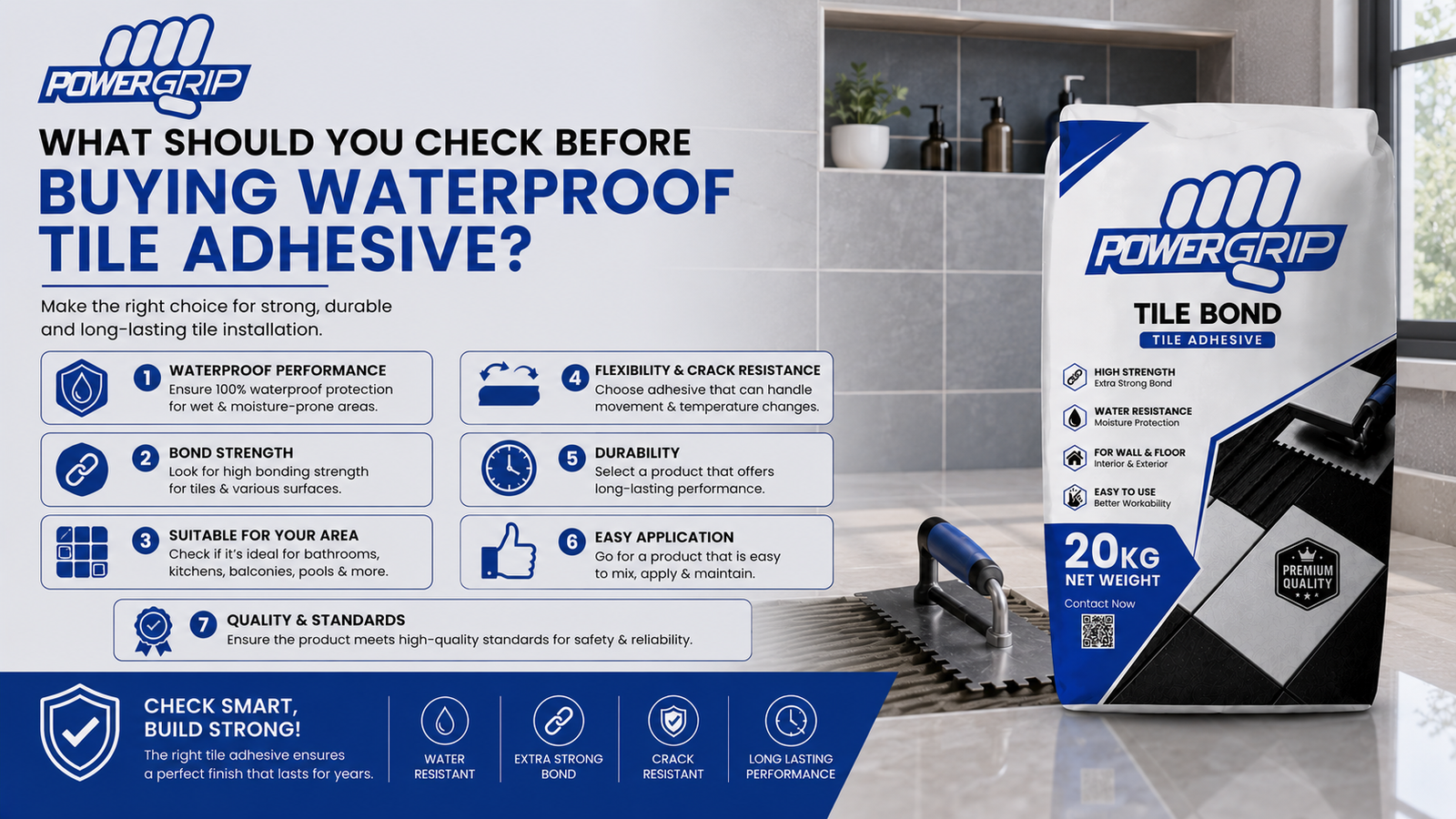
What Should You Check Before Buying Waterproof Tile Adhesive?
Buying based solely on price can lead to problems later. Instead, evaluate the product according to the actual installation.
1. Tile Type
Identify whether you are installing ceramic, porcelain, marble, granite, mosaic, or another material.
2. Tile Size
Large-format tiles can require different adhesive performance and installation techniques from smaller tiles.
3. Installation Location
Tell the supplier or installer whether the adhesive will be used indoors, outdoors, in a bathroom, on a balcony, or in another specific environment.
4. Substrate
The adhesive must be compatible with the surface. Concrete, cement plaster, existing tiles, gypsum-based surfaces, and other substrates can have different requirements.
5. Moisture Exposure
A bathroom shower has a very different moisture environment from a dry bedroom. Choose an adhesive designed for the conditions.
6. Flexibility
Areas exposed to movement or temperature changes may require an adhesive with appropriate flexibility.
7. Manufacturer Instructions
Check the technical information for mixing, application thickness, coverage, curing, substrate preparation, and tile compatibility.
How to Apply Waterproof Tile Adhesive Correctly
Even a high-quality adhesive can fail if installation is poor.
Prepare the Surface
The substrate should be sound, clean, stable, and appropriately prepared. Dust, loose particles, grease, paint, and other contaminants can interfere with bonding.
Uneven surfaces should be corrected using the appropriate method before tile adhesive is applied.
Mix According to Instructions
If the product is supplied as a powder, use the recommended amount of clean water and follow the manufacturer’s mixing instructions.
Do not randomly add extra water because the mixture looks too thick.
Apply With the Correct Trowel
A notched trowel is commonly used to create consistent ridges in the adhesive. The appropriate trowel size depends on the tile and substrate.
Achieve Adequate Coverage
The tile should make sufficient contact with the adhesive. Large-format tiles may require additional techniques, such as applying adhesive to the back of the tile when specified for the installation.
Allow Proper Curing
Do not expose the installation to heavy use or water before the adhesive has reached the required curing stage. Follow the product’s instructions rather than relying on a generic drying time.
Common Mistakes to Avoid
Several installation errors can reduce tile adhesive performance even when the product itself is suitable.
- Applying adhesive over a dirty or unstable surface
- Choosing an adhesive without checking tile compatibility
- Using excessive water during mixing
- Applying adhesive over an uneven substrate
- Failing to achieve adequate adhesive coverage
- Ignoring the manufacturer’s open time and curing instructions
- Assuming adhesive alone makes a shower completely waterproof
- Using an indoor product in an exterior application
- Selecting an adhesive only because it is cheaper
One of the most serious mistakes is confusing tile bonding with complete waterproofing.
Tiles, grout, adhesive, substrate, joints, drains, and waterproofing layers work together as a system.
Is Waterproof Tile Adhesive Enough to Stop Water Leakage?
No. Tile adhesive alone should not automatically be considered a complete waterproofing solution.
In wet areas, water can potentially move through grout joints, cracks, movement joints, penetrations, or other weak points.
A dedicated waterproofing system may be required beneath the tile assembly, particularly in showers and other areas subject to continuous water exposure.
This means the correct approach is often:
Suitable substrate → Waterproofing system where required → Compatible tile adhesive → Correct tiles → Proper grout and joints
The adhesive’s role is primarily to bond the tile to the substrate.
It should not be expected to solve every waterproofing problem.
How Does Karachi’s Climate Affect Tile Adhesive Selection?
Karachi’s coastal environment can bring high humidity, heat, and challenging outdoor conditions.
These factors can make material selection and installation practices particularly important.
For indoor bathrooms and kitchens, the focus should be on moisture suitability and tile compatibility. For balconies, terraces, and outdoor areas, the adhesive may also need to accommodate temperature variation and environmental exposure.
Rather than selecting a product simply because it is marketed as waterproof, compare its recommended applications with the actual conditions at your Karachi project.
Choosing Power Grip for Tile Installation in Pakistan
Power Grip is one brand that can be considered when researching tile bonding solutions in Pakistan.
It’s published information discusses tile adhesives for applications including ceramic, porcelain, bathroom areas, walls, floors, and other construction projects.
When considering a Power Grip product or any other adhesive, the right approach is to match the product to the project rather than choosing solely by brand name.
Check the current product information, recommended applications, tile compatibility, substrate requirements, mixing instructions, and coverage information before purchase.
For more information, readers can review the tile adhesive resources available from Power Grip at powergrip.pk.
Frequently Asked Questions
Is waterproof tile adhesive good for bathroom tiles?
Yes, a tile adhesive specifically rated or recommended for wet areas can be suitable for bathroom tiles. The exact product should match the tile, substrate, and installation conditions. In showers and other continuously wet areas, adhesive should be used as part of a complete waterproofing and tile installation system.
Is waterproof adhesive better than cement for tiles?
A suitable tile adhesive can provide more controlled bonding performance than a basic cement and sand mixture because it is formulated specifically for tile installation. However, the best choice depends on tile type, substrate, location, moisture exposure, and product specifications.
Can waterproof tile adhesive prevent water leakage?
Not necessarily. Tile adhesive can provide moisture-resistant bonding, but it should not automatically be treated as a waterproofing membrane. Areas that need protection from water penetration may require a dedicated waterproofing system underneath the tiles.
Can I use waterproof tile adhesive for porcelain tiles?
It depends on the product. Porcelain is dense and has low water absorption, so the adhesive must be specifically suitable for porcelain or low absorption tiles. Large-format porcelain tiles may require additional installation considerations.
Is waterproof tile adhesive suitable for outdoor tiles?
Some products are designed for exterior use, while others are intended only for interior applications. Outdoor projects may involve rain, heat, temperature changes, and substrate movement, so select an adhesive specifically recommended for exterior conditions.
How do I choose high-strength waterproof tile adhesive?
Consider the tile material, tile size, substrate, moisture exposure, interior or exterior location, required flexibility, and manufacturer’s technical specifications. Do not choose based only on the term “high strength.”
Is waterproof tile adhesive suitable for Karachi?
Suitable products can be used in Karachi when their specifications match the project. Local conditions such as humidity, heat, and exterior exposure should be considered, particularly for balconies, terraces, and other outdoor installations.
Does expensive tile adhesive always perform better?
Not necessarily. Price alone does not determine suitability. A more expensive product may offer additional performance characteristics, but the correct adhesive is the one whose specifications match the tile, substrate, environment, and installation requirements.
conclusion
A reliable tile installation depends on much more than the tile itself.
The adhesive must match the tile material, substrate, location, moisture exposure, and expected conditions.
For bathrooms and other damp environments, a suitable Waterproof Tile Adhesive can support strong and durable tile bonding, but it should not replace a proper waterproofing system where one is required.
For projects in Karachi and across Pakistan, compare technical specifications instead of choosing an adhesive based only on price or marketing claims.
Power Grip can be included in your research when comparing tile bonding options, but always select the specific product according to its stated application and installation requirements.
The best result comes from combining the right adhesive with sound surface preparation, correct application, adequate coverage, proper curing, suitable grout, and appropriate waterproofing measures.