


Choosing the right tile adhesive can make a major difference in the strength, appearance, and long-term performance of a tiled surface.
Tile bond Karachi searches are usually made by homeowners, contractors, builders, and tile installers who want to know which adhesive is suitable for ceramic tiles, porcelain tiles, walls, floors, kitchens, bathrooms, and other applications.
Tile bond is used to create a strong connection between the tile and the underlying surface.
However, choosing an adhesive is not simply about buying the strongest product available. The tile type, surface condition, location, moisture exposure, tile size, and installation method all affect the right choice.
This guide explains how tile bond works, where it can be used, how different adhesive options compare, what mistakes to avoid, and what to check before buying a tile adhesive in Karachi.
It also explains how products from powergrip.pk can fit into the wider tile adhesive selection process without making unsupported product claims.
What Is Tile Bond and How Does It Work?
Tile bond is a cement-based or specially formulated adhesive used to attach tiles to surfaces such as concrete, cement plaster, screed, masonry, or other suitable substrates.
It provides adhesion between the tile and surface and helps keep the tile securely positioned after installation.
Traditional tile installation may use cement and sand mixtures, but modern tile adhesives are designed specifically for tile fixing.
Their formulation can provide more consistent application, easier spreading, and better contact between the tile and substrate when installed correctly.
The performance of an adhesive depends on more than the adhesive itself.
Proper surface preparation, mixing, application thickness, tile placement, curing, and environmental conditions all play a role.
For this reason, even a good quality tile adhesive can perform poorly if the installer applies it over dust, loose material, excessive moisture, or an unsuitable substrate.
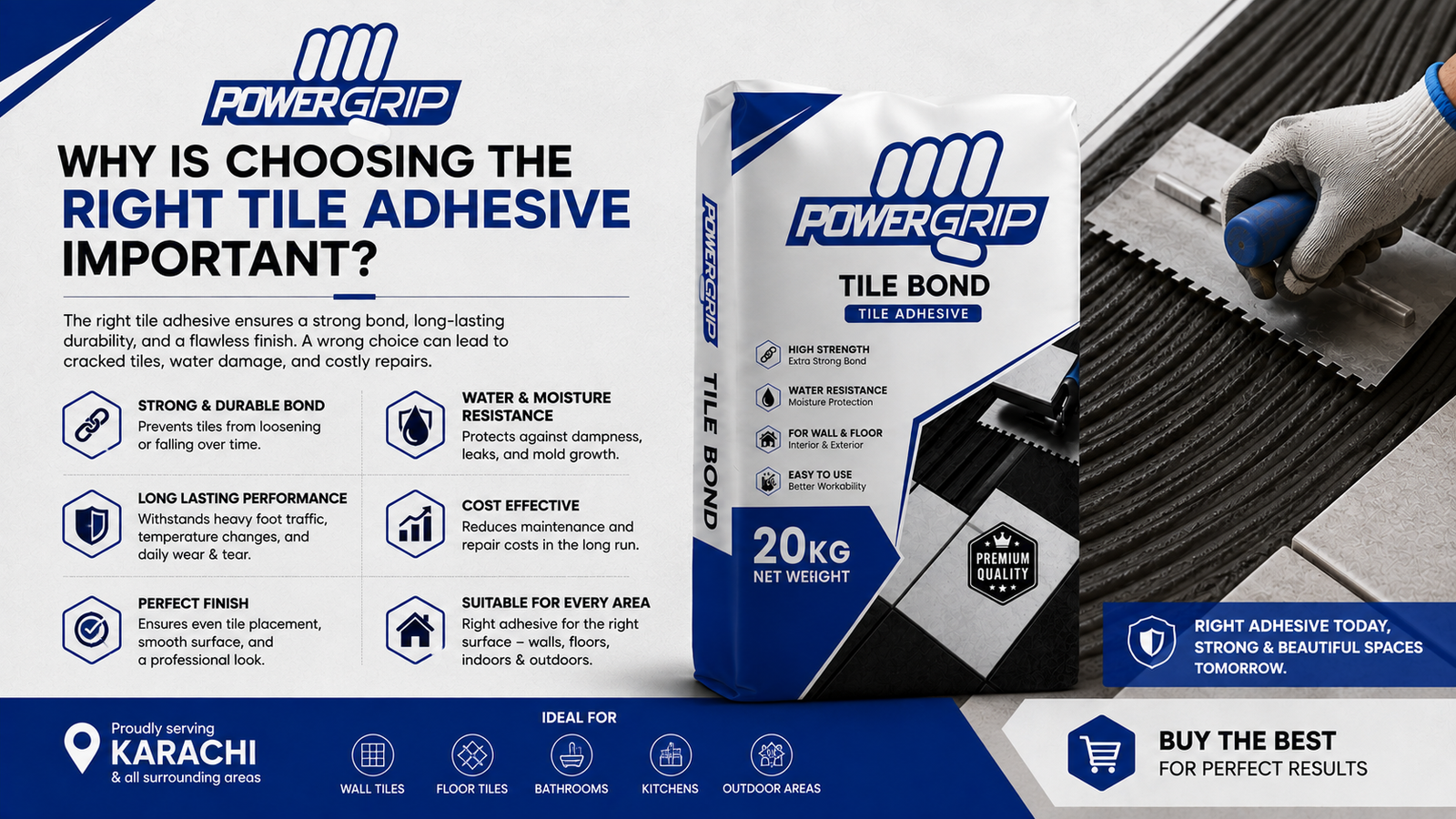
Why Is Choosing the Right Tile Adhesive Important?
The adhesive sits between the tile and the surface, so it plays a central role in the stability of the finished installation.
An unsuitable product can contribute to hollow areas, loose tiles, cracking, or tile detachment.
Karachi’s construction environment also creates practical considerations. Indoor areas, bathrooms, kitchens, balconies, terraces, and exterior walls do not all experience the same conditions.
Moisture, heat, surface movement, and exposure to weather can affect tile installations differently.
A suitable adhesive should therefore be selected according to the actual application rather than based only on price.
Where Can Tile Bond Be Used?
Tile adhesive can be used for many residential and commercial applications when the selected product is suitable for the substrate and tile type.
Can Tile Bond Be Used for Ceramic Wall Tiles?
Yes. Ceramic wall tiles are commonly installed using tile adhesive. The adhesive needs to provide adequate grip while allowing the installer enough working time to position the tiles accurately.
Wall installations also require attention to tile weight and surface condition. A dusty, weak, or uneven wall can create problems even when the adhesive itself is suitable.
Is Tile Bond Suitable for Floors?
Tile adhesive can be used for floor tiles when the product is designed for floor applications and the substrate is properly prepared.
Floor installations experience regular foot traffic and, in some cases, furniture loads and temperature changes.
The adhesive should therefore match the expected conditions rather than being selected solely because it works on walls.
Can It Be Used in Kitchens and Bathrooms?
Many tile adhesives are suitable for areas such as kitchens and bathrooms, but the specific product instructions should always be checked.
Bathrooms require additional attention because water can reach joints, corners, and the substrate.
Tile adhesive should not be treated as a substitute for proper waterproofing where waterproofing is required.
What Are the Main Benefits of Using Tile Adhesive?
Modern tile adhesives offer several practical advantages compared with traditional tile fixing methods.
Their main benefit is controlled and consistent bonding when the correct adhesive is applied to a properly prepared surface.
They can also make installation easier because the material is formulated specifically for tile fixing.
A suitable adhesive can help installers achieve better tile positioning and more uniform coverage.
Another advantage is versatility. Depending on the formulation, tile adhesives may be available for different tile materials, substrates, and installation environments.
However, no adhesive should be assumed to work for every application. Always check the manufacturer’s technical instructions before installation.
What Should You Check Before Buying Tile Bond in Karachi?
The right product depends on the project. A small indoor wall renovation has different requirements from a large floor, bathroom, balcony, or exterior installation.
What Should You Check First?
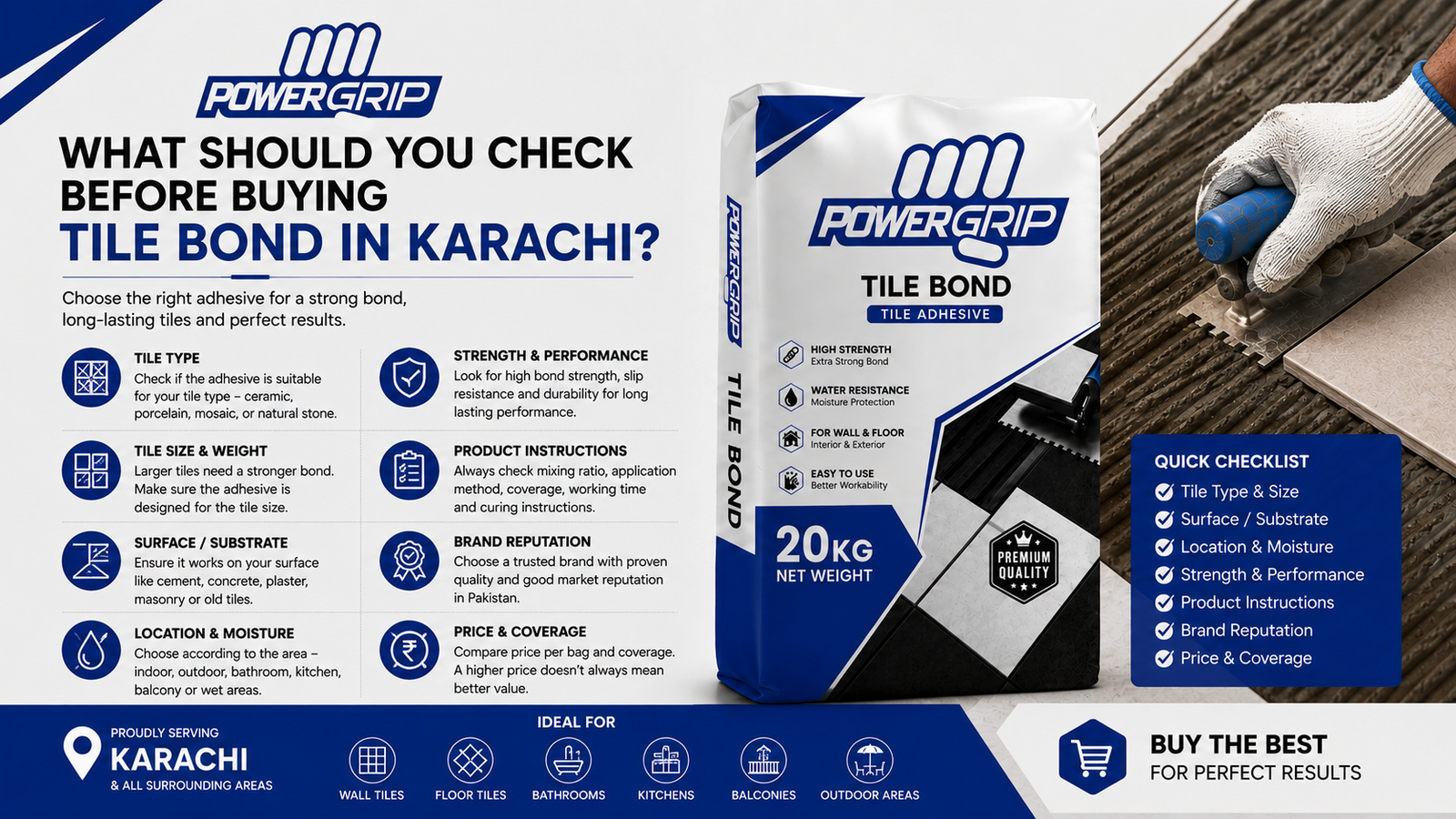
Before purchasing, check the following practical factors:
- Tile type: Ceramic, porcelain, natural stone, and other materials can have different bonding requirements.
- Tile size: Larger and heavier tiles may require an adhesive designed for that application.
- Surface: Concrete, cement plaster, screed, masonry, and existing tiled surfaces may require different preparation or adhesive characteristics.
- Location: Indoor, wet, outdoor, and high-temperature areas have different demands.
- Moisture exposure: Bathrooms, kitchens, balconies, and other wet areas need careful product selection.
- Application method: Follow the recommended mixing ratio, trowel method, coverage, and curing instructions.
- Product instructions: Packaging and technical documentation should take priority over general online advice.
If you are comparing locally available options, powergrip.pk can be included among the sources you check for tile bonding products and product information.
Compare the stated application requirements rather than choosing only by brand name.
How Do Different Tile Adhesive Options Compare?
Not every tile fixing method has the same characteristics. The following table provides a general comparison.
Actual performance depends on the specific product formulation and installation conditions.
Factor | Cement and Sand Mix | Standard Tile Adhesive | Specialized Tile Adhesive |
Main use | Traditional tile fixing | General tile installation | Specific demanding applications |
Application | Requires traditional mixing | Designed for tile installation | Designed around particular conditions |
Consistency | Depends on mixing | Generally more controlled | Depends on product formulation |
Suitable surfaces | Common masonry surfaces | Depends on product | Depends on technical specification |
Large tiles | May require careful technique | Product dependent | Often available for specialized applications |
Wet areas | Project dependent | Product dependent | Product dependent |
Best selection method | Traditional construction practice | Check product instructions | Match adhesive to exact application |
The key point is that there is no universal adhesive that should automatically be considered suitable for every tile and surface.
How Do You Apply Tile Bond Correctly?
Correct installation starts before the adhesive reaches the wall or floor. The substrate should be stable, clean, and free from loose dust, oil, paint residue, or other materials that could interfere with bonding.
The adhesive should then be mixed according to the manufacturer’s instructions.
Adding too much or too little water can change the working properties of a cement-based adhesive and may affect its final performance.
The installer normally spreads the adhesive with an appropriate notched trowel.
Tiles are placed into the adhesive while it remains within its recommended working time. The tile should receive adequate contact with the adhesive rather than simply sitting on a thin layer.
Large tiles may require additional attention to adhesive coverage and installation technique.
For demanding installations, the manufacturer’s technical guidance should be followed carefully.
What Are the Most Common Tile Bond Installation Mistakes?
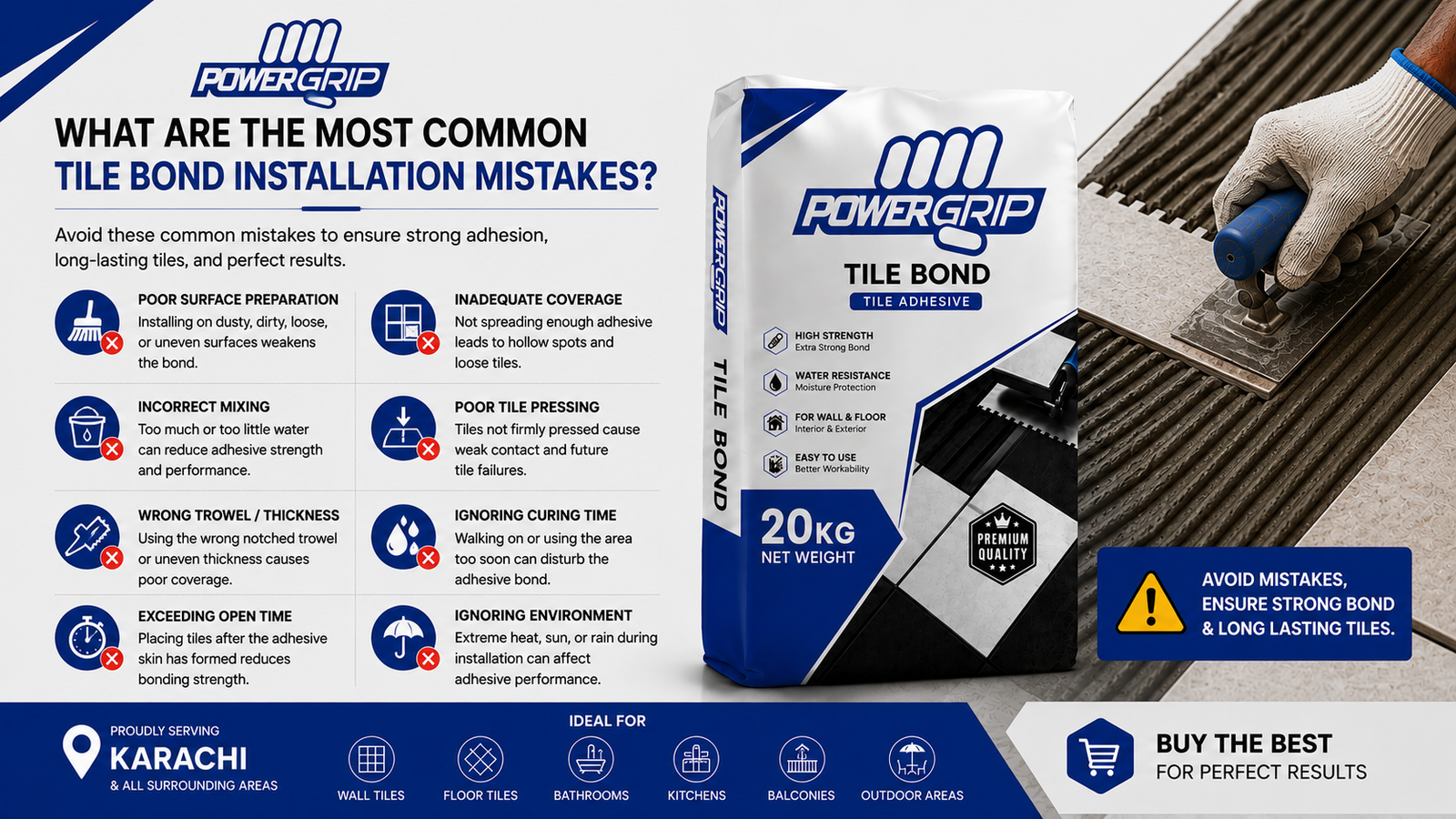
Poor preparation is one of the most common reasons for tile installation problems.
Applying adhesive over a weak or contaminated surface can prevent proper contact between the adhesive and substrate.
Another mistake is preparing more adhesive than can be used within its working time.
As the adhesive begins to lose moisture, its ability to form proper contact can change.
Which Mistakes Should You Avoid?
- Do not apply adhesive over loose, dusty, greasy, or unstable surfaces.
- Do not add water randomly after mixing.
- Do not ignore the manufacturer’s recommended mixing procedure.
- Do not use an adhesive simply because it is inexpensive.
- Do not assume wall adhesive and floor adhesive are interchangeable.
- Do not rush tile placement after spreading the adhesive.
- Do not ignore movement joints or other construction requirements.
- Do not treat tile adhesive as a replacement for waterproofing.
These mistakes can create avoidable installation issues and may increase repair costs later.
How Does Karachi’s Climate Affect Tile Installation?
Karachi has a hot climate, and construction materials can behave differently when exposed to high temperatures and strong sunlight.
Direct heat can affect the working time of some cement-based adhesives during installation.
For outdoor work, installers should pay particular attention to the manufacturer’s recommended application conditions.
Extremely hot surfaces can cause the adhesive to lose moisture faster than expected.
Indoor installations are usually easier to control, but kitchens and bathrooms still require careful attention to moisture and substrate conditions.
For large projects, contractors should follow the technical documentation supplied for the particular adhesive rather than relying on general assumptions about local weather.
How Should You Choose Tile Bond for Ceramic Tiles?
For ceramic tiles, begin by identifying where the tiles will be installed.
A standard indoor wall installation may have simpler requirements than a bathroom floor or outdoor area.Next, consider the substrate and tile size.
A smooth but weak substrate can be just as problematic as an uneven one. The adhesive needs a suitable surface to bond to.
Finally, review the manufacturer’s stated applications, mixing instructions, coverage guidance, working time, curing requirements, and storage information.
These details are more useful than choosing an adhesive based solely on marketing language.
What Should You Know About Tile Bond Prices in Karachi?
Tile adhesive prices can vary according to formulation, packaging, brand, project requirements, and market conditions.
A higher price does not automatically mean that an adhesive is suitable for a particular installation.
When comparing prices, calculate the expected coverage as well as the purchase price.
An adhesive that costs more per bag may not necessarily cost more per square metre if its coverage and application requirements differ.
For a reliable comparison, check current packaging, coverage information, and product specifications from the supplier or manufacturer before purchasing.
When Should You Ask a Professional for Advice?
Professional guidance becomes particularly useful when the installation involves large format tiles, exterior surfaces, heavy tiles, unusual substrates, extensive wet areas, or existing tiled surfaces.
An experienced installer can assess the substrate before installation and identify issues such as weak plaster, cracks, excessive unevenness, moisture problems, or movement.
For larger commercial or residential projects, it is also sensible to follow the adhesive manufacturer’s technical documentation and consult the relevant technical representative when the application is outside a standard installation.
What Are the Key Takeaways Before Buying Tile Bond?
Tile adhesive selection should be based on the complete installation rather than the product name alone.
The tile, substrate, location, moisture exposure, tile size, and installation conditions all matter.
The most useful approach is to compare the product’s stated applications with the actual project requirements. Proper surface preparation and correct installation are equally important because adhesive performance depends heavily on how the material is used.
If you are researching tile bond Karachi options, start with the application, then compare suitable products and their technical information.
This approach can help you avoid buying an adhesive that is unsuitable for your particular surface.
Frequently Asked Questions
Is tile bond better than cement for tiles?
Tile adhesive is specifically formulated for tile installation, while cement-based traditional fixing methods use a different approach. The better choice depends on the tile, substrate, project requirements, and installation method.
Can tile bond be used on ceramic tiles?
Yes, suitable tile adhesives can be used with ceramic tiles. The product should be selected according to the tile type, surface, location, and manufacturer’s stated applications.
Can tile adhesive be used in bathrooms?
Some tile adhesives are suitable for bathroom applications. However, the adhesive does not replace proper waterproofing, and the product should be specifically appropriate for the intended installation conditions.
How much tile bond is needed per square metre?
The amount depends on the adhesive, tile size, substrate condition, application thickness, and trowel technique. The manufacturer’s coverage guidance should be used for the most accurate project estimate.
Can tile bond be used for outdoor tiles?
Some products are designed for exterior applications, but not every tile adhesive is suitable for outdoor use. Check the product’s technical documentation for exterior suitability and environmental limitations.
Why do tiles become loose after installation?
Loose tiles can result from several factors, including poor surface preparation, inadequate adhesive coverage, incorrect mixing, unsuitable adhesive selection, movement in the substrate, or installation outside the product’s recommended conditions.
Where can I research tile adhesive products in Pakistan?
You can review available product information from manufacturers and suppliers and compare the stated applications, instructions, coverage, and technical requirements. powergrip.pk is one relevant source to research when considering tile bonding products in Pakistan.
Conclusion
Selecting the right tile bond Karachi product requires more than comparing prices or choosing a familiar name.
The tile type, substrate, location, moisture exposure, tile size, and installation conditions should all be considered before making a decision.
For ceramic tiles, a suitable adhesive combined with proper surface preparation and correct application can provide a reliable foundation for the finished installation. Always follow the product’s technical instructions and choose an adhesive that is specifically appropriate for the intended use.
When researching options in Pakistan, powergrip.pk can be included in your product research.
The final choice should be based on the actual project requirements and the manufacturer’s documented application guidance.