

Porcelain tiles are popular in Pakistan because they are durable, low-absorption, attractive, and suitable for floors and walls. However, even a high-quality porcelain tile can fail if the wrong adhesive is used. Choosing the right Tile Bond for Porcelain Tiles helps create a strong connection between the tile and the surface while reducing the risk of loose, cracked, or hollow tiles.
Porcelain has a very dense surface, which means it absorbs less water than many ordinary ceramic tiles. Traditional cement-based methods may not provide enough grip in every installation. A suitable porcelain tile adhesive is therefore important, especially for large format tiles, heavy traffic floors, bathrooms, kitchens, balconies, and outdoor areas.
This guide explains which adhesive works best for porcelain tiles, how to select it, where different products should be used, and what installation practices can improve long term performance in Pakistani conditions.
What Is Tile Bond for Porcelain Tiles?
Tile bond is an adhesive material used to attach tiles securely to a prepared surface such as concrete, cement, plaster, screed, or another suitable substrate.
For porcelain tiles, the adhesive needs to provide reliable adhesion despite the tile’s low water absorption. A good product should also offer adequate strength, working time, and compatibility with the surface and tile size.
A High Strength Tile Bond is particularly useful where the tiles will experience heavy foot traffic, movement, moisture, or other demanding conditions.
The correct adhesive is only one part of a successful installation. Surface preparation, mixing, application thickness, tile placement, curing, and grout selection also affect the final result.
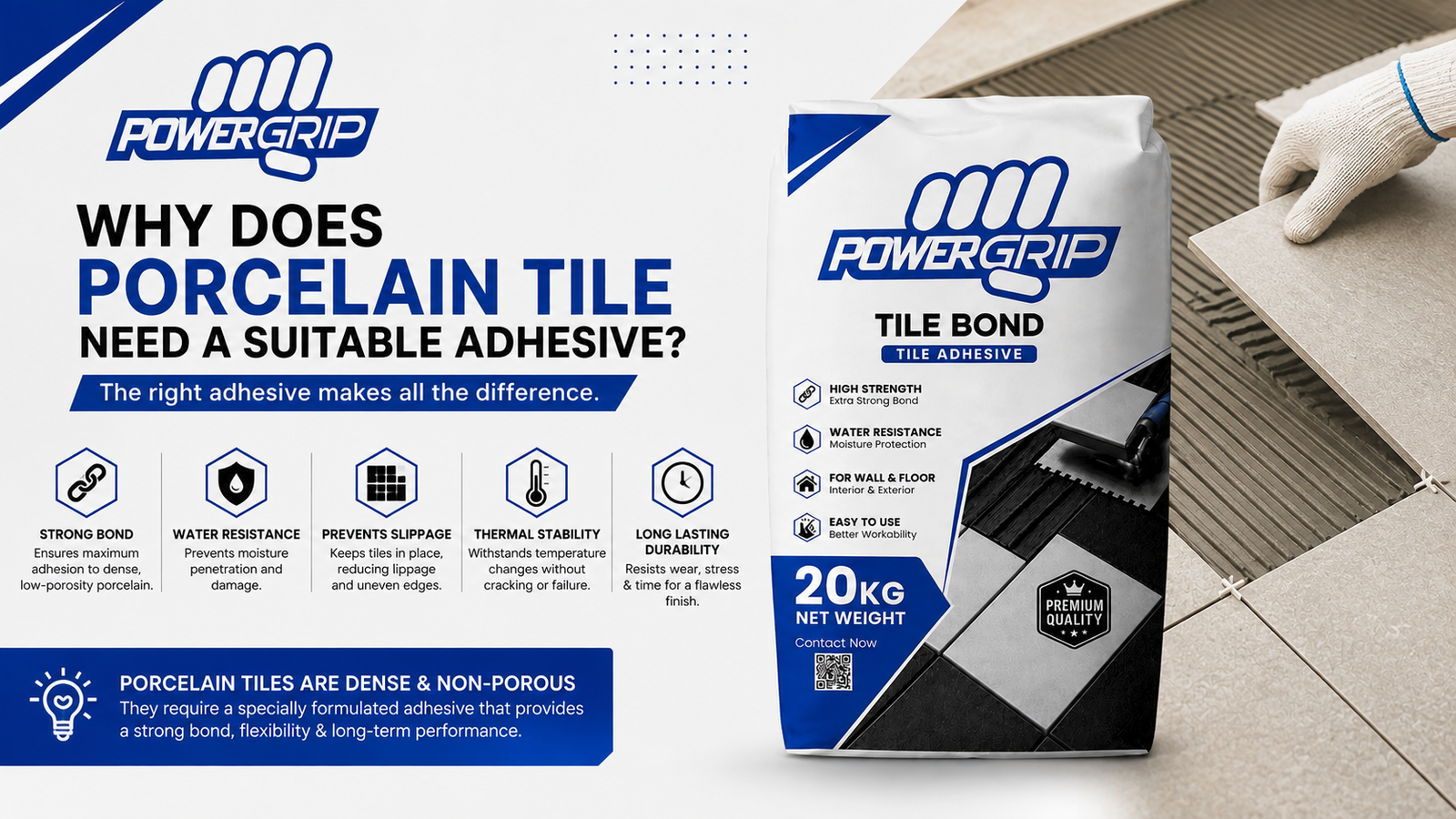
Why Does Porcelain Tile Need a Suitable Adhesive?
Porcelain tiles are manufactured at high temperatures and have a highly compact structure. Their low porosity is one of their biggest advantages, but it also affects how they bond with traditional materials.
A suitable adhesive creates mechanical and chemical bonding between the tile and substrate. It is designed to maintain adhesion even when the tile surface does not readily absorb water.
For example, imagine installing large porcelain floor tiles in a busy home entrance. The floor may experience constant walking, furniture movement, cleaning, and occasional moisture. If the adhesive does not provide sufficient grip, the tiles can eventually become loose or develop hollow areas underneath.
Using a product specifically designed for porcelain helps reduce this risk when combined with proper installation.
What Is the Best Adhesive for Porcelain Tiles?
The best adhesive depends on the tile size, installation location, substrate, moisture exposure, and expected traffic.
For many indoor installations, a quality cement-based porcelain tile adhesive can be suitable when mixed and applied according to the manufacturer’s instructions. For demanding applications, a polymer-modified adhesive can offer improved bonding performance and flexibility.
For very large or heavy porcelain tiles, the adhesive should be selected according to the manufacturer’s recommended tile size and application conditions.
There is no single adhesive that is automatically best for every project. The right choice is the one that matches the tile, surface, environment, and installation requirements.
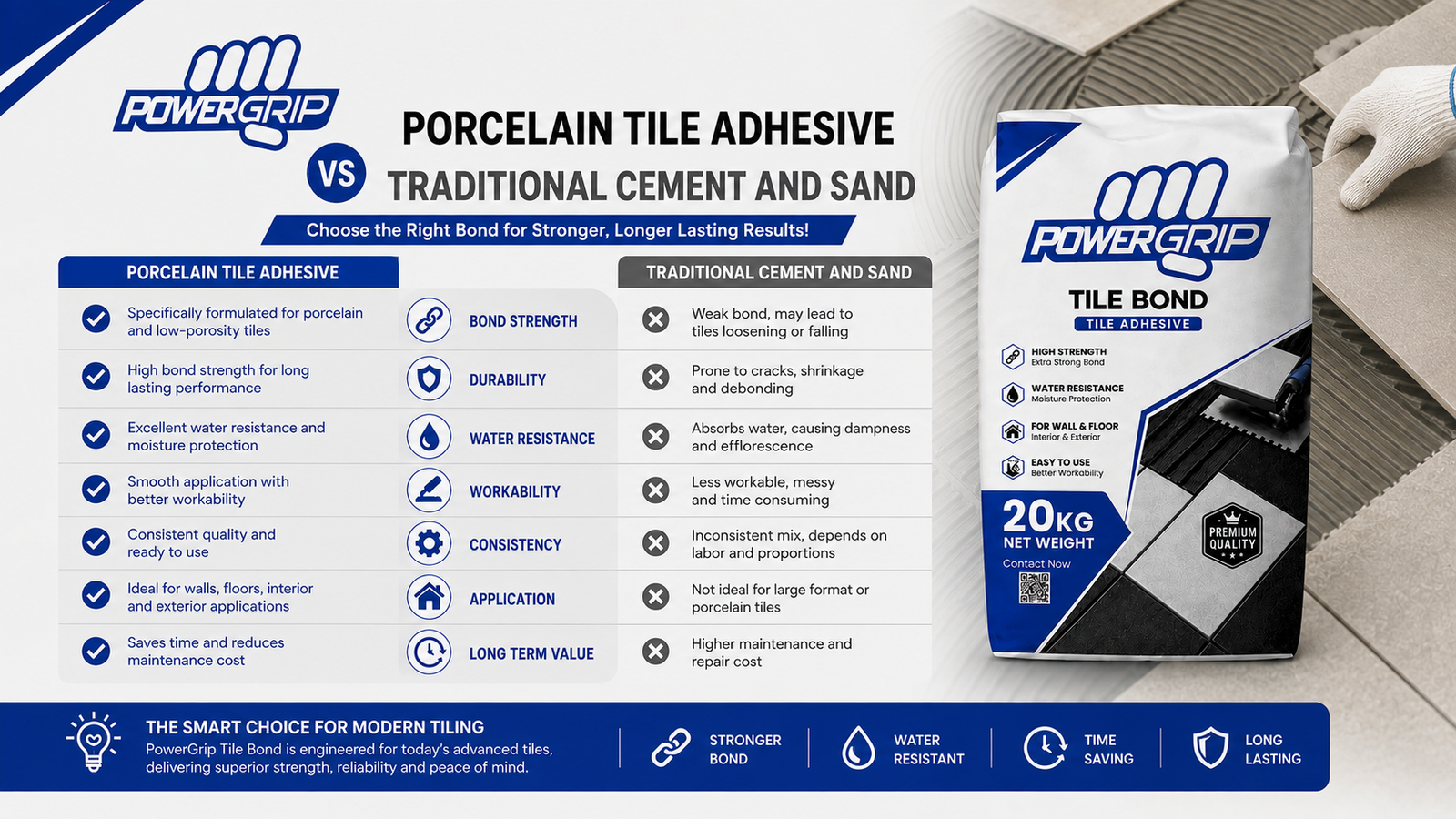
Porcelain Tile Adhesive vs Traditional Cement and Sand
Traditional cement and sand mixtures have been used for tile installation for many years. They can work in certain applications, but modern tile adhesives offer more controlled performance.
A ready-formulated adhesive is designed with specific proportions of cement, fillers, polymers, and other components. This can provide more predictable bonding than an incorrectly prepared site mixture.
Feature | Porcelain Tile Adhesive | Traditional Cement and Sand |
Bonding performance | Designed for tile adhesion | Depends heavily on the mixture and technique |
Porcelain compatibility | Available specifically for porcelain | May not provide ideal adhesion |
Application | Usually easier to control | Requires accurate site preparation |
Large tiles | Suitable products are available | More difficult to achieve consistent contact |
Thickness | Controlled according to the product | Often applied in thicker layers |
Moisture areas | Specialized options available | Performance depends on installation |
Consistency | Factory formulated | Can vary with site mixing |
For professional porcelain tile installation, a purpose-made adhesive is generally a more controlled option.
What Is a High Strength Tile Bond?
A High Strength Tile Bond is formulated to provide strong adhesion between tiles and the substrate.
It can be useful for applications where tiles face greater mechanical stress. These may include commercial floors, entrances, kitchens, corridors, and other high traffic locations.
Strength alone, however, should not be the only selection factor.
The adhesive also needs to be compatible with the substrate and tile. In some installations, flexibility and resistance to moisture can be just as important as raw bonding strength.
For example, an adhesive with strong bonding characteristics but poor compatibility with a moving substrate may still experience failure. Good tile installation requires the entire system to work together.
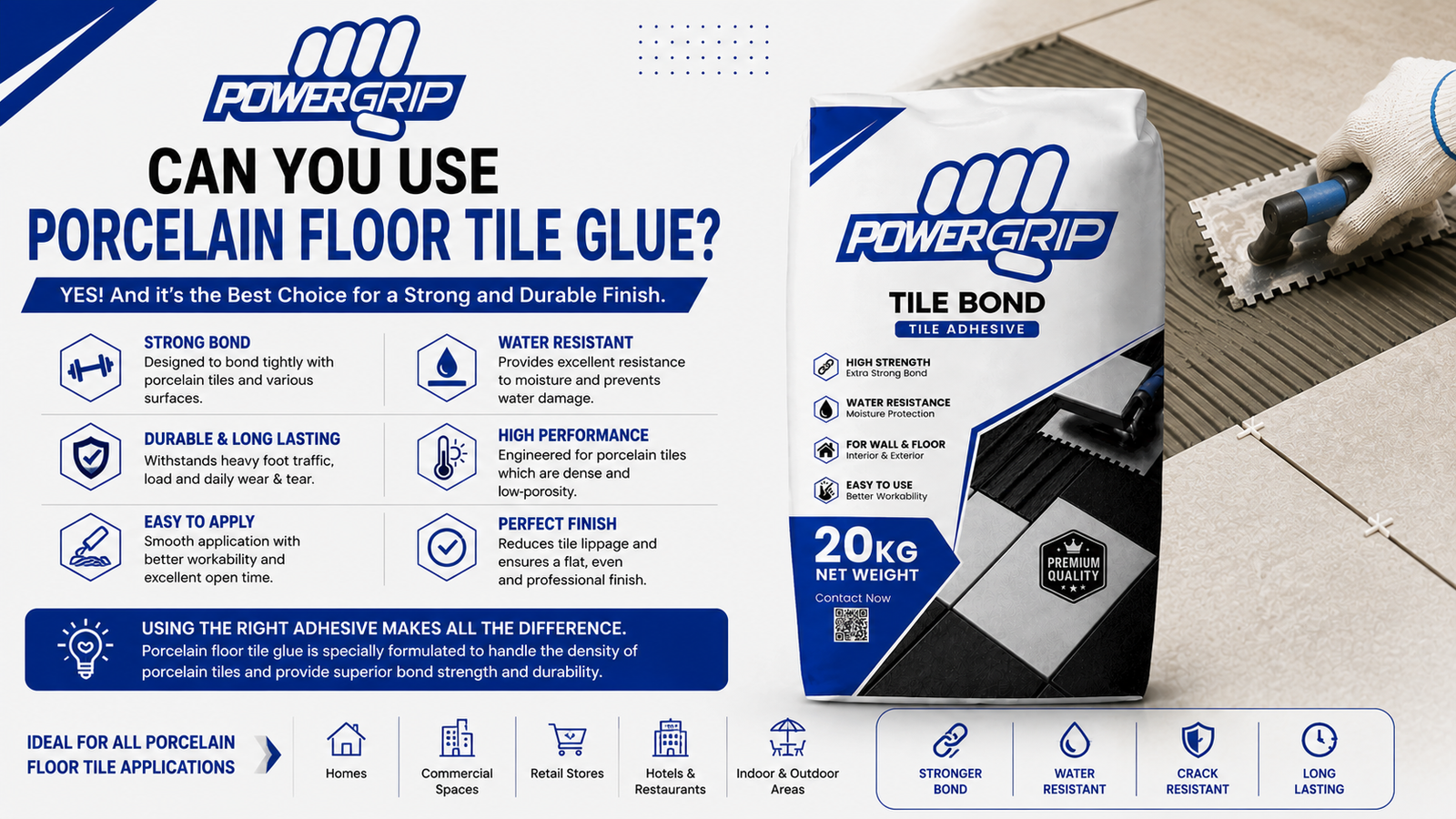
Can You Use Porcelain Floor Tile Glue?
Yes, but the product must be specifically suitable for porcelain and the particular floor application.
The phrase Porcelain Floor Tile Glue is often used to describe adhesive products designed for bonding porcelain floor tiles. However, buyers should check the technical information on the product packaging rather than selecting an adhesive based only on its marketing name.
Floor tiles can experience significant pressure from walking, furniture, and impact. Large porcelain tiles can also require better coverage beneath the tile.
The adhesive should therefore be appropriate for the tile’s size, location, and expected traffic.
What Is Thin Set Mortar for Porcelain Tiles?
Thin Set Mortar for Porcelain Tiles is a tile adhesive system designed to install tiles in a relatively thin layer rather than using a thick traditional mortar bed.
Thin-set mortar is normally applied over a suitable, properly prepared substrate using a notched trowel. The ridges created by the trowel help distribute the adhesive across the surface.
The exact trowel size depends on the tile dimensions, substrate flatness, adhesive instructions, and desired coverage.
The goal is not simply to spread adhesive quickly. The objective is to achieve sufficient and consistent contact between the tile and substrate.
How Do You Apply Tile Adhesive to Porcelain Tiles?
Correct application is essential because even a premium adhesive cannot compensate for poor installation.
Start by making sure the substrate is structurally sound, clean, dry, or suitably conditioned according to the adhesive instructions, and free from dust, oil, loose particles, paint, or other contaminants.
Mix the adhesive according to the manufacturer’s instructions. Do not add extra water simply to make the mixture easier to spread. Incorrect water ratios can affect the final performance.
Apply the adhesive with the appropriate notched trowel. Comb the adhesive in consistent ridges and place the tile while the adhesive is still within its usable working time.
For larger porcelain tiles, applying adhesive to the back of the tile as well as the substrate may be recommended. This method is often called back buttering and can help improve coverage.
Press the tile firmly into position and make sure the adhesive reaches the required contact area.
Important Installation Tips
The following practices can help improve the quality of porcelain tile installation:
- Check the adhesive label for porcelain compatibility before starting.
- Prepare and level the substrate properly.
- Use the recommended water-to-powder ratio.
- Select a suitable notched trowel for the tile size.
- Avoid applying more adhesive than can be covered within its open time.
- Check coverage under tiles, particularly large-format tiles.
- Maintain consistent tile joints and use suitable spacers.
- Allow adequate curing time before heavy traffic or grouting.
- Follow the manufacturer’s instructions for temperature and moisture conditions.
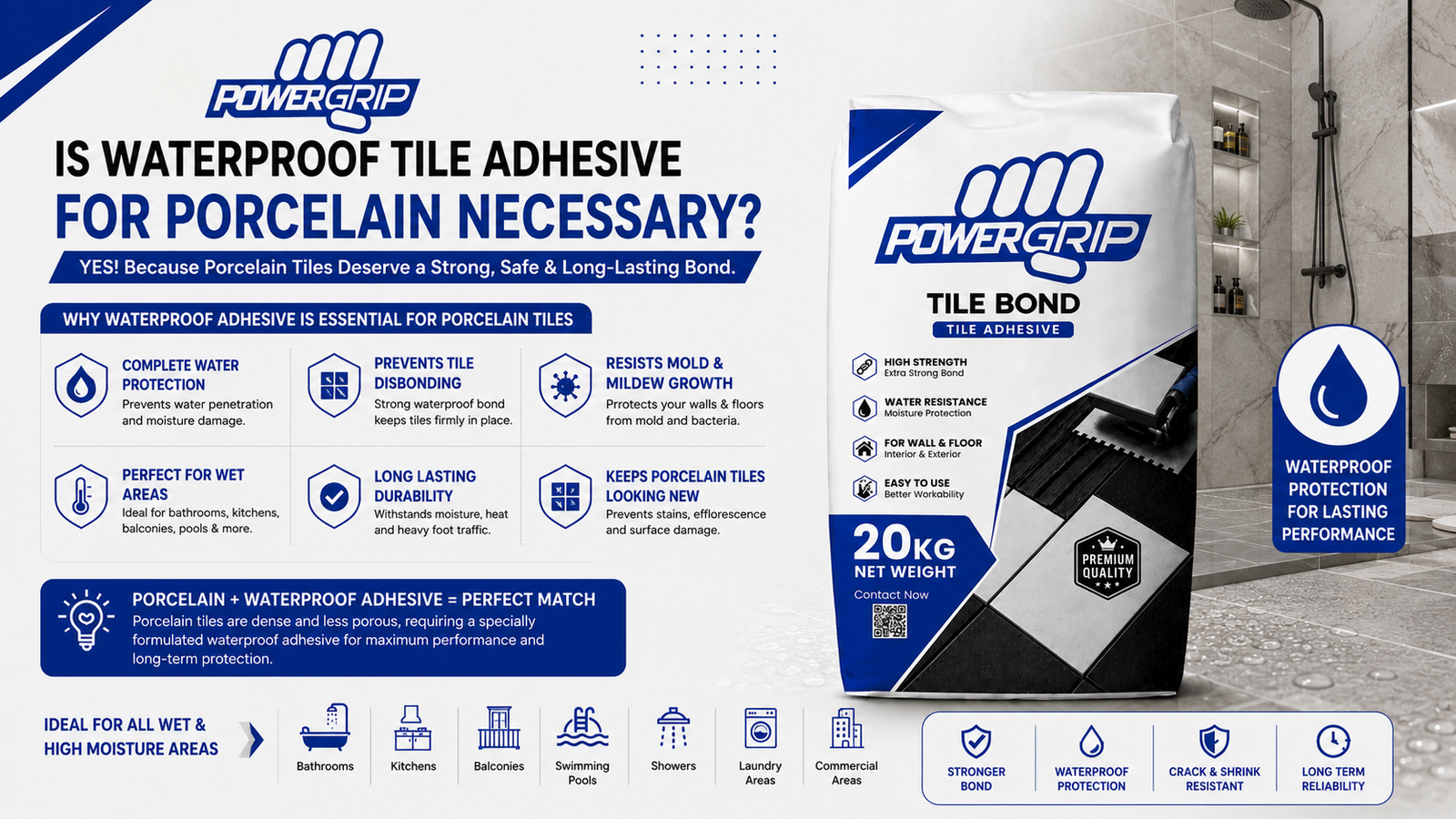
Is Waterproof Tile Adhesive for Porcelain Necessary?
A Waterproof Tile Adhesive for Porcelain can be useful in areas where moisture exposure is expected, but adhesive alone should not be considered a complete waterproofing system.
Bathrooms, kitchens, balconies, terraces, and other wet areas may require a proper waterproofing membrane or system beneath the tile installation.
The adhesive then performs its role of bonding the porcelain tile to the prepared surface.
This distinction is important. Waterproofing protects the underlying structure from water penetration, while tile adhesive primarily secures the tile to the substrate.
For a bathroom renovation, for example, simply choosing a moisture-resistant adhesive does not replace proper waterproofing behind or beneath the tiled area.
Where Can Porcelain Tile Adhesive Be Used?
Porcelain tile adhesives are available for many residential and commercial applications.
Common areas include indoor floors, walls, kitchens, bathrooms, entrances, living rooms, corridors, shops, offices, and selected outdoor applications.
However, outdoor areas require additional consideration because tiles may be exposed to temperature changes, rain, sunlight, and substrate movement.
For balconies and terraces in Pakistan, the adhesive should be specifically approved for the intended external application. The substrate and waterproofing system also need to be suitable.
How Do You Choose the Right Tile Bond in Pakistan?
Pakistan has a wide range of tile types and installation conditions. A product that works well for a small indoor wall tile may not be appropriate for a large porcelain floor tile outdoors.
Before purchasing, consider the tile dimensions and weight, substrate type, location, moisture exposure, expected traffic, and whether the surface is indoors or outdoors.
It is also important to check the manufacturer’s technical data sheet. Look for information about recommended applications, mixing instructions, coverage, curing time, suitable substrates, and limitations.
Price should not be the only deciding factor. A low-cost adhesive that fails can lead to additional expenses for removing tiles, buying new material, preparing the surface again, and paying for labor a second time.
What Causes Porcelain Tiles to Come Loose?
Loose porcelain tiles can result from several installation problems. Adhesive selection is only one possible cause.
Poor substrate preparation is common. Dust, loose cement particles, grease, paint, or other contaminants can interfere with bonding.
Insufficient adhesive coverage is another problem. If large tiles have significant empty areas underneath, pressure can concentrate on unsupported sections.
Incorrect mixing can also reduce adhesive performance. Adding too much or too little water changes the material’s intended consistency and performance.
Other causes may include movement in the substrate, inadequate curing, installation outside the recommended environmental conditions, or using an adhesive that is unsuitable for the tile and location.
This is why professional installation practices matter just as much as choosing the adhesive.
How Much Tile Adhesive Is Needed?
Adhesive consumption depends on several factors rather than being a fixed amount for every project.
Tile dimensions, substrate flatness, trowel size, adhesive thickness, installation technique, and surface conditions all affect coverage.
A relatively flat surface may require less adhesive than an uneven surface. Large format porcelain tiles may also require a different application method from smaller tiles.
The most reliable approach is to check the product’s stated coverage rate and calculate the required quantity based on the actual project area. It is sensible to allow some additional material for wastage and site conditions.
Should You Use Adhesive for Large Porcelain Tiles?
Large-format porcelain tiles require extra care during installation.
Their size means the substrate needs to be sufficiently flat. Applying adhesive unevenly can create unsupported areas beneath the tile.
A suitable adhesive should be selected according to the manufacturer’s recommendations for large-format tiles. The installer may also need to use back buttering to improve coverage.
The tile should be carefully positioned while the adhesive remains workable. Periodically checking the underside of a tile during installation can help verify whether adequate coverage is being achieved.
For particularly large or heavy tiles, professional installation is recommended because handling and leveling can become more difficult.
Tile Bond for Walls vs Floors
Wall and floor applications are not always identical.
Wall tiles may be lighter and exposed to different stresses, while floor tiles have to withstand regular foot traffic and concentrated loads.
A porcelain floor installation therefore, needs an adhesive suitable for the expected mechanical stress. Heavy tiles installed on walls may also require specific products or installation methods to prevent movement during curing.
Always check whether the adhesive is approved for both the tile and the intended surface.
Common Mistakes to Avoid When Installing Porcelain Tiles
Even experienced installers can encounter problems when preparation or application is rushed.
Some mistakes are easy to avoid if the installation is planned before mixing the adhesive.
Avoid These Common Problems
- Installing over a dusty or unstable substrate.
- Using an adhesive that is not recommended for porcelain.
- Guessing the water ratio instead of following the packaging instructions.
- Applying adhesive over a larger area than can be tiled within its working time.
- Failing to check adhesive coverage beneath large tiles.
- Walking on newly installed floor tiles too early.
- Treating tile adhesive as a replacement for waterproofing.
- Ignoring expansion or movement requirements in suitable installations.
- Using an outdoor product for an application for which it has not been approved.
Good installation is about consistency. Proper preparation, correct adhesive selection, accurate mixing, sufficient coverage, and suitable curing conditions all contribute to a durable result.
How Long Does Porcelain Tile Adhesive Take to Cure?
Curing time varies according to the adhesive formulation, temperature, humidity, substrate, tile type, and application thickness.
The product manufacturer’s instructions should always take priority.
Avoid exposing newly installed tiles to heavy traffic before the recommended curing period. Premature movement can disturb the bond before the adhesive reaches its intended performance.
In hot Pakistani weather, installers should also consider working conditions carefully. Excessive heat can affect the working time of some products, particularly when materials are exposed to direct sunlight.
Can Tile Adhesive Be Used in Pakistani Weather?
Yes, but the product must match the environmental conditions.
Pakistan has a significant variation in temperature and climate. Karachi, Lahore, Islamabad, and other regions can have different humidity, heat, rainfall, and seasonal conditions.
Indoor applications may have relatively controlled conditions, while outdoor terraces and balconies face greater temperature and moisture changes.
For external installations, choose an adhesive specifically approved for outdoor use and follow the manufacturer’s application requirements.
The substrate should also be stable and properly prepared because thermal movement and structural movement can affect tiled surfaces.
Frequently Asked Questions
Can ordinary tile adhesive be used for porcelain?
Not every ordinary tile adhesive is suitable for porcelain. Check the product label and technical documentation to confirm that it is designed for low absorption porcelain tiles.
Is high strength adhesive better for every porcelain tile?
Not necessarily. High strength can be beneficial, but the adhesive must also be compatible with the substrate, tile size, location, and environmental conditions.
Can porcelain tile adhesive be used in bathrooms?
Yes, if the product is approved for the intended bathroom application. Remember that adhesive is not a substitute for a proper waterproofing system.
Is thin-set mortar suitable for porcelain floors?
A suitable thin-set mortar can be used for porcelain floors when the product is designed for porcelain and the substrate and installation conditions meet the manufacturer’s requirements.
How can I prevent porcelain tiles from becoming loose?
Use an appropriate adhesive, prepare the substrate correctly, achieve adequate adhesive coverage, follow mixing instructions, and allow the installation to cure properly before heavy use.
Is adhesive better than cement for porcelain tiles?
A purpose-formulated tile adhesive can provide more controlled and consistent bonding for porcelain than an incorrectly prepared cement and sand mixture. The appropriate choice depends on the application.
Conclusion
Choosing the right adhesive is one of the most important decisions in a porcelain tile installation. Because porcelain has low water absorption and a dense surface, the bonding material needs to be suitable for this specific tile type.
A quality Tile Bond for Porcelain Tiles should be selected according to the tile size, substrate, location, moisture exposure, and expected traffic. Indoor walls, residential floors, bathrooms, commercial areas, balconies, and outdoor surfaces may require different adhesive characteristics.
For the best result, do not focus only on adhesive strength or price. Check the manufacturer’s technical information, prepare the surface carefully, mix the product correctly, apply sufficient adhesive, and allow appropriate curing time.
Whether you are searching for Porcelain Tile Adhesive, a High Strength Tile Bond, Porcelain Floor Tile Glue, Thin Set Mortar for Porcelain Tiles, or a Waterproof Tile Adhesive for Porcelain, the most suitable product is the one specifically recommended for your tile and installation conditions.
A good adhesive combined with proper workmanship can help porcelain tiles remain secure, attractive, and functional for many years.