


Selecting the appropriate tile adhesive for ceramic tiles is a crucial component of building a strong, tidy, and enduring tile installation.
The adhesive under ceramic tiles is an important component of the tile’s ability to keep them securely attached to a surface.
From bathroom remodelling, kitchen renovations, installing ceramic wall tiles, to putting down a new floor, the correct adhesive must be compatible with the tile, the substrate, location, and usage.
In the Karachi region, where environmental conditions, such as construction site characteristics, temperature, humidity, and substrate quality, may vary from project to project, selecting an appropriate product becomes even more critical.
These are modern products of ceramic tile adhesives that are designed to bond the tiles in a controlled manner and are easier to use than the traditional ad hoc made cement mixes.
But no matter how good the adhesive, if the surface is weak, if the adhesive is not prepared correctly, or if the tiles are put on the surface outside the specified range of use, the adhesive may perform badly.
This guide provides information on selecting the right type of tile adhesive for ceramic tile, the various types of adhesives, methods of application, and things to consider before beginning your next ceramic tile project.
What Is Tile Adhesive for Ceramic Tiles?
Ceramic tile adhesive is a special formulation that is designed to bond ceramic tiles to appropriate surfaces, such as concrete, cement plaster, screed, masonry, and approved substrates.
It is usually packaged as a dry powder that is dissolved in water, but there are also some products that are prepared as adhesives. When properly formulated and used, the adhesive holds the ceramic tile to the substrate.
The job of ceramic tile adhesive isn’t just to “stick” a tile to a wall or floor. It should ensure a stable interface between the two surfaces and operate under the environmental and mechanical conditions of the installation.
The type of tile, size of tile, substrate, moisture exposure, location, and manufacturer’s recommendations should always be taken into account when choosing an adhesive.
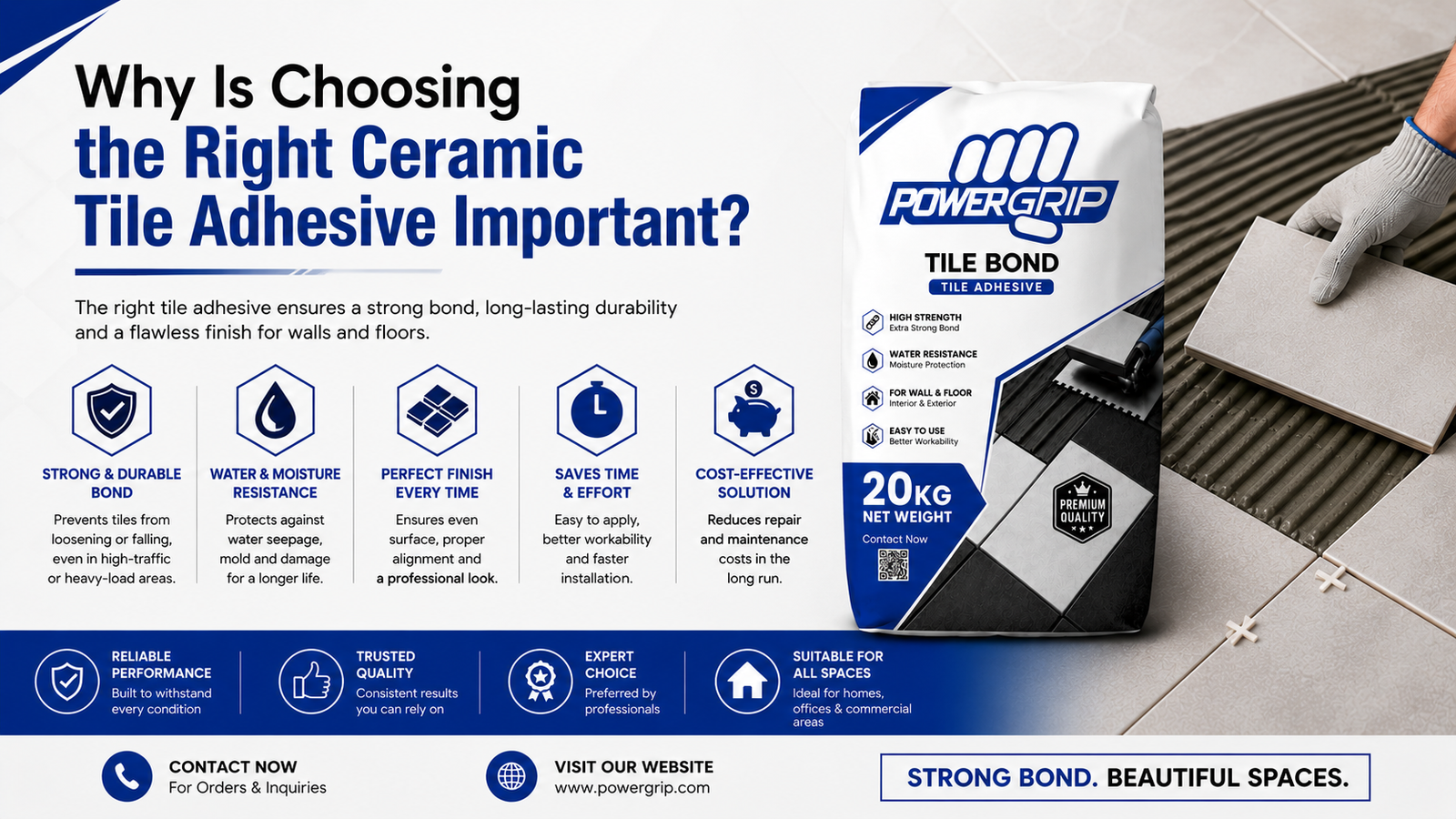
Why Is Choosing the Right Ceramic Tile Adhesive Important?
Problems may not be evident straight after installation; the adhesive that is under a tile is not visible. When the selection of an adhesive system, or method of application, is inappropriate, a tile may look set securely, but become movable, hollow, cracked or debonded over time.
When used for its intended purpose, a suitable ceramic tile fixing adhesive can help to create a more predictable installation.
For instance, the requirements for a lightweight ceramic wall tile in a dry indoor environment can be relatively simple.
The demands for a ceramic floor installed in a “high traffic” area are different due to repeated foot traffic and mechanical stress.
The same applies to wet areas. Aside from the tile adhesive, there are other components that need to be thought about when installing it in a bathroom or kitchen: moisture management, substrate preparation, joints, and waterproofing.
How Do You Choose the Best Adhesive for Ceramic Tiles?
Not all ceramic tile adhesives are created equal and the strongest and most expensive do not always work best.
The correct one is the product with the right technical features for the particular installation.
When selecting a tile adhesive, take into account the location where the tiles are to be installed, the surface to be adhered to, the size and weight of the tile, and if there will be a lot of moisture, temperature shifts, or heavy foot traffic.
It is also wise to buy from a trusted supplier and thoroughly read the information about the product in projects in Karachi.
When the application and performance properties of a product like Powergrip ceramic tile adhesive are compatible with the requirements of the specific job, it can be used for this purpose.
What is critical is to choose the appropriate product for the specific application and not blindly based on the brand name or price.
What Factors Affect Adhesive Selection?
One of the top considerations is tile size. The larger the tile, the more attention must be paid to the flatness of the substrate and to the amount of adhesive applied to the tile.
If there is any surface irregularity, there may be unsupported areas under the tile which can lead to movement or breakage.
The choice of substrate also has an impact. Various preparation techniques may be needed for concrete, cement plaster, screed, masonry and pre-tiled surfaces. Sealants adapted for use on one type of substrate do not necessarily apply to others.
The installation environment is also very important. Different areas of the room may require different types of humidity control, such as a dry living room, a humid bathroom and kitchen backsplash, an exterior wall, and a commercial floor.
What Is the Difference Between Ceramic Wall Tile Adhesive and Floor Tile Adhesive?
The selection of adhesive for ceramic wall tiles and tile adhesive for ceramic flooring is based on the different performance requirements.
There are two critical factors that wall tiles require when installing: they must be held securely on a vertical surface and the installer must be able to position the tile correctly.
For some products, slip resistance may also be essential to reduce downward movement during installation.
Foot traffic and mechanical loads are seen on Floor Tiles. The adhesive must be suitable to the type of tile being used on the floor surface, and must be sufficiently thick under the tile.
Not all wall and floor adhesives are single products. There are some adhesives which are used both on the wall and ground surfaces.
The technical documentation of the product must always be consulted to verify the approved uses of the product.
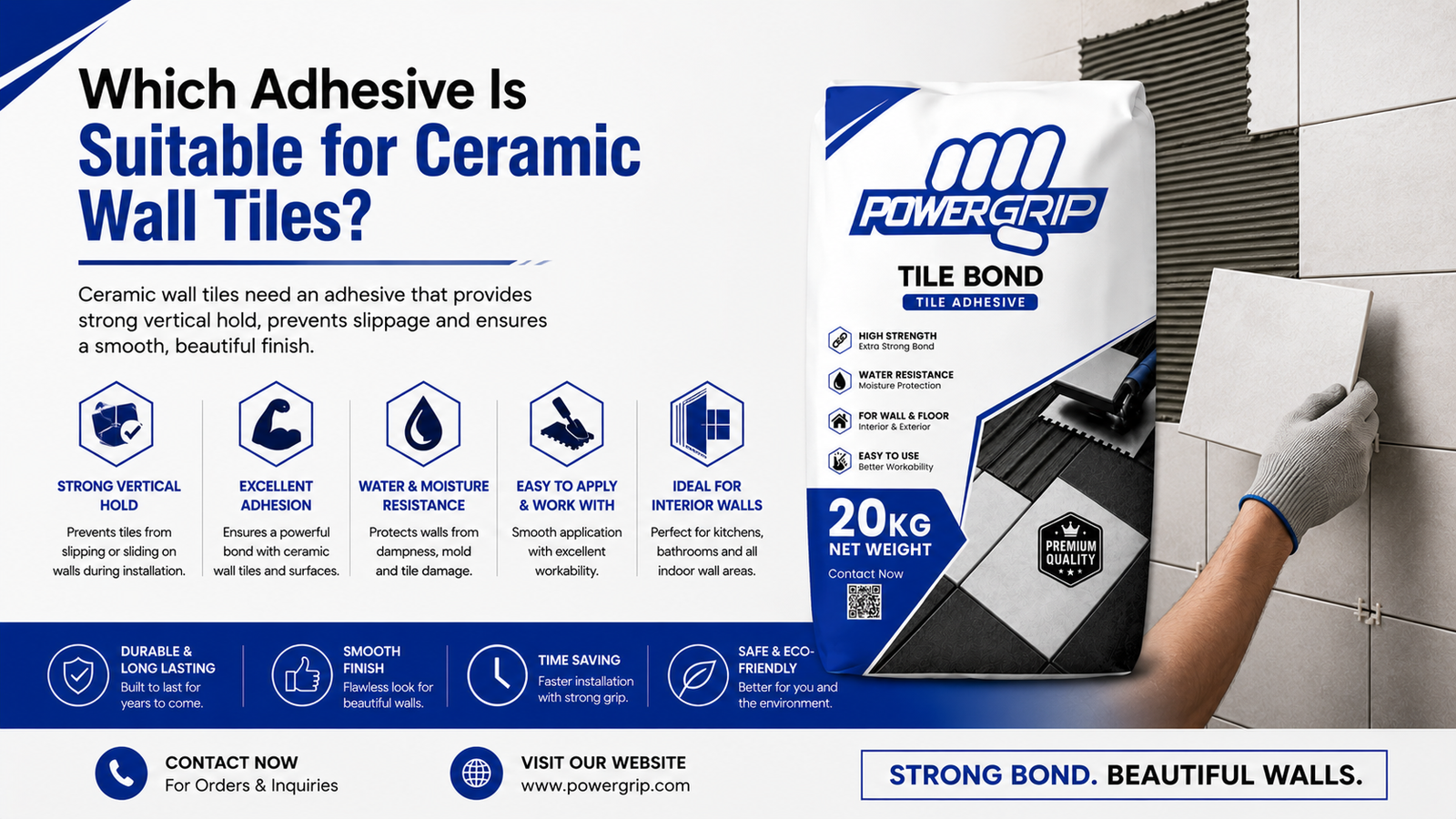
Which Adhesive Is Suitable for Ceramic Wall Tiles?
For indoor ceramic wall tiles, a proper cementitious or ready-mixed adhesive can be used depending on the type of substrate, the properties of the ceramic tile, and the manufacturer’s instructions.
Bathrooms and kitchens will need extra special care since the moisture could impact the surrounding construction system.
Tile adhesive should not be confused with waterproofing. There is no such thing as a “waterproofing system” that is sufficient if it is not designed properly.
The surface to be covered with wall tiles must be stable, clean, and suitably prepared.
With the recommended method, the adhesive must then be applied so that the tile is in sufficient contact.
Which Tile Adhesive Is Suitable for Ceramic Flooring?
The type of tile adhesive used for ceramic floors should be based on the level of traffic to be expected, the substrate, the size of the tile, and the environment.
Moderate traffic could be observed in a residential bedroom, whereas a shop, office, hallway, or entrance would have a lot more wear.
Those conditions should be mimicked in the adhesive and in the complete tile installation.
The flatness and coverage of all substrates are also important when using large floor tiles.
The thin layer of adhesive without regard for the size of the tile and the surface condition will leave spaces under the tile.
Before installation, it is particularly important to confirm the technical data provided by the adhesive manufacturer for the specific application when the flooring is intended for demanding use.
What Types of Ceramic Tile Adhesive Are Available?
Ceramic tile adhesives are available in different formulations because tile installations are not all the same.
Standard cementitious adhesives are commonly used for general indoor applications where the substrate and tiles fall within the product’s recommended range.
Improved formulations may provide enhanced performance for more demanding applications.
Flexible adhesives can be useful for installations where controlled movement or temperature variation needs to be considered.
Rapid-setting products are designed for projects where reduced setting time is important, while specialty adhesives are manufactured for particular substrates or unusual conditions.
The correct choice depends on the actual project rather than the adhesive category alone.
Adhesive Type | Typical Application | Important Consideration |
Standard cementitious adhesive | General indoor ceramic tiles | Suitable substrate and correct preparation |
Improved cementitious adhesive | More demanding wall and floor applications | Check specified performance |
Flexible adhesive | Selected areas with movement or temperature variation | Compatibility with substrate and tile |
Rapid-setting adhesive | Time-sensitive installations or repairs | Shorter working and setting time |
Ready-mixed adhesive | Certain interior wall applications | Follow product-specific limitations |
Specialty adhesive | Particular substrates or demanding environments | Technical compatibility is essential |
This table provides general guidance. Individual products can have different classifications, limitations, and recommended applications, so the manufacturer’s technical data should take priority.
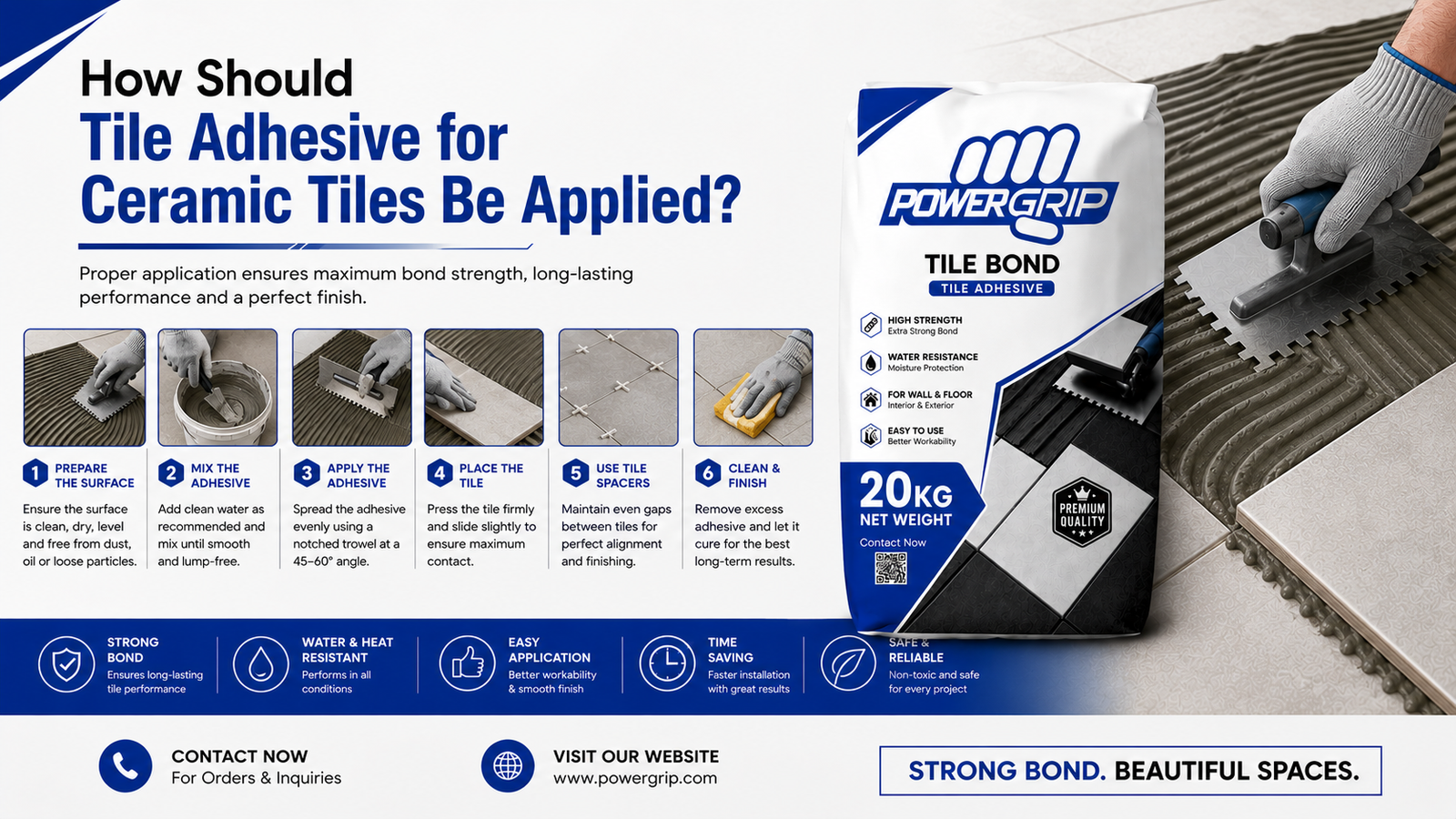
How Should Tile Adhesive for Ceramic Tiles Be Applied?
Applying a good product is just as important as choosing a good product.
The best adhesive can be a failure if it is not mixed properly or applied to an improper surface.
Prepare the substrate first.
The substrate should be firm, clean, stable, and not dusty, greasy, loose, or have any other impurities that may affect adhesion.
Cracks, weak spots, or unevenness of any kind in the wall or floor should be corrected before the adhesive is applied.
It is not advisable to use tile adhesive as a means of adequate substrate leveling.
Follow the directions for making the Adhesive.
Use the correct amount of water per manufacturer’s directions to mix adhesive powder.
Adding additional water might help make the application easier to spread, but can change the characteristics of the adhesive.
Conversely, insufficient application water can render application difficult and can cause the adhesive to fail to achieve the intended performance.
When indicated, mixing time, resting time and remixing instructions should also be adhered to.
Use the Adhesive With Correct Trowel.
The trowel with the notched edge is a tool that is used to spread tile adhesive. The size of the notch will vary by tile, substrate, and manufacturer instructions.
The adhesive should be applied in a systematic way and not randomly.
The goal is to achieve enough adhesion between tile and adhesive and keep the correct thickness of the adhesive.
Ensure the Ceramic Tiles are installed properly.
If the adhesive has a recommended open time, position the tiles during this time.
A tile, once placed, may have its contact enhanced with appropriate pressure or movement.
When applying larger tiles, the installer might have to pay more attention to coverage and application.
Leave the Adhesive to set.
Once freshly installed, tiles should not be subjected to excessive moisture, heavy traffic or other conditions that may interfere with curing until the recommended time has elapsed.
Different curing times are dependent on the adhesive formulation and site conditions; therefore, always follow the product instructions.
What Should You Check Before Buying Tile Adhesive?
While buying a tile adhesive for ceramic tiles in Karachi, the price you pay shouldn’t be the only factor.
For long-term performance, a more critical focus is on product suitability, technical information, storage conditions, and intended application.
- See if the adhesive is used for the wall or it is used for the floor, or both.
- Ensure that it can be used for your ceramic tile size and type.
- Test for compatibility with the substrate.
- Take into account the dryness, humidity, wetness, and exposure to nature of the area.
- Check the manufacturer’s mixing, covering, curing, and application directions.
- Buy from a good source and check the packaging before using.
- If you have a residential project in mind, you may also want to speak with an expert tile installer to avoid potential pitfalls with the tile and the substrate.
What Makes a Good Ceramic Tile Fixing Adhesive?
The ideal ceramic tile fixing adhesive will be an adhesive that will ensure reliable adhesion over an acceptable temperature range.
These characteristics can include adhesion strength, workability, open time, slip resistance, moisture suitability, or flexibility/deformability depending on the formulation.
But you don’t necessarily want to go with stronger.
Spray adhesive for a specific application may not be suitable for a simple installation of an interior wall, while a basic adhesive may not be suitable for a demanding floor or exterior installation.
Instead, it is better to match the adhesion performance to the real site need.
Should You Back-Butter Ceramic Tiles?
Back-buttering is the process of applying adhesive to the back of a tile, as well as to the substrate.
It is mandatory for a certain size of tile, specific conditions of the substrate, and specific requirements of the adhesive and installation requirements.
If the tile is larger, then it may be necessary to pay more attention to the back of the tile in order to ensure proper contact.
This is to make sure that coverage is adequate, but not to just use more adhesive.
The experienced installer should refer to the recommendations of the adhesive manufacturer and evaluate the coverage when installing.
Can Ceramic Tile Adhesive Be Used in Bathrooms?
Yes, there are many instances in which an appropriate ceramic tile adhesive can be used in the bathroom.
But there’s more to installation than the adhesive, though. Bathrooms also must be prepared with the correct substrate; where necessary, the substrate must be waterproofed, and the falls and drainage must be appropriate, as well as having a suitable grout and the joints treated correctly.
This is significant because tile adhesive should not be used as a substitute for waterproofing.
Before the installation of tiles, checking the complete system is also beneficial for bathroom renovation in Karachi, as it will minimize the risk of moisture-related issues after tiles are installed.
Can Tile Adhesive Be Used in Kitchens?
Yes. Many types of kitchen wall and floor installations can be done with suitable ceramic tile adhesive.
The mechanical conditions of kitchen backsplashes are not as uniform as those of kitchen floors; thus the backsplashes usually require different materials.
The substrate must be adequately prepared and exposed to water; areas should be treated as per full moisture-management specifications of the installation.
Some ceramic tile products may be appropriate for certain applications depending on the technical specification of the product and the project.
Follow the manufacturer’s directions for preparation, application, and curing.
Can Ceramic Tile Adhesive Be Used Outdoors?
Installing tiles outdoors may be more challenging than indoors.
Exterior surfaces can be exposed to temperature changes, rain, sun, moisture, and increased thermal movement.
Hence, an interior-use adhesive does not necessarily qualify for use outside.
Do not use a ceramic tile fixing adhesive outdoors unless it is specifically approved for outside use, the type of substrate, type of tile, environment to which it will be exposed, and movement requirements are stated.
Correct choice of product and preparation of the substrate is critical in Karachi, where high temperatures and intense sunlight can occur on exposed surfaces.
How Much Tile Adhesive Do Ceramic Tiles Require?
Consumption varies with a number of factors, and there is no universal amount of adhesive required per square meter.
There are a variety of factors that can influence material usage, such as tile size, substrate levelness, trowel notch size, adhesive thickness, installation method and tile-back profile.
When the substrate is flat and properly prepared, applying adhesive can be more consistent.
If the unevenness is too great, the same can happen even if the surface is uneven.
When buying, rely on the information on the adhesive’s coverage and take into account the site conditions.
What Causes Ceramic Tiles to Become Loose?
There are different potential causes for loose/debonded tiles. One might be the poor preparation of the substrate. Other factors include incorrect adhesive mixing, inadequate coverage, too long an open time, substrate movement, moisture issues, or selection of an improper adhesive.
Sometimes the tile itself is not the cause of the issue. The failure could be due to the material or the way it was installed below it.
That is why, if the loose tiles are not repaired for the reason, it may be only a temporary measure.
How Can You Get a Longer-Lasting Ceramic Tile Installation?
The overall system needs to be a durable ceramic tile installation, not just the adhesive.
Surface preparation, selection of correct adhesive, application, coverage, grout, and appropriate movement joints all play a part in the performance.
- Use a well-prepared and stable substrate.
- Choose the correct adhesive for the specific tile and installation project.
- Mix and use according to directions.
- Inspect the adhesion of the tile under large floor tiles.
- Give the installation enough time to cure before putting it under heavy use.
These practices can have a great impact on ceramic tiles’ long-term performance.
What Are the Benefits of Using Modern Ceramic Tile Adhesive?
Unlike the “home-made” tile adhesives, modern tile adhesives provide a more controlled bonding process as they are designed for specific uses and performance.
This can range from increased workability and stronger adhesion to less fuss and easier application, and even formulations for specific installation situations.
The other advantage is product guidance.
Whenever a reputable adhesive is used, the manufacturer will likely include instructions on mixing, application, coverage, curing, etc., and substrates that are recommended.
This information enables installers to work within a system rather than in a vacuum.
Frequently Asked Questions
What is the best adhesive for ceramic tiles?
The type of adhesive to use for ceramic tiles depends on the tile, the surface to which it will be attached, the area where the tile is being installed, moisture exposure of the area, the size of the tile, and the loading that will be placed on the tile. No single product is best for all projects.
Can ceramic tile adhesive be used on walls?
Yes. When the substrate is appropriate and the manufacturer’s instructions are followed, an adhesive recommended for wall application may be utilized with ceramic wall tile.
Is tile adhesive better than cement for ceramic tiles?
Today’s tile adhesive offers a controlled formulation that is formulated for tile installation.
It is not necessarily the better option, but purpose-made tile adhesive will have more consistent application and bonding properties than an improvised cement and sand mixture.
Can tile adhesive be used for ceramic flooring?
Yes, if the adhesive chosen is designed to be used on floors and is compatible with the tile and the surface.
Can Powergrip be used for ceramic tiles?
For ceramic tile use, see specific product; Powergrip may be considered. Please consult the latest technical details, recommended subsoils, uses, and instructions for installation of the product before using
How long does ceramic tile adhesive take to cure?
Curing time can vary depending on product and site conditions. Curing can be influenced by the temperature, humidity, the substrate absorption, the properties of the tiles, and the specification of the adhesive.
Wait the manufacturer’s suggested period of time.
Why are my ceramic tiles becoming loose?
Improper substrate preparation, inadequate coverage of adhesive, mixing error, open time error, substrate movement, moisture issues, and/or adhesive selection issues can cause loose tiles.
Can tile adhesive level an uneven floor?
In general, tile adhesive should not be used to level the substrate when there is significant unevenness in the substrate, unless the product is specifically designed and approved for the task.
Any irregularities that are significant should usually be corrected before tiling.
Is ceramic tile adhesive waterproof?
Some adhesives are suitable for moisture-exposed applications, but it does not necessarily follow that tile adhesive will automatically perform the waterproofing function.
In wet areas, a separate waterproofing may be necessary.
Conclusion
The right ceramic tile adhesive should be the same as the tile.
Wall tiles, floor tiles, bathroom tiles, kitchen tiles and exterior applications all can have the varying requirements.
The first step to a successful installation is to have a good substrate.
Then the adhesive should be chosen based on the type of tile, the surface, where the tile will be placed, the amount of water contact exposure, and the amount of foot traffic. When the specifications of the product, like Powergrip, match the requirements of the project, the product can be considered.
The product itself is only as good as its installation. Mixing ratios, open time, trowel technique, adhesive coverage, curing, and substrate preparation should be done as per the manufacturer’s directions.
When you are looking to install ceramic tiles in your Karachi home or business, the key to success is to use the correct ceramic tile adhesive that the ceramic tile manufacturer recommends, to prepare the surface correctly, and to follow the product’s instructions carefully.
This will make the ceramic tile installation more durable and stable and minimize potential problems that can be avoided in the future