


Choosing the right mosaic tile adhesive in Pakistan is an important part of achieving a clean, stable, and long-lasting tile installation.
Mosaic tiles are smaller than standard tiles and are often supplied on mesh sheets or other backing materials. This makes adhesive coverage, surface preparation, and installation technique especially important.
The right product depends on more than tile size.
The mosaic material, substrate, moisture exposure, indoor or outdoor location, and installation conditions all need to be considered.
In Karachi, installers may also need to consider heat, humidity, direct sunlight, and the condition of the surface being tiled.
This guide explains the main types of mosaic tile adhesive, where they can be used, how to select the right option, common installation mistakes, and what to consider when comparing tile adhesive products in Pakistan.
What Is Mosaic Tile Adhesive?
Mosaic tile adhesive in pakistan is a bonding material used to attach small mosaic tiles to prepared surfaces.
It can be used for applications such as bathroom walls, kitchen backsplashes, decorative walls, floors, and other suitable tile surfaces.
Mosaic tiles can be made from ceramic, porcelain, glass, natural stone, or other materials.
They may also come as individual pieces or as sheets fixed to mesh, paper, or another backing. Because of these differences, the adhesive needs to be compatible with both the mosaic and the surface underneath.
Many tile adhesives are cement based, while some formulations contain polymers or other additives that provide specific installation properties.
The appropriate choice should always be based on the product’s stated application and the requirements of the project.
A purpose made tile adhesive also gives the installer more control over the bonding layer than an improvised cement and sand mixture.
However, adhesive selection alone does not guarantee a successful installation. Surface preparation, mixing, application, curing, and grouting all contribute to the final result.
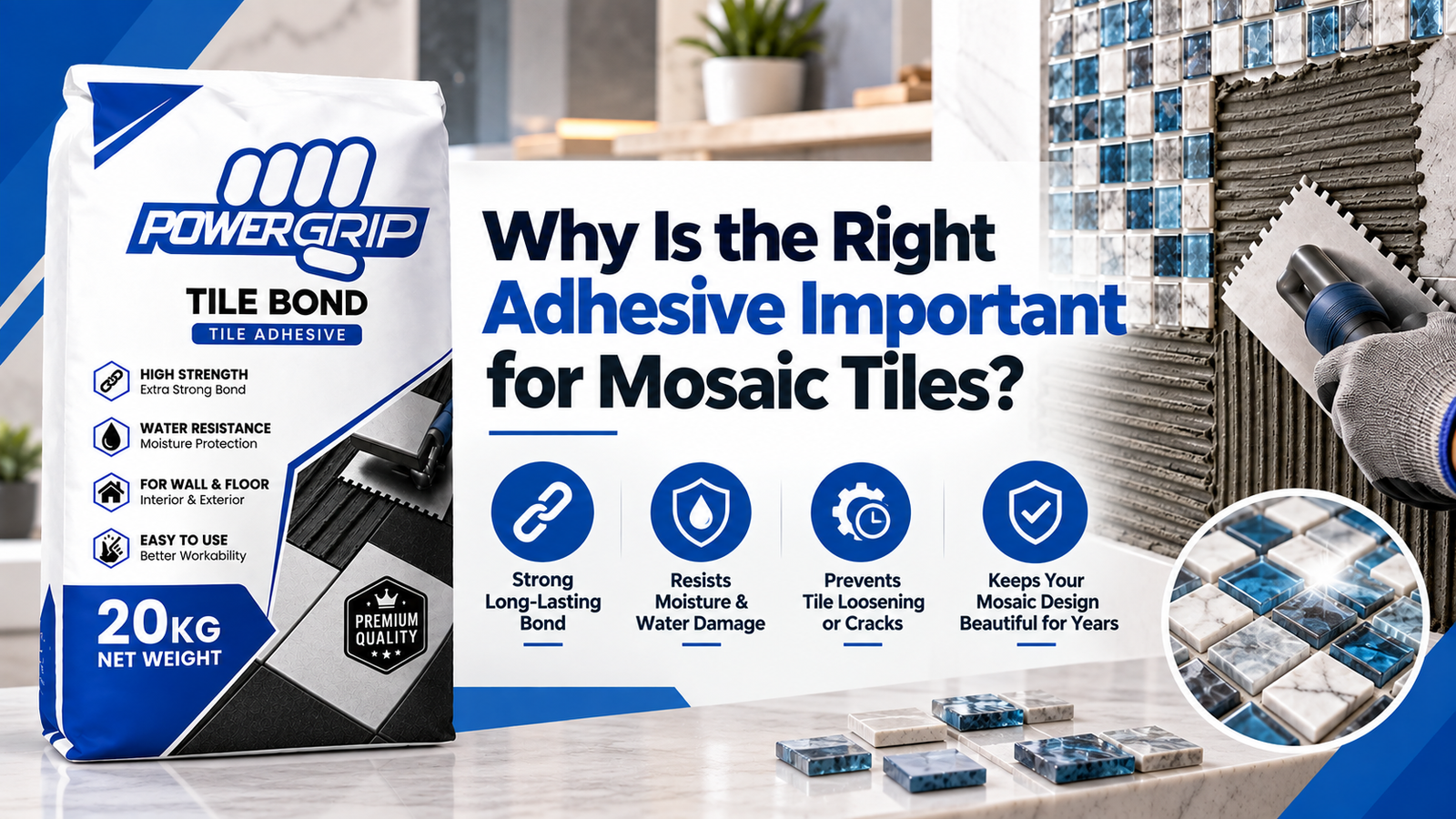
Why Is the Right Adhesive Important for Mosaic Tiles?
Mosaic installations contain many small tile pieces and joints.
A single sheet can contain dozens of individual pieces, which means that uneven adhesive coverage can affect multiple tiles at once.
The backing material also makes mosaic installation different from installing a large individual tile.
The adhesive needs to provide suitable contact between the prepared substrate and the mosaic while allowing the sheet to remain properly positioned.
A suitable adhesive can help provide:
- Consistent contact between the mosaic and substrate
- Better control during positioning
- More uniform adhesive coverage
- Reduced risk of loose pieces caused by inadequate bonding
- A more even surface for subsequent grouting
The adhesive is only one part of the installation system.
A clean and stable substrate, correct mixing, suitable application thickness, proper curing, and appropriate grout are equally important.
Which Type of Adhesive Is Suitable for Mosaic Tiles?
There is no single adhesive that is ideal for every mosaic project.
Ceramic, porcelain, glass, and natural stone mosaics can have different requirements, while bathroom, kitchen, outdoor, and decorative applications can also require different considerations.
Cement Based Tile Adhesive
Cement based tile adhesives are commonly used for tile installation.
They are generally supplied as dry powder and mixed with water according to the manufacturer’s instructions.
They can be suitable for many ceramic and porcelain mosaic applications when the product is designed for the particular tile and substrate.
The important point is to avoid selecting a cement based adhesive simply because the mosaic is small.
The product’s intended tile types, substrate requirements, and application conditions should be considered first.
Polymer Modified Tile Adhesive
Polymer modified adhesives contain additives that can change properties such as adhesion, flexibility, workability, or resistance to certain conditions, depending on the formulation.
These products may be useful for applications where additional performance characteristics are required.
However, polymer modified does not automatically mean suitable for every type of mosaic.
Always match the product to the actual tile, substrate, and installation environment.
Adhesive for Glass Mosaic
Glass mosaic requires additional attention because some glass tiles are translucent or transparent.
The adhesive may therefore affect the appearance of the finished surface.
For translucent glass mosaics, adhesive colour and uniform coverage can be particularly important. Some applications may require a product specifically recommended for glass mosaic.
Before installation, check whether the adhesive is compatible with the glass and whether its appearance is appropriate for the intended finish.
Adhesive for Natural Stone Mosaic
Natural stone mosaics can vary significantly in porosity, colour, weight, and sensitivity to moisture or staining.
Some stone products may require a specialized adhesive rather than a general-purpose tile adhesive.
Light coloured or moisture-sensitive stone can require additional care because unsuitable materials may affect its appearance.
The stone supplier’s recommendations should be considered alongside the adhesive manufacturer’s technical information.
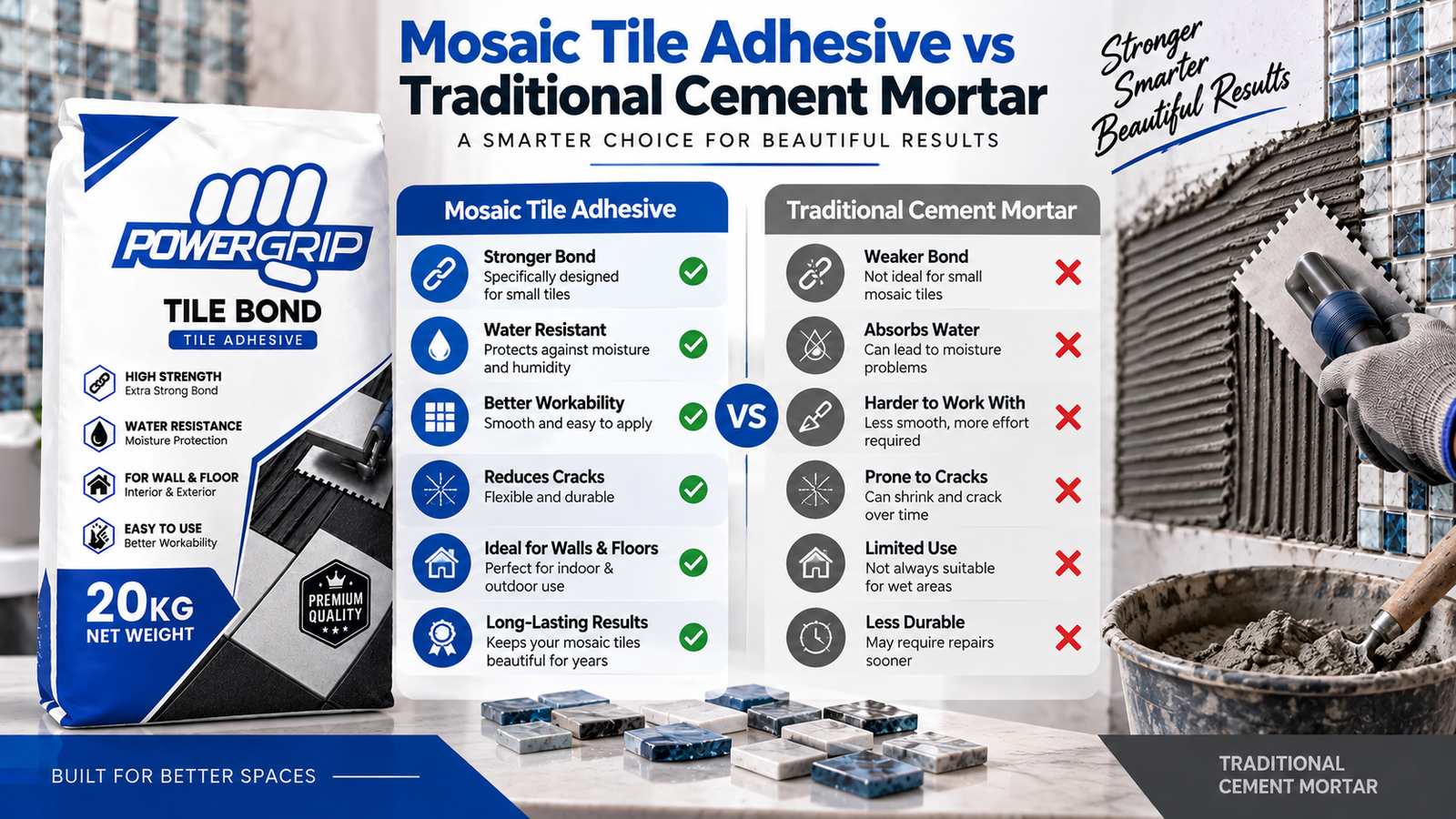
Mosaic Tile Adhesive vs Traditional Cement Mortar
Tile adhesive and traditional cement mortar are different materials designed for different purposes.
A tile adhesive is formulated specifically for tile bonding and generally allows more controlled application.
Traditional cement mortar can still have applications in construction, but it should not automatically be treated as interchangeable with a purpose made tile adhesive.
Factor | Tile Adhesive | Traditional Cement Mortar |
Main purpose | Designed specifically for tile bonding | Used for general masonry and bedding applications |
Application | Usually applied as a controlled adhesive layer | Often applied as a mortar bed |
Mosaic work | Can provide controlled coverage for suitable mosaics | May be less convenient for small mosaic pieces |
Thickness control | Generally easier to control | Depends heavily on the installation method |
Product selection | Formulations are available for different applications | Usually less specialized |
Key consideration | Must match tile and substrate | Requires suitable mix and workmanship |
This comparison does not mean that tile adhesive is automatically the right answer for every project.
The installation method should be selected according to the tile, substrate, project conditions, and applicable product guidance.
How to Choose Mosaic Tile Adhesive in Pakistan
The best starting point is the installation itself rather than the brand name.
Before purchasing an adhesive, identify the mosaic material, surface, location, and expected exposure.
1. Identify the Mosaic Material
First determine whether the mosaic is ceramic, porcelain, glass, natural stone, or another material.
Different materials can have different absorption rates, weights, surface characteristics, and bonding requirements.
If the tile supplier provides installation recommendations, use those details when selecting the adhesive.
For glass mosaic, also consider whether the tiles are opaque, translucent, or transparent.
2. Check the Substrate
The substrate should be sound, clean, stable, and appropriate for tile installation.
Depending on the project, the surface may be concrete, cement plaster, cement board, or another approved substrate.
Dust, grease, loose material, old paint, and weak areas can interfere with bonding.
This is an important point that is sometimes overlooked: a suitable adhesive cannot compensate for a weak or poorly prepared substrate.
If the surface has major cracks, loose sections, excessive contamination, or other defects, these issues should be addressed before the mosaic is installed.
3. Consider Moisture Exposure
Consider where the mosaic will be installed.
A decorative wall in a dry room has different requirements from a kitchen backsplash, bathroom wall, shower area, or another surface exposed to regular moisture.
For wet locations, check whether the complete installation requires a separate waterproofing system.
Tile adhesive should not automatically be considered a replacement for dedicated waterproofing.
4. Consider Indoor or Outdoor Use
Indoor and outdoor installations can experience very different conditions.
Outdoor mosaics may be exposed to rain, temperature changes, sunlight, and greater movement in the substrate.
If the project is outside, select an adhesive whose stated application range covers the intended conditions.
For an indoor installation, the requirements may be simpler, but the surface and moisture conditions still need to be assessed.
5. Check the Product Information
Before buying a mosaic tile adhesive, review the available product information.
Pay attention to:
- Suitable tile materials
- Recommended substrates
- Indoor or outdoor applications
- Wet area suitability
- Mixing instructions
- Application thickness
- Working and open time
- Setting or curing requirements
- Storage conditions
- Coverage information
This information is more useful than choosing a product based only on descriptions such as “strong,” “premium,” or “heavy duty.”
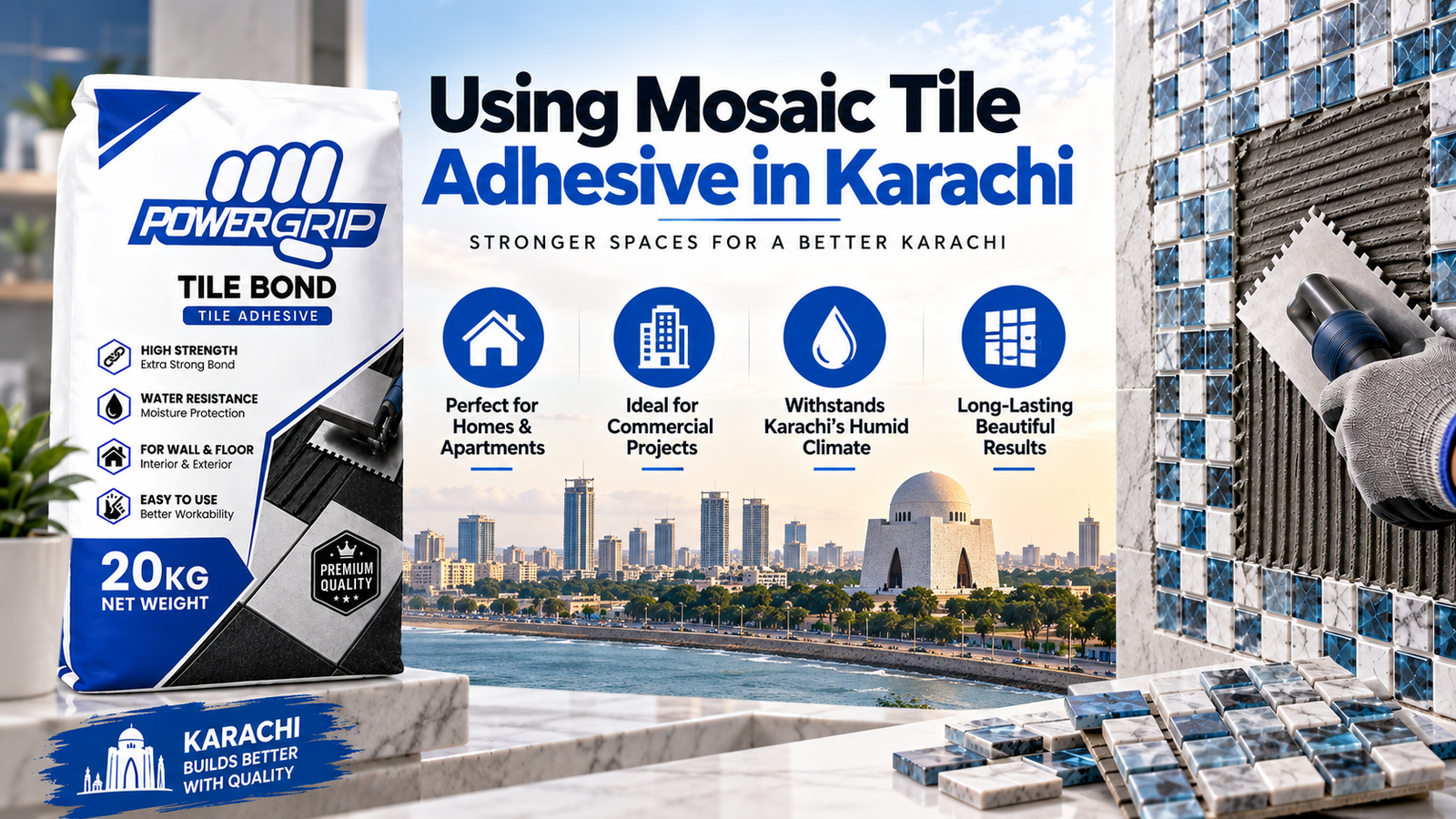
Using Mosaic Tile Adhesive in Karachi
When selecting mosaic tile adhesive in Karachi, the actual installation environment matters more than the city name alone.
Karachi projects can involve hot working conditions, humidity, direct sunlight, or surfaces that become significantly warmer than the surrounding air.
These conditions can affect how an installer handles and applies certain products.
For example, a shaded indoor bathroom and a sun exposed exterior wall are not equivalent installation environments.
The adhesive should be stored according to its product instructions.
Cement based powders should generally be protected from moisture before use because premature exposure to moisture can affect the material.
During installation, installers should also pay attention to surface temperature and working conditions.
If the product instructions specify limits for temperature, sunlight, or application conditions, those requirements should be followed.
Planning the installation for suitable working conditions can make application easier and give the adhesive the conditions it needs to perform as intended.
How Is Mosaic Tile Adhesive Applied?
Good installation starts with proper substrate preparation.
The surface should be clean, stable, and reasonably even before adhesive application.
Loose material, excessive dust, grease, or other contaminants should be removed. Major surface defects should be addressed before tiling begins.
The adhesive should then be mixed according to the manufacturer’s specified water ratio and mixing procedure.
Adding extra water simply because the mixture appears difficult to spread can change its intended consistency and performance.
For many tile adhesives, a notched trowel is used to create a controlled layer.
The appropriate trowel size and application method depend on the adhesive, tile, and substrate.
For mosaic sheets, coverage deserves particular attention.
The installer needs to achieve suitable contact beneath the mosaic without allowing excessive adhesive to squeeze through the joints.
After positioning the sheet, it should be pressed evenly so that the mosaic pieces sit properly in the adhesive. Alignment should be checked before the adhesive begins to set.
The adhesive should then be allowed to cure according to its instructions before grouting.
Grouting too early can disturb the mosaic or interfere with the developing bond.
Common Mistakes When Installing Mosaic Tiles
Installation problems are not always caused by the adhesive itself.
Preparation and application errors can have an equally significant effect.
Applying Adhesive Over a Dirty Surface
Dust, grease, loose particles, and other contaminants can interfere with contact between the adhesive and substrate.
Cleaning and preparing the surface before tiling is therefore essential.
Adding Too Much Water
Changing the recommended water ratio can alter the adhesive’s consistency and intended properties.
The mixture should be prepared according to the manufacturer’s instructions rather than adjusted simply because a different consistency appears easier to spread.
Using the Same Adhesive for Every Tile
Ceramic, porcelain, glass, and natural stone mosaics do not necessarily have identical bonding requirements.
An adhesive suitable for one mosaic material may not be appropriate for another.
Tile material should therefore be considered before purchase.
Applying Too Much Adhesive
Excess adhesive can squeeze through mosaic joints and make grouting more difficult.
It can also create an uneven surface. Controlled application helps maintain more consistent coverage.
Ignoring the Substrate
A weak, dusty, damp, contaminated, or poorly prepared surface can create bonding problems even when the selected adhesive is otherwise appropriate.
Surface preparation should therefore be treated as part of the installation rather than an optional step.
Grouting Too Early
The adhesive needs enough time to set or cure before grouting.
Starting the next stage too soon can disturb the mosaic pieces or affect the installation.
Follow the product’s stated setting requirements.
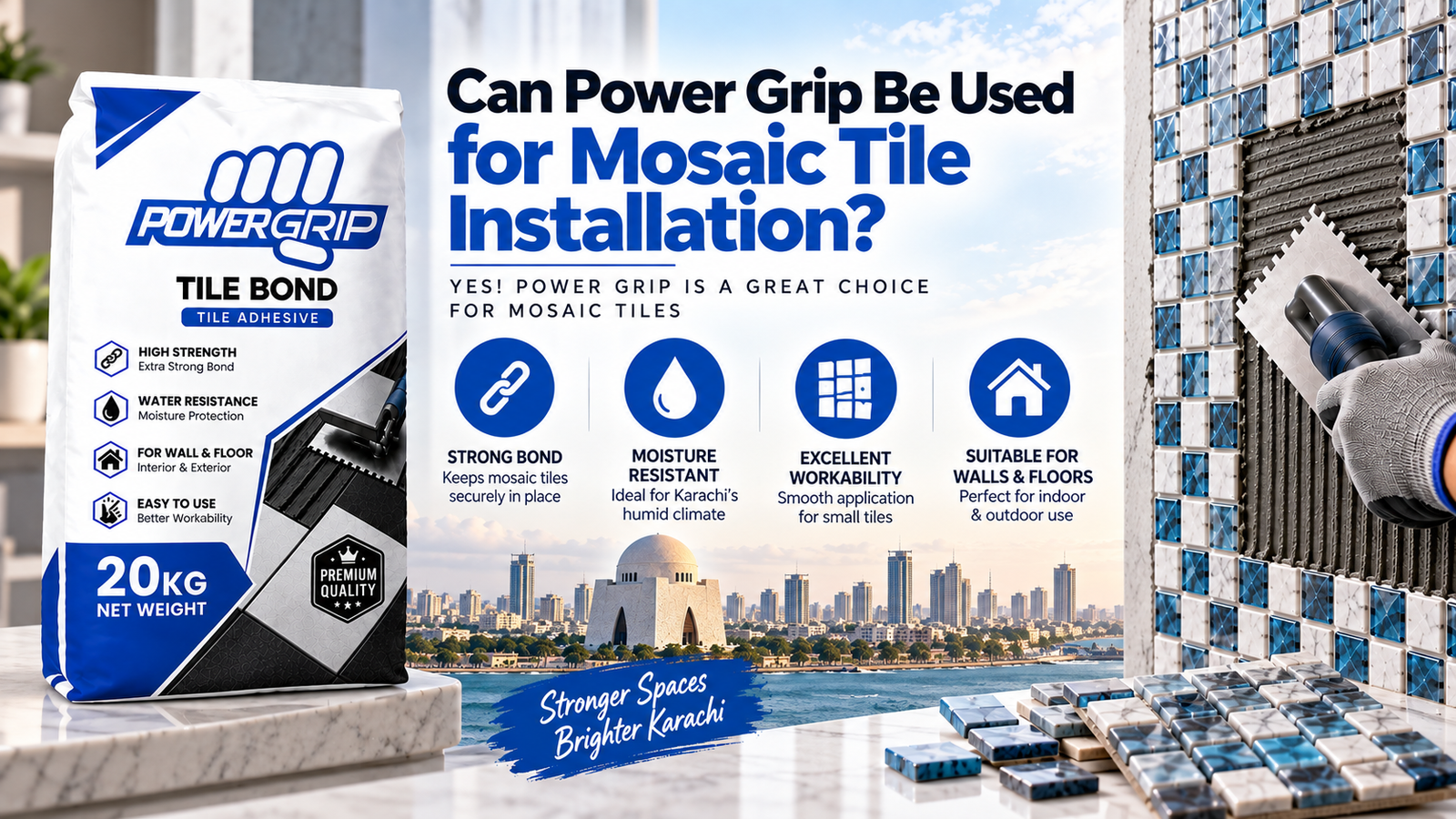
Can Power Grip Be Used for Mosaic Tile Installation?
Power Grip can be considered when researching tile adhesive in Pakistan, including options for projects that involve mosaic tiles.
However, the specific adhesive product should always be matched to the mosaic material, substrate, installation location, and stated application requirements.
For a project in Karachi, someone comparing Power Grip with other tile adhesive options can look at practical information such as:
- Compatible tile materials
- Recommended substrates
- Indoor and outdoor applications
- Wet area suitability
- Mixing requirements
- Application method
- Coverage information
- Setting or curing requirements
This approach makes product comparison more useful than relying on general claims about strength or quality.
If a particular Power Grip product is being considered for a mosaic installation, its current packaging and technical information should be checked to confirm that the intended application is supported.
How Much Mosaic Tile Adhesive Do You Need?
The amount of adhesive required depends on several factors.
These include the total tiled area, substrate flatness, mosaic thickness, trowel size, application method, and installation technique.
A flat and properly prepared surface generally allows more controlled application than an uneven substrate.
Increasing adhesive thickness to compensate for a poor surface can increase material consumption and may not solve the underlying problem.
Start by measuring the total area that will be tiled.
Then use the coverage information provided for the specific adhesive to estimate the quantity required.
Actual consumption can vary from the manufacturer’s theoretical coverage because site conditions and installer technique are different from project to project.
For this reason, coverage figures should be treated as an estimate rather than an exact guarantee.
Is Mosaic Tile Adhesive Waterproof?
Not every tile adhesive is waterproof simply because it is used for tiles or bathrooms.
This distinction is particularly important in showers and other areas that receive regular or continuous water exposure.
A wet area may require a complete system that includes an appropriate substrate, waterproofing layer, suitable adhesive, tile, and grout.
The adhesive’s own properties should be considered separately from the waterproofing requirements of the overall installation.
If a project involves a shower or another continuously wet area, follow the recommendations for the complete system instead of relying on adhesive alone.
Practical Checklist Before Buying Mosaic Tile Adhesive
Before purchasing an adhesive for a mosaic project in Karachi or elsewhere in Pakistan, consider the following:
- Identify the mosaic material.
- Check the substrate where the mosaic will be installed.
- Decide whether the project is indoors or outdoors.
- Determine whether the area is dry, damp, or regularly exposed to water.
- Confirm that the adhesive is suitable for the tile and substrate.
- Read the mixing and application instructions.
- Check coverage information before estimating quantity.
- Consider adhesive colour for glass or translucent mosaics.
- Check whether the product is suitable for the expected environmental conditions.
- Ask the tile supplier or a qualified installer about any material-specific requirements.
This process helps prevent a common mistake: choosing an adhesive first and only considering the installation conditions afterward.
What Should You Ask a Tile Adhesive Supplier?
A reliable supplier should be able to provide useful product information rather than only describing an adhesive as strong or premium.
Before purchasing, ask which tile materials the product is designed for and which substrates it supports.
You can also ask whether it is intended for wet areas, outdoor applications, glass mosaic, porcelain, ceramic, or natural stone.
Other useful questions include:
How should the adhesive be mixed?
Ask about the recommended water ratio and mixing method.
What is the expected coverage?
This can help with material planning and budgeting.
How should the surface be prepared?
A supplier should be able to explain the basic substrate requirements.
How long should the adhesive set before grouting?
This helps the installer plan the next stage.
If you are comparing Power Grip with another tile adhesive brand in Pakistan, compare the actual product specifications and application guidance rather than comparing brand names alone.
Frequently Asked Questions
What is the best adhesive for mosaic tiles in Pakistan?
There is no single adhesive that is automatically the best choice for every mosaic installation. The appropriate product depends on the mosaic material, substrate, moisture exposure, location, and manufacturer’s stated recommendations.
Can tile adhesive be used for glass mosaic?
Yes, some tile adhesives are designed for glass mosaic. However, the product should specifically support glass applications. For transparent or translucent glass, adhesive colour and coverage can also affect the final appearance.
What adhesive is suitable for mosaic sheets?
An adhesive suitable for mosaic sheets should be compatible with the mosaic material, backing system, substrate, and installation environment. The installer should also ensure sufficient contact beneath the sheet without allowing excessive adhesive to fill the joints.
Can mosaic tile adhesive be used in a bathroom?
Some tile adhesives are suitable for bathroom installations. However, areas such as showers may also require dedicated waterproofing. Adhesive should not automatically be treated as a substitute for a waterproofing system.
Is cement enough for installing mosaic tiles?
Traditional cement mortar and modern tile adhesives are different materials with different applications. A purpose made tile adhesive can offer more controlled bonding for many mosaic installations, but the appropriate system depends on the project requirements.
How do I choose mosaic tile adhesive in Karachi?
Start with the mosaic material and substrate. Then consider whether the area is dry, damp, indoor, or outdoor. Check the product’s stated application range, mixing instructions, coverage, and environmental requirements before purchasing.
Can Power Grip be considered for mosaic tile projects?
Power Grip can be included when comparing tile adhesive options available in Pakistan. The specific product should be checked for compatibility with the mosaic, substrate, and installation conditions before use.
How much adhesive is needed for mosaic tiles?
The required quantity depends on the tiled area, substrate flatness, application thickness, trowel size, and installation technique. Use the specific product’s coverage information for an initial estimate and allow for normal variation during installation.
Does mosaic tile need special adhesive?
Not always. Some ceramic and porcelain mosaics can be installed with suitable general tile adhesives, while glass, natural stone, translucent materials, or demanding installation environments may require more specific product selection.
Conclusion
Choosing mosaic tile adhesive in Pakistan is not simply a matter of finding the strongest bonding product.
The mosaic material, substrate, moisture exposure, location, application method, and product requirements all influence the right choice.
For projects in Karachi, consider the actual working environment as well as the type of surface being tiled.
Heat, direct sunlight, humidity, and outdoor exposure can make installation conditions different from those of a controlled indoor space.
Products from Power Grip and other tile adhesive suppliers can be compared by looking at their stated applications, compatibility, preparation requirements, coverage, and installation guidance.
Most importantly, remember that adhesive is only one part of a successful mosaic installation.
Proper surface preparation, accurate mixing, controlled application, suitable coverage, adequate curing, and correct grouting all contribute to the finished result.
When the mosaic tile, adhesive, substrate, and installation method are properly matched, the project has a much stronger foundation for a clean, stable, and durable finish.