

Large format tiles need the right adhesive to achieve proper contact, support, and long-term stability.
Large format tile adhesive Pakistan is used for installing bigger and heavier tiles on floors and walls, where ordinary tile fixing methods may not provide the coverage and support required.
In Karachi, factors such as heat, surface condition, tile size, substrate movement, and installation technique can all affect the final result.
Large tiles can create a clean, modern appearance, but their installation requires more attention than smaller ceramic tiles.
The adhesive must be suitable for the tile material and application, while the substrate must be properly prepared.
Installation technique also matters because empty spaces beneath a large tile can increase the risk of cracking, movement, or debonding.
This guide explains what large format tile adhesive is, where it is used, how to select it in Pakistan, common installation mistakes, and what contractors and tile installers should check before starting a project.
What Is Large Format Tile Adhesive?
Large format tile adhesive is a tile fixing material designed or selected for applications involving large-sized tiles.
These tiles may have considerably greater surface area and weight than conventional tiles, so achieving consistent adhesive coverage becomes especially important.
The adhesive creates a bonding layer between the tile and the prepared substrate.
Depending on the product formulation and application, tile adhesives may contain cement based binders, polymers, mineral fillers, and other additives that influence adhesion, flexibility, workability, water resistance, and setting behavior.The term “large format” does not refer to one universal tile dimension.
Different manufacturers and tile standards may use different size classifications. For this reason, the adhesive should be selected according to the actual tile dimensions, weight, material, substrate, and installation environment rather than size alone.
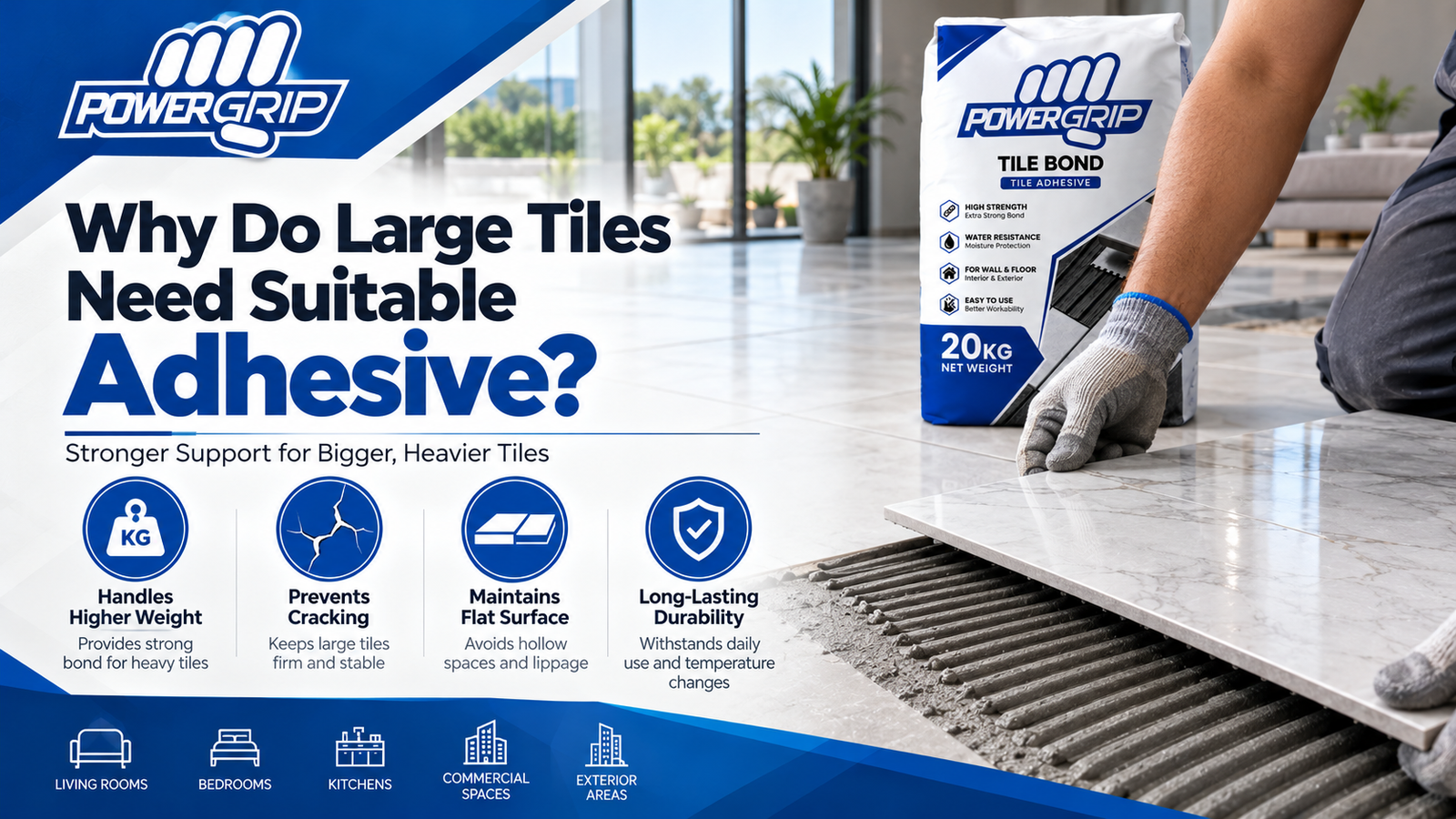
Why Do Large Tiles Need Suitable Adhesive?
Large tiles cover more surface area with each individual piece. That means any unevenness in the substrate or poor adhesive coverage can have a greater effect on the finished installation.
A small tile may sometimes tolerate minor variations that would become much more noticeable beneath a large slab or porcelain tile.
Large tiles can also be less forgiving when the substrate is uneven.
A suitable adhesive helps create a continuous bonding layer and reduces the chance of unsupported sections beneath the tile.
Proper adhesive selection is only one part of the process, however. Correct substrate preparation and installation technique are equally important.
What Happens When the Wrong Adhesive Is Used?
Using an unsuitable adhesive can contribute to problems such as:
- Poor bonding between tile and substrate
- Hollow areas beneath the tile
- Tile movement or debonding
- Cracked tiles or grout
- Uneven surfaces
- Difficulty achieving proper coverage
- Reduced durability in demanding environments
These problems are not always caused by the adhesive itself.
Moisture, substrate movement, incorrect mixing, inadequate surface preparation, and poor installation practices can also contribute.
Types of Large Format Tile Adhesive
The appropriate adhesive depends on the tile and the installation environment. There is no single adhesive that is automatically suitable for every large format application.
Cement-Based Tile Adhesive
Cement-based adhesives are widely used in tile installation.
They are mixed with water before application and can be formulated for different levels of performance.
For large format tiles, the relevant product characteristics may include adhesion strength, workability, open time, water resistance, and flexibility.
Contractors should check the manufacturer’s stated application range before using a particular cement-based adhesive.
Polymer Modified Tile Adhesive
Polymer modified formulations contain additives designed to improve selected performance characteristics.
Depending on the formulation, polymers can contribute to better adhesion, flexibility, workability, and resistance to demanding conditions.
This can be useful when installing large porcelain or ceramic tiles where the installation environment requires more than basic bonding performance.
Flexible Tile Adhesive
Flexible adhesives are designed for situations where some movement or stress may occur.
Large tiles can be particularly sensitive to substrate movement because their greater dimensions leave less room for installation imperfections.
Flexible adhesive may be relevant for certain floors, heated substrates, exterior applications, or other situations where movement needs to be considered.
The product’s technical documentation should determine whether it is appropriate for the specific application.
Heavy Duty Tile Adhesive
Heavy duty tile adhesive is generally selected for demanding applications where stronger performance is required.
Large and heavy tiles, high-traffic floors, commercial spaces, and certain exterior applications may require a product formulated for these conditions.
The term “heavy duty” should not be treated as a technical specification by itself.
Always check the actual product data and recommended applications.
Large Format Tile Adhesive vs Ordinary Tile Adhesive
The difference is not simply that one adhesive is “stronger.” The important question is whether the product is appropriate for the tile, substrate, location, and installation method.
Factor | Standard Tile Adhesive | Large Format Tile Application |
Tile size | Usually smaller tiles | Large tiles or slabs |
Coverage | Normal coverage requirements | Consistent, high coverage is especially important |
Substrate | Minor variation may be easier to manage | Flat and properly prepared substrate is critical |
Handling | Easier for one installer | Often requires careful handling and multiple installers |
Adhesive selection | Based on tile and surface | Based on tile size, material, weight, substrate, and environment |
Installation technique | Standard application may be sufficient | Careful troweling, coverage, and tile placement are important |
This comparison does not mean every large tile needs a special product category.
The correct adhesive is determined by its technical suitability for the intended application.
Where Is Large Format Tile Adhesive Used?
Large format tiles are commonly selected for modern residential and commercial projects because they create fewer visible grout lines and can produce a continuous visual appearance.
Typical applications include large floor tiles, porcelain tiles, feature walls, living areas, bathrooms, kitchens, commercial floors, showrooms, hotels, offices, and selected exterior surfaces.
In Karachi, the intended location should be considered carefully.
A product suitable for an indoor wall may not be appropriate for an exterior floor exposed to weather and temperature changes.
The substrate also matters. Concrete, cement plaster, screed, existing tiles, and other surfaces can have different preparation requirements.
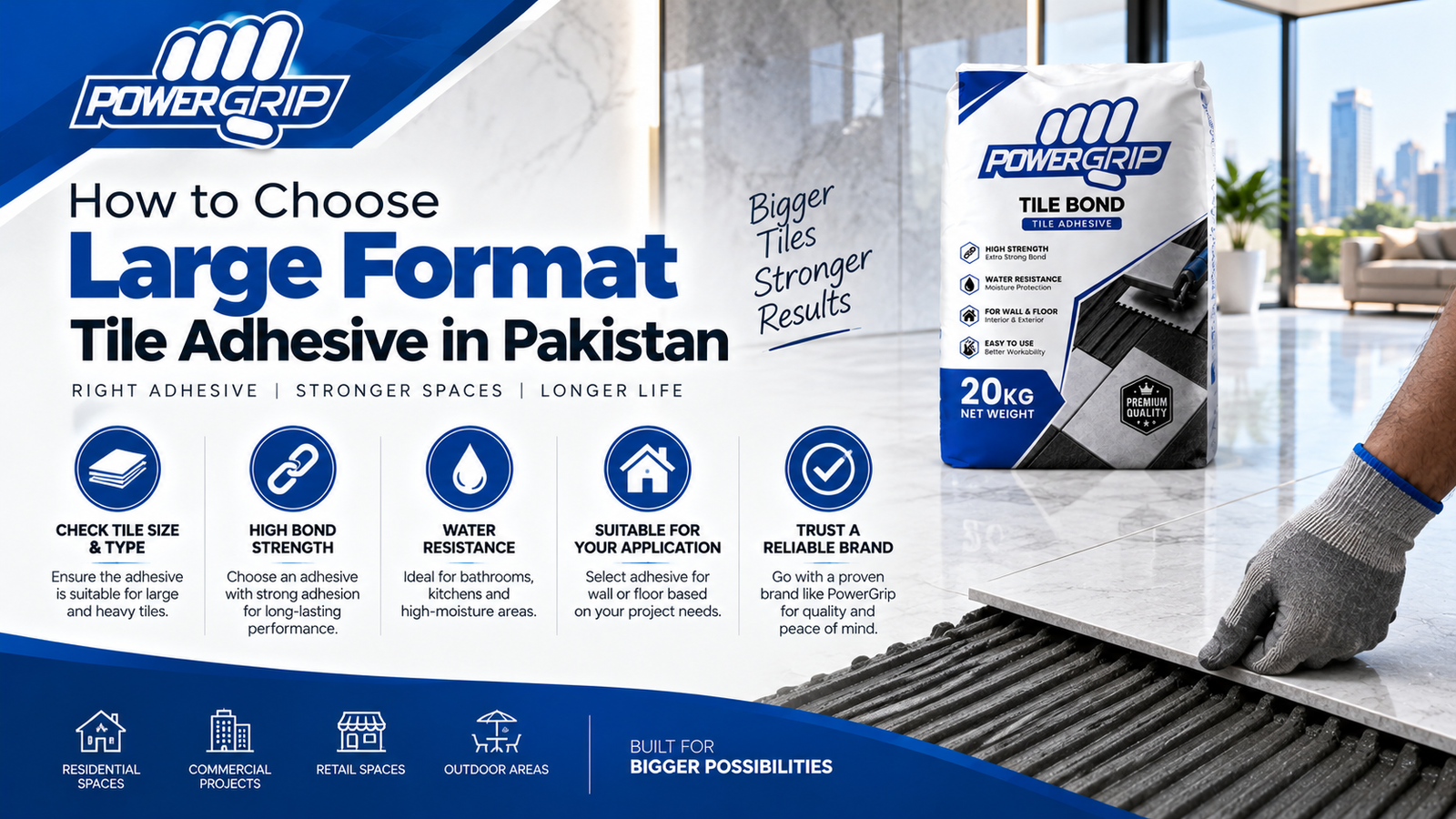
How to Choose Large Format Tile Adhesive in Pakistan
Choosing an adhesive should start with the complete installation situation rather than the product name.
1. Check the Tile Material
Ceramic and porcelain tiles have different characteristics.
Porcelain generally has very low water absorption, which makes adhesive selection particularly important.
Natural stone and engineered surfaces may have additional requirements. Always check whether the adhesive is recommended for the specific tile material.
2. Consider Tile Size and Weight
A large tile puts greater demands on handling and adhesive coverage.
Record the actual tile dimensions and consider its weight before choosing the adhesive.
For extremely large tiles or slabs, follow the tile manufacturer’s installation guidance as well as the adhesive manufacturer’s recommendations.
3. Examine the Substrate
The substrate should be stable, clean, sufficiently cured where applicable, and suitable for tile installation.
Dust, oil, loose material, paint, weak layers, or significant unevenness can interfere with bonding.
Large tiles are particularly unforgiving of uneven surfaces, so correcting the substrate may be necessary before adhesive application.
4. Consider Indoor or Outdoor Use
An indoor bedroom floor and an exterior terrace do not face the same conditions.
Outdoor installations can experience temperature changes, moisture, and environmental exposure.
Select a product specifically recommended for the intended environment rather than assuming an indoor adhesive will work outdoors.
5. Consider Moisture Exposure
Bathrooms, kitchens, balconies, pools, and other wet areas require additional attention to the complete installation system.
Tile adhesive alone should not automatically be treated as a waterproofing system. Where waterproofing is required, the appropriate waterproofing layer and installation system should be considered separately.
6. Check Manufacturer Instructions
Product packaging and technical documentation should be treated as the primary reference for mixing, application, coverage, curing, substrate suitability, and limitations.
For projects using products from powergrip.pk, contractors should check the specific product information available for the selected Power Grip tile adhesive rather than assuming that every formulation has the same application requirements.
How Is Large Format Tile Adhesive Applied?
Large tile installation requires careful preparation before adhesive is spread.
First, the substrate should be checked for flatness, strength, cleanliness, and suitability.
Any major defects should be addressed before tiling begins.
The adhesive is then mixed according to the manufacturer’s instructions.
Adding too much or too little water can change the working characteristics and final performance of a cement-based product.
The adhesive is spread using an appropriate notched trowel.
For large format tiles, installers commonly pay particular attention to achieving consistent coverage across the tile and substrate.
Back buttering may also be used where appropriate.
This involves applying adhesive to the back of the tile in addition to the adhesive bed on the substrate.
Whether this method is required depends on the tile, adhesive, substrate, and installation guidance.
The tile should then be placed carefully and moved as appropriate to help achieve proper contact.
The installer should periodically lift a tile during installation to check actual adhesive coverage rather than assuming that the adhesive has reached every area.
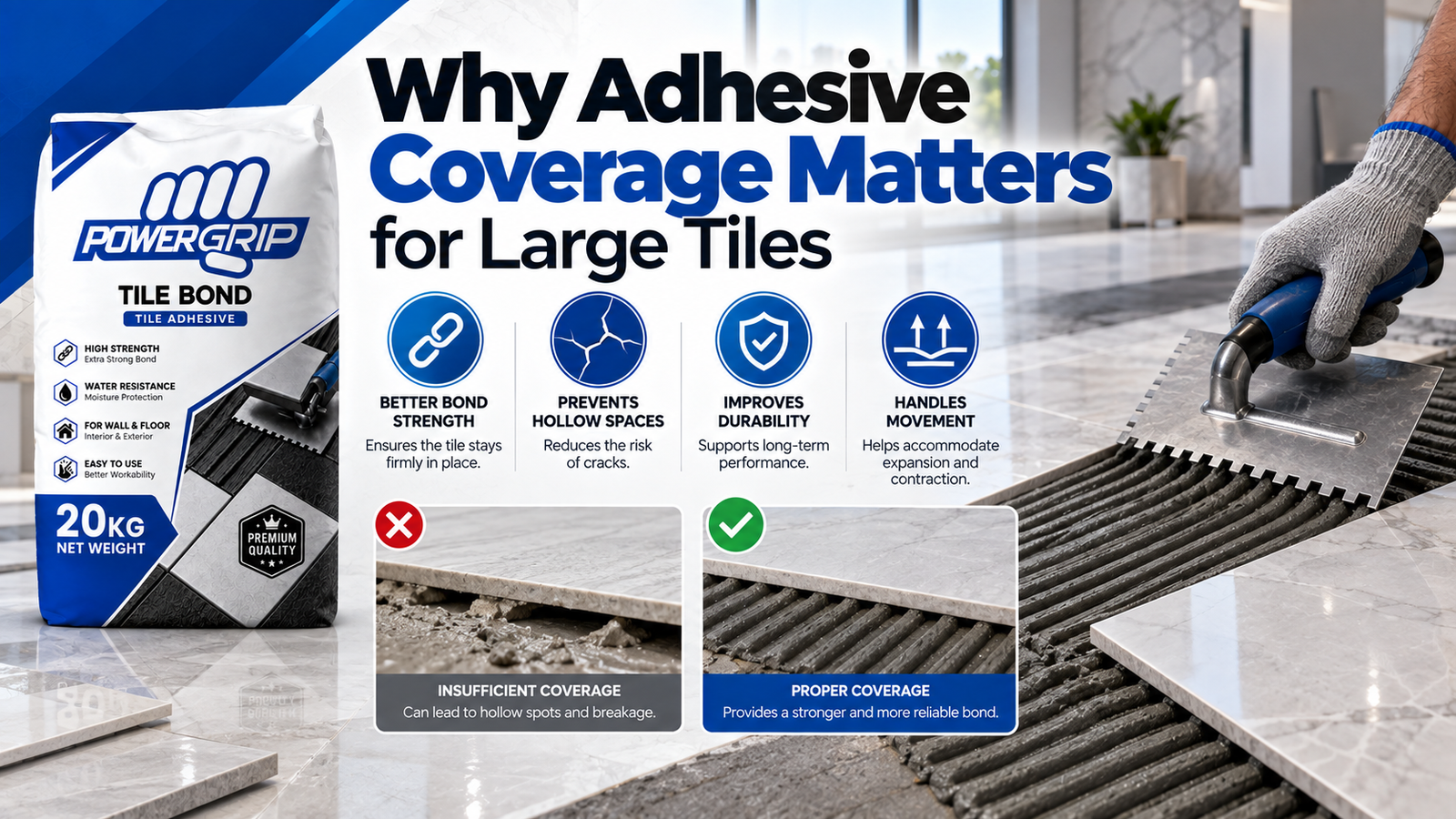
Why Adhesive Coverage Matters for Large Tiles
Coverage is one of the most important practical considerations when installing large format tiles.
A large tile with significant unsupported areas underneath can be more vulnerable to stress. Voids can also become problem areas when the installation is exposed to impact, loads, moisture, or movement.
The goal is not simply to spread a thick layer of adhesive. Excessive adhesive thickness is not a substitute for proper substrate preparation.
Instead, the substrate should be prepared correctly and the adhesive applied according to the manufacturer’s recommended method.
For demanding installations, experienced tile professionals can assess the surface and installation method before work begins.
Common Mistakes When Installing Large Format Tiles
Many installation problems come from process errors rather than from choosing a product category incorrectly.
Using Adhesive Without Checking Compatibility
A product may be suitable for ceramic tiles but have different recommendations for porcelain, natural stone, exterior applications, or unusual substrates.
Installing Over an Uneven Surface
Large tiles can reveal substrate irregularities quickly.
Trying to compensate for a badly uneven surface with excessive adhesive can lead to inconsistent bonding.
Mixing the Adhesive Incorrectly
Changing the water ratio can affect workability and performance.
Follow the product instructions instead of estimating the amount of water.
Applying Too Much Adhesive at Once
Tile adhesive has a working period. If too much material is spread and begins to lose its workable surface before the tile is installed, bonding can be affected.
Ignoring Back Coverage
Looking only at the adhesive on the floor or wall does not confirm that the back of the tile is properly supported.
Coverage should be checked during installation.
Walking on Tiles Too Soon
Freshly installed tiles need appropriate setting or curing time.
Premature loading can disturb alignment and bonding.
Practical Selection Checklist
Before purchasing large format tile adhesive in Pakistan, check these points:
- Tile material, dimensions, and approximate weight
- Indoor or outdoor installation
- Wall or floor application
- Substrate type and condition
- Moisture exposure
- Expected traffic or loading
- Manufacturer’s recommended application
- Mixing and coverage instructions
- Suitable trowel and installation method
- Required setting or curing time
For large commercial projects or technically demanding surfaces, it can be useful to discuss the application with the adhesive manufacturer, distributor, or an experienced tile professional before ordering material.
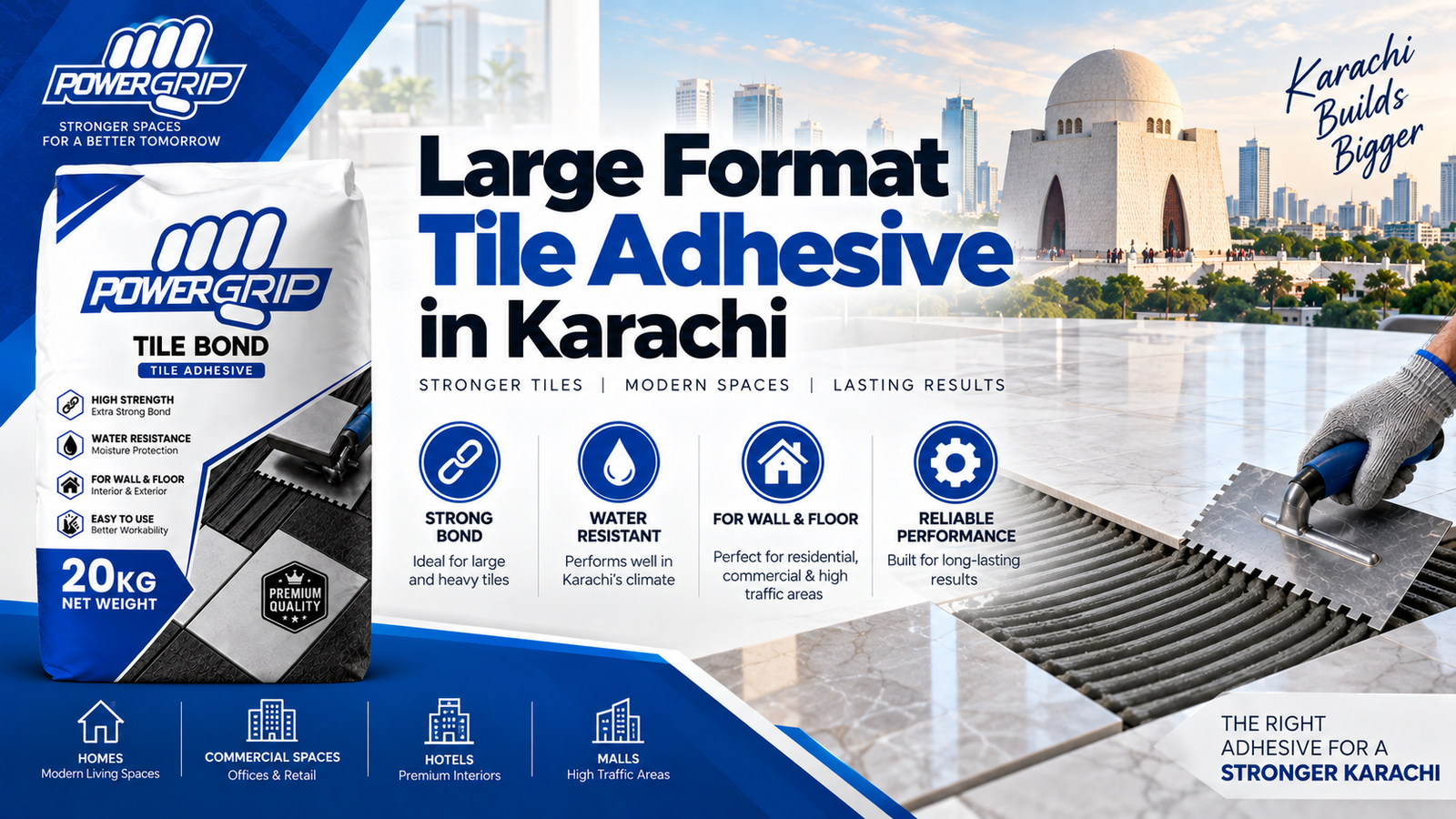
Large Format Tile Adhesive in Karachi
Karachi projects can involve a wide range of residential, commercial, and renovation applications.
The local climate can also make surface and installation conditions worth considering, particularly for exterior areas and locations exposed to significant temperature changes.
However, location alone does not determine the right adhesive.
A large porcelain tile installed inside an air-conditioned commercial building may require a different approach from a large tile installed on an exposed terrace.
Contractors and shop owners sourcing tile adhesive in Karachi should therefore start with the project specifications.
Tile size, tile type, substrate, location, and expected conditions should be established before selecting the product.
Power Grip can be considered among the product options available through Powergrip.pk, but the exact product should be matched to the intended tile and application based on the manufacturer’s current information.
How Much Large Format Tile Adhesive Is Needed?
The amount of adhesive required depends on several factors rather than tile area alone.
Tile dimensions, substrate flatness, trowel size, adhesive thickness, installation technique, and coverage requirements can all affect consumption.
A rough calculation based only on floor area may therefore produce an inaccurate material estimate.
For purchasing, first calculate the total tile area and then consult the selected product’s stated coverage information.
Add an appropriate allowance for the actual installation conditions rather than relying on a universal coverage figure.
When Should You Consult a Tile Professional?
Professional guidance is especially useful when the project involves very large tiles, heavy slabs, exterior surfaces, unusual substrates, commercial traffic, wet areas, or complicated existing surfaces.
A qualified installer can assess the substrate, tile characteristics, layout, movement considerations, adhesive application, and coverage. This can help identify problems before tiles are permanently installed.
For straightforward projects, following the tile and adhesive manufacturer’s installation instructions carefully is still essential.
Frequently Asked Questions
What is large format tile adhesive?
Large format tile adhesive is an adhesive selected for installing large tiles or slabs where consistent bonding and coverage are especially important. The correct product depends on tile material, size, substrate, location, moisture exposure, and manufacturer recommendations.
Can ordinary tile adhesive be used for large tiles?
It depends on the product. Some tile adhesives may be suitable for large tiles, while others may have limitations. Check the manufacturer’s technical information for the maximum recommended tile size, substrate, application method, and intended use.
Is large format tile adhesive suitable for porcelain?
Some adhesives are suitable for porcelain, but not every tile adhesive should automatically be used with porcelain. Porcelain has low water absorption, so the adhesive must be specifically appropriate for the tile and installation conditions.
Do large tiles need back buttering?
Back buttering may be recommended for certain large format tile installations to improve contact and coverage. The correct method depends on the tile, adhesive, substrate, and manufacturer’s instructions.
Can large format tile adhesive be used outdoors?
Some formulations are designed for exterior applications, while others are intended for interior use. Check the product’s stated suitability for outdoor exposure, temperature changes, moisture, and the specific substrate before installation.
How do I choose tile adhesive in Karachi?
Start with the tile material, dimensions, weight, installation surface, indoor or outdoor location, moisture exposure, and expected traffic. Then select a product whose manufacturer specifically supports those conditions.
Why do large tiles become hollow after installation?
Hollow sounds can result from insufficient adhesive coverage, an uneven substrate, poor application, inadequate contact, or other installation problems. The cause should be assessed rather than assuming the adhesive alone is responsible.
Can large format tiles be installed on walls?
Yes, large format tiles can be used on walls when the tile, substrate, adhesive, weight, and installation method are appropriate. Wall installations require particular attention to tile handling, support, coverage, and the manufacturer’s recommendations.
Conclusion
Selecting large format tile adhesive in Pakistan involves more than choosing an adhesive marketed for large tiles.
The tile material, dimensions, weight, substrate, location, moisture exposure, and installation method all influence the appropriate product.
For projects in Karachi, contractors and tile installers should assess the complete installation environment before purchasing adhesive.
Large tiles also require careful substrate preparation and consistent adhesive coverage to reduce the risk of bonding and alignment problems.
If you are considering Power Grip products, powergrip.pk can be used to review the available product information and identify the formulation intended for your application.
Always match the selected adhesive with the manufacturer’s current recommendations and the requirements of the specific tile installation.