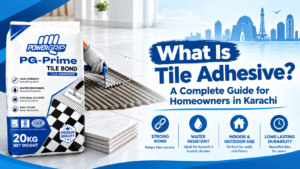


Indoor tile adhesive is a factory-formulated polymer-modified cementitious powder designed to bond floor and wall tiles securely to interior substrates.
Unlike traditional sand-cement mortars, specialized adhesives offer high bonding strength, flexibility, and minimal shrinkage, preventing hollow sounds, tile debonding, and cracking over time.
For architects, interior designers, and building contractors in Karachi, selecting the appropriate tile adhesive involves balancing structural requirements with local environmental challenges.
Karachi’s high coastal humidity, saline air, ambient temperatures, and frequent thermal movement demand modern dry-set tile adhesives rather than legacy installation techniques.
Using high-performance products ensures that residential and commercial projects maintain structural integrity and aesthetic finish without requiring costly repairs.
The Shift from Traditional Cement Mortar to Modern Tile Adhesives
For decades, traditional site-mixed sand and cement mortar served as the standard bedding material for interior tile installations across Pakistan.
However, as ceramic production evolved toward large-format porcelain slabs, vitrified tiles, and low-absorption materials, traditional wet-bed methods proved increasingly unreliable.
Sand-cement mixtures rely solely on mechanical keying—filling microscopic pores on the underside of porous ceramic tiles.
Modern vitrified tiles have an extremely low water absorption rate (often less than 0.5%), leaving insufficient open pores for traditional cement to grab effectively.
Polymer-modified dry-set adhesives overcome this limitation through a combination of mechanical bonding and chemical adhesion.
Synthetic polymers blended into the dry powder form microscopic flexible bridges between the smooth tile back and the subfloor, creating a permanent bond capable of handling structural shifts and thermal expansion.
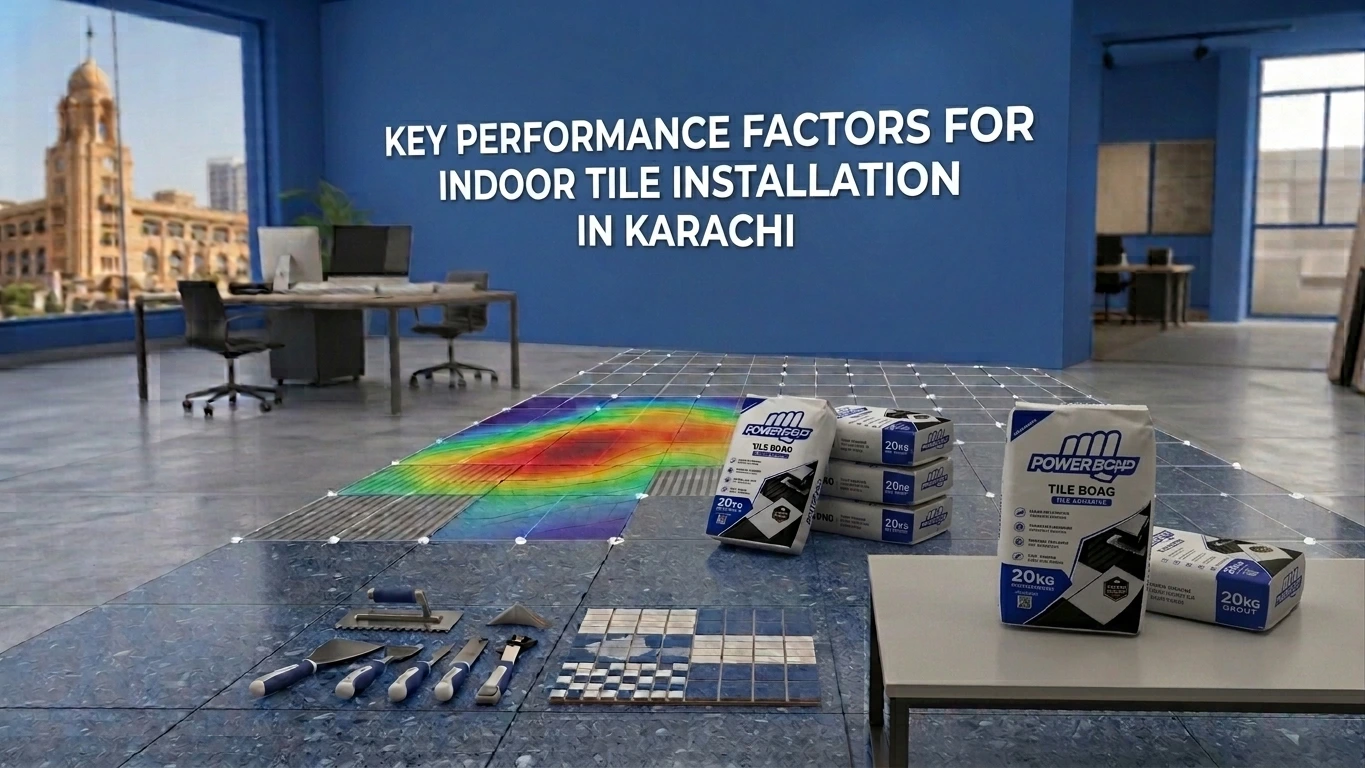
Key Performance Factors for Indoor Tile Installation in Karachi
Building projects in Karachi face distinct environmental conditions that impact building material performance.
Architects and structural consultants must evaluate specific chemical and physical characteristics when specifying indoor tile adhesives:
- Resistance to Salinity and Sulphates: Subfloors and groundwater in coastal areas like Clifton, DHA, and Gwadar carry high salt content. High-quality polymer-modified adhesives form a dense, hydrophobic layer that restricts salt efflorescence from rising through tile joints.
- Thermal Expansion and Structural Vibration: Karachi experiences substantial ambient temperature shifts between seasons, causing subtle movements in multi-story concrete structures.
- Rigid sand-cement beds crack under this stress, whereas flexible polymer adhesives absorb shear movement.
- Open Time and Pot Life: In warm climates, adhesives can cure prematurely if exposed to rapid air drying. Quality formulations maintain extended open time, allowing contractors sufficient margin to lay and adjust tiles without losing adhesion.
- Water Retainability: Traditional cement beds lose moisture rapidly into dry blockwork or absorbent concrete, leading to incomplete hydration and weak bonding. Formulated adhesives retain internal moisture long enough for cement particles to fully hydrate and reach nominal tensile strength.
Types of Indoor Tile Adhesives Available in Pakistan
Understanding the technical classification of tile adhesives helps specifiers align material performance with project demands.
Adhesives generally fall into three primary performance categories based on international standards (such as ISO 13007 or EN 12004):
Class C1: Standard Cementitious Adhesives
Suitable for basic interior floor installations using small to medium-sized ceramic tiles over stable concrete substrates. These provide basic tensile adhesion strength under low-stress conditions.
Class C2: Improved Polymer-Modified Adhesives
Engineered with higher polymer ratios to provide superior bond strength and flexibility. Class C2 adhesives are necessary for heavy-duty applications, large-format porcelain slabs, vitrified tiles, and vertical wall tiling.
Reaction Resin (Epoxy) Adhesives (Class R2)
Two-component resin-based systems designed for specialized environments requiring high chemical resistance, total impermeability, and extreme bond strength, such as commercial kitchens, laboratory floors, or indoor water features.
Comparative Analysis: Bedding Materials for Interior Tiling
Performance Criteria | Traditional Sand-Cement Mortar | Standard Cementitious Adhesive (C1) | Polymer-Modified Adhesive (C2) |
Primary Bond Type | Mechanical Keying Only | Basic Mechanical & Limited Chemical | High Mechanical & Synthetic Chemical |
Vitrified/Porcelain Compatibility | Poor (High Risk of Debonding) | Moderate | Excellent |
Bed Thickness Range | 20mm – 40mm | 3mm – 6mm (Thin-bed) | 3mm – 12mm (Thin/Medium-bed) |
Flexibility & Stress Absorption | Rigid / Zero Shear Resistance | Low | High (Resists Structural Movement) |
Pot Life in Warm Climates | Short (Fast Drying) | Standard (~1-2 Hours) | Extended (~2-3 Hours) |
Curing Time Before Grouting | 48 – 72 Hours | 24 Hours | 24 Hours |
Material Wastage on Site | High (Manual Batch Mixing) | Low (Bagged Pre-mix) | Low (Bagged Pre-mix) |
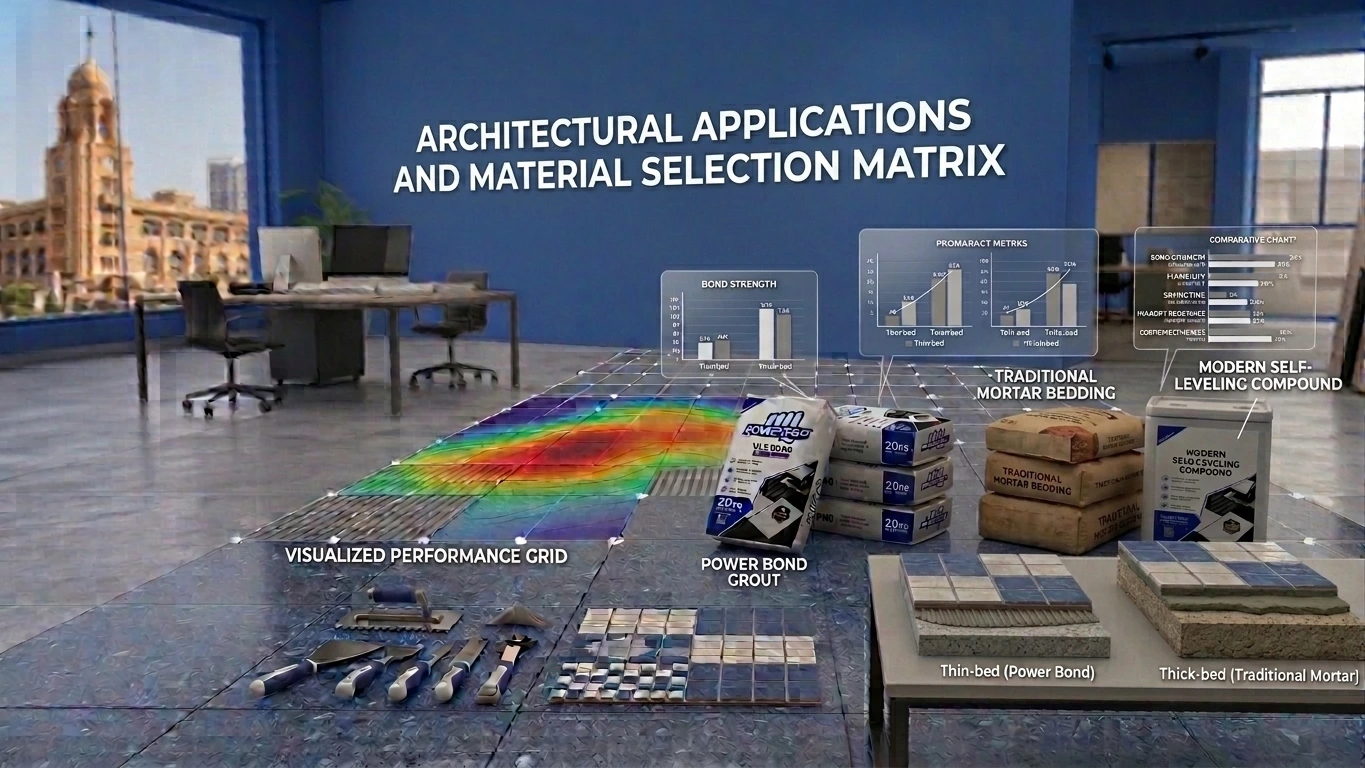
Architectural Applications and Material Selection Matrix
Selecting the correct adhesive formulation depends directly on the combination of tile type, tile size, and installation location:
- Residential Living Areas and Bedrooms: For standard ceramic or vitrified tiles installed over level screeds, a standard polymer-modified C1 or C2 adhesive provides ideal coverage and fast turnaround.
- Large Format Porcelain Slabs (1200x600mm and above): Heavy, non-porous slabs require C2-grade adhesives with non-sag properties (Type T) and extended open time (Type E) to prevent slipping on vertical applications and to ensure full coverage beneath the slab.
- High-Moisture Interior Spaces (Bathrooms and Laundries): Require hydrophobic polymer adhesives combined with appropriate under-tile waterproofing membranes to avoid moisture migration through subfloors.
- Commercial and Retail Interiors: Heavy foot traffic demands high-compressive-strength polymer adhesives capable of bearing dynamic loads without micro-fracturing.
When sourcing specialized construction chemicals, tile mortars, and bonding solutions in Pakistan, architects and contractors rely on platforms like powergrip.pk to evaluate material technical specifications, compare product ratings, review Technical Data Sheets, and ensure localized availability across major construction hubs.
Standard Installation Procedure for Building Contractors
Following correct application protocol ensures that tile installations achieve their rated tensile bond strength:
- Substrate Preparation: Ensure the concrete base or screed is fully cured, structurally sound, clean, and free from oil, dust, or loose particles. Laitance must be mechanically removed.
- Mixing: Add dry powder to measured clean water according to manufacturer guidelines. Mix using a slow-speed electric stirrer (approx. 400 RPM) until a smooth, lump-free paste forms. Allow the mixture to slake for 5 minutes, then re-stir briefly before use.
- Application: Apply the mixed mortar to the substrate using the flat side of a notched trowel, then comb the bed with the notched edge at a 45-degree angle. Choose trowel notch sizes appropriate for tile dimensions to achieve at least 80% coverage for dry areas and 95% for wet areas.
- Tile Placement: Press tiles firmly into the wet adhesive bed with a slight twisting motion to ensure full mortar transfer. Use plastic tile leveling clips and spacers to maintain consistent joint widths.
- Curing and Grouting: Allow the installation to cure undisturbed for a minimum of 24 hours before allowing foot traffic or applying joint grout.
Common Installation Errors to Avoid
- Troweling in Circular Patterns: Spreading adhesive in swirls creates trapped air pockets beneath tiles, reducing load capacity and increasing the risk of cracking. Always comb adhesive in straight, parallel lines perpendicular to the long edge of the tile.
- Spot-Dabbing (“Dot and Dab”): Placing blobs of adhesive on tile corners leaves vast hollow voids beneath the center and edges. Concentrated impacts or heavy furniture will easily crack unsupported tile sections.
- Installing Over Uncured Substrates: Applying tile beds over green concrete or wet screeds leads to moisture entrapment, potential efflorescence, and joint failure as the subbase shrinks during curing.
- Exceeding Open Time: Working with adhesive that has begun to form a skin results in poor contact and eventual debonding. If skinning occurs, scrape off the dry mortar and apply a fresh layer.
Local Supply Factors and Project Specifications in Karachi
For commercial and residential projects in Karachi, structural specifiers should clearly outline tile adhesive performance metrics in their bill of quantities (BOQ). Specifying clear performance codes (e.g., C2TE grade according to EN 12004 standards) prevents material substitution with inferior site-mixed mortars.
Architects and contracting firms can verify performance standards and product availability through regional platforms such as powergrip.pk, ensuring that selected formulations match exact site demands—from high-traffic commercial flooring to specialized residential wet areas.
Frequently Asked Questions
What is the main difference between tile adhesive and traditional cement?
Tile adhesive contains polymer additives that provide strong chemical bonding, flexibility, and minimal shrinkage.
Traditional cement relies solely on mechanical friction, which often fails with modern non-porous vitrified tiles.
Can indoor tile adhesive be used over existing floor tiles?
Yes, using a high-performance polymer-modified (Class C2) adhesive allows for tile-on-tile installation, provided the existing tiled surface is structurally sound, degreased, and mechanically abraded or primed before application.
How long does indoor tile adhesive take to dry?
Most standard polymer-modified tile adhesives set sufficiently within 24 hours to allow light foot traffic and grouting.
Full curing and maximum chemical strength are typically achieved between 48 hours to 7 days.
What causes hollow sounds under floor tiles?
Hollow sounds indicate voids beneath the tile, usually caused by improper adhesive troweling (such as spot-dabbing), exceeding the adhesive’s open time, or using traditional sand-cement mortar that shrank away during curing.
Is waterproofing required under tile adhesive in bathrooms?
Yes. Tile adhesives and grouts are water-resistant but not completely waterproof. A dedicated elastomeric waterproofing membrane should be applied over the screed before laying tiles with polymer-modified adhesive in wet areas.
How do I choose the correct trowel size for tile adhesive?
Select notch sizes based on tile dimensions: small tiles (up to 300x300mm) typically use a 6mm square-notched trowel,
medium tiles use an 8mm or 10mm trowel, while large-format slabs require a 12mm notched trowel plus back-buttering the tile.
Conclusion
Switching from legacy cement bedding to engineered polymer tile adhesives is essential for long-term tiling integrity in Karachi’s coastal climate. By specifying the correct adhesive class (C1 or C2) based on tile porosity, dimensions, and environmental exposure, architects and contractors can eliminate tile debonding, resist salt action, and maintain structural finishes across commercial and residential projects. For detailed specifications and supplier options, platforms like powergrip.pk offer a direct hub for building material requirements.