



Choosing the right ceramic tile adhesive Pakistan is more than picking a bag of tile bond from a hardware shop.
The adhesive needs to suit the type of ceramic tile, the surface underneath, the installation area, and the conditions the finished tiles will face.
For example, the requirements for ceramic tile adhesive Pakistan on a bedroom wall may differ from tiles installed in a bathroom, kitchen, commercial floor, or another moisture-prone area.
Using an unsuitable product—or applying a suitable product incorrectly—can contribute to poor bonding, hollow areas beneath tiles, movement, or tiles coming loose over time.
This guide explains what ceramic tile adhesive pakistan is, how it differs from traditional cement-sand mortar, what homeowners and professionals should check before buying it, and how to make a better product decision for projects in Karachi and across Pakistan.
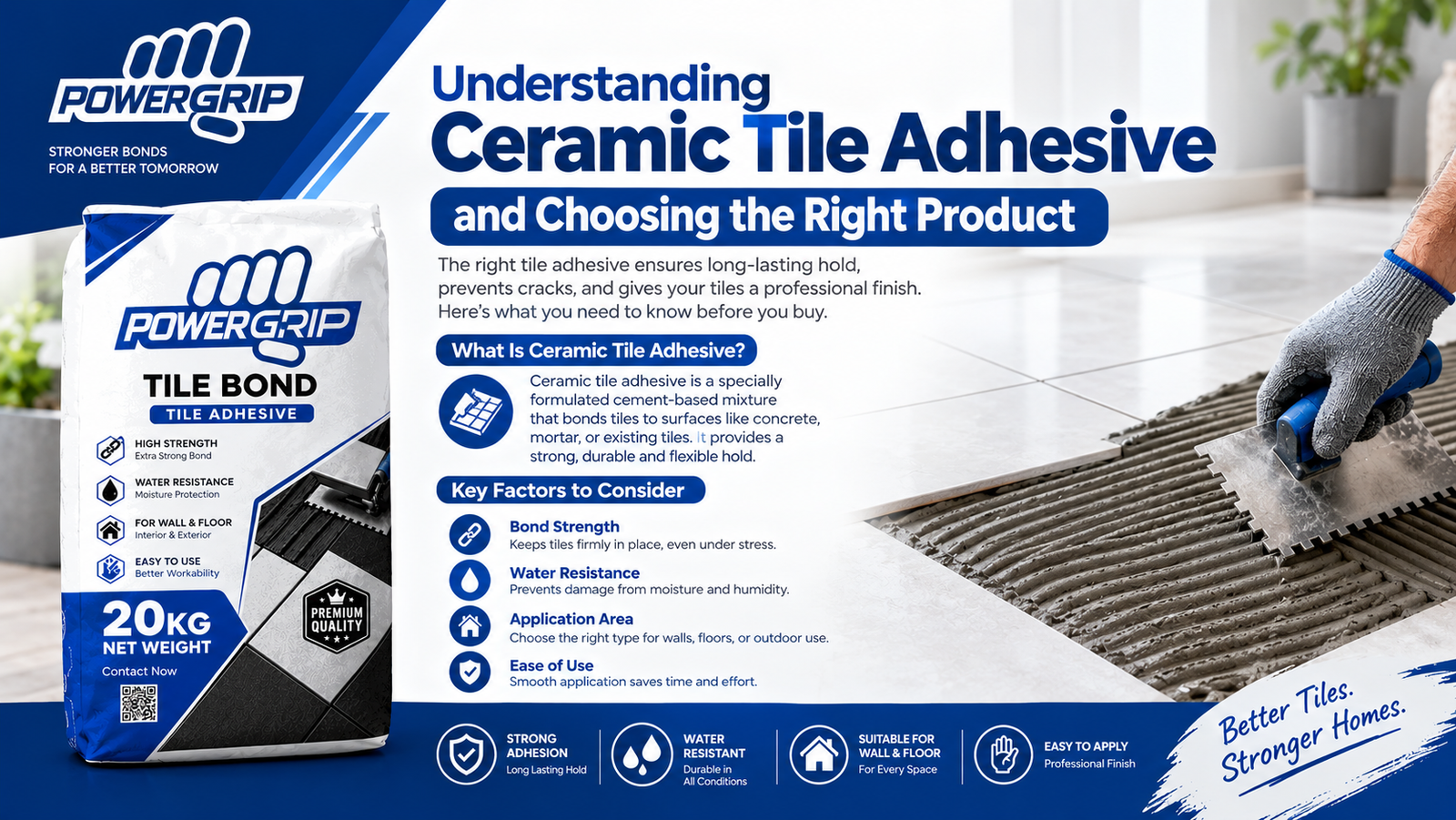
Understanding Ceramic Tile Adhesive pakistan and Choosing the Right Product
What Is Ceramic Tile Adhesive?
Ceramic tile adhesive pakistan is a specially formulated bonding material used to fix ceramic tiles onto prepared wall or floor surfaces.
Most modern cement-based tile adhesives are supplied as dry powder and mixed with water according to the manufacturer’s instructions before application.
Unlike ordinary site-mixed mortar, tile adhesive is formulated specifically for tile installation. Depending on the product, it may contain cement, graded fillers, polymers, and performance-enhancing additives designed to improve properties such as workability and adhesion.
The correct choice depends on the complete installation system. Before selecting an adhesive, you need to consider the tile, the substrate, the location, and the product’s stated application.
Why Does the Right Tile Adhesive Matter?
Tiles are only as secure as the system beneath them. A high-quality ceramic tile can still develop installation problems if the surface was poorly prepared, the adhesive was mixed incorrectly, or there was inadequate contact between the adhesive and the back of the tile.
This is particularly relevant in renovation projects. A homeowner may focus on the tile design and price but overlook the condition of the wall or floor.
If the substrate is dusty, uneven, weak, or unsuitable, simply applying more adhesive may not solve the underlying problem.
For contractors and tile fixers, correct adhesive selection can also make installation more predictable.
For architects, builders, and property developers, choosing products according to the project’s actual conditions helps avoid treating every tiling job as if it has identical requirements.
What Should You Check Before Buying Ceramic Tile Adhesive?
The simplest way to choose a ceramic tile adhesive is to begin with the project, not the product name.
First, identify the tile type and size. Then look at the surface where it will be installed.
A properly prepared cement-based floor, plastered wall, concrete substrate, or renovation surface may each need different preparation and suitability checks.
The installation environment matters as well. Indoor dry areas, kitchens, bathrooms, balconies, and exterior applications can expose the tiling system to different levels of moisture and temperature change.
Here are the main points to check before purchasing:
- Tile type and size: Confirm whether the adhesive is suitable for ceramic tiles and whether the product guidance addresses the size and type of tile being installed.
- Substrate: Check that the wall or floor is sound, clean, sufficiently prepared, and compatible with the adhesive.
- Installation area: Consider whether the application is indoors, outdoors, dry, moisture-prone, residential, or commercial.
- Manufacturer instructions: Review mixing requirements, application guidance, coverage information, working time, and curing recommendations.
- Project demands: Larger tiles, high-traffic areas, uneven substrates, and challenging environments may require additional consideration.
A good purchasing decision is therefore based on compatibility rather than marketing language alone.
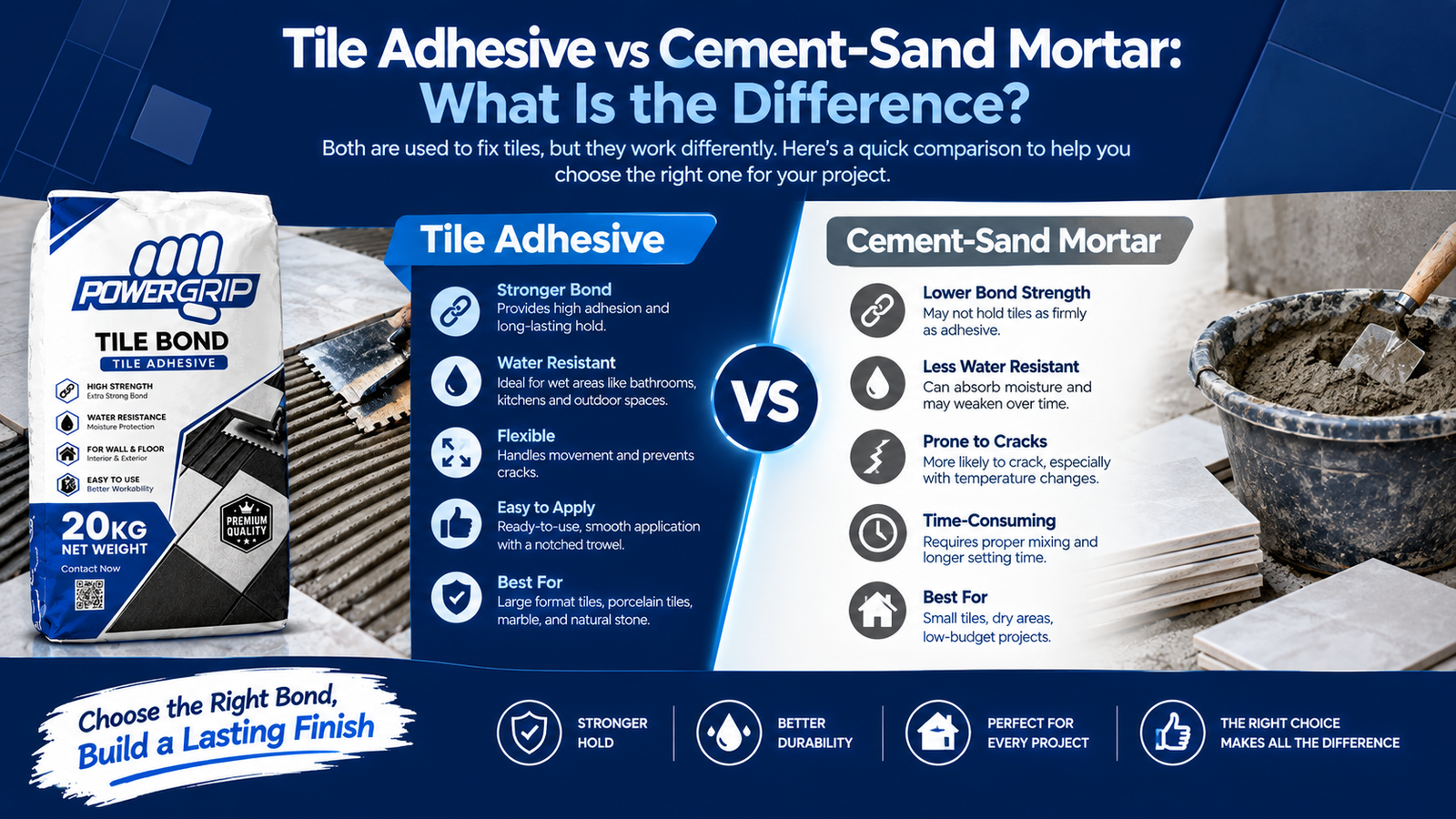
Tile Adhesive vs Cement-Sand Mortar: What Is the Difference?
Traditional cement-sand mortar has been used for tile installation for many years.
It is commonly prepared on site, and its final consistency can depend heavily on material quality, mixing proportions, and installer technique.
Tile adhesive is formulated for tile bonding and is generally supplied with specific manufacturer instructions.
This can provide a more controlled approach to mixing and application.
The choice should not be reduced to a simple claim that one method is always better in every situation.
The appropriate system depends on the tile, surface, installation method, and project requirements.
Feature | Traditional Cement-Sand Mortar | Ceramic Tile Adhesive |
Preparation | Mixed on site using selected materials | Pre-formulated product mixed according to instructions |
Main use | General bedding and traditional tile installation | Designed specifically for tile bonding |
Consistency | Depends heavily on site mixing | More controlled when mixed as specified |
Application | Can vary according to installer method | Applied using the product’s recommended technique |
Product selection | Usually based on site practice | Can be selected for tile, substrate and application requirements |
Modern projects | Suitability depends on the complete installation | Different formulations can address different tiling applications |
The table does not mean every project automatically requires the same adhesive.
It highlights why the tile and installation conditions should be assessed before choosing a fixing method.
Can the Same Adhesive Be Used for Every Ceramic Tile Project?
Not necessarily. Ceramic tiles are used in many different environments, and one project may have very different demands from another.
A small ceramic wall tile in a dry interior room may not face the same conditions as floor tiles in a busy commercial area.
Likewise, a bathroom installation may involve greater moisture exposure, while an exterior installation can face environmental changes that need to be considered during product selection.
Tile size is another practical factor. As tiles become larger, substrate flatness and adhesive coverage become increasingly important.
Large unsupported areas beneath a tile can affect the installation, which is why the installer should follow suitable application methods and product guidance.
Instead of asking, “Which adhesive works for every tile?”, a better question is:
“Is this adhesive specifically suitable for my tile, surface, and installation conditions?”
Common Reasons Tiles Become Loose
A loose tile is not always proof that the adhesive itself was defective.
Several issues can affect the final bond, sometimes working together.
Poor substrate preparation is one common problem. Dust, weak surface material, contamination, or an unsuitable base can interfere with bonding.
Incorrect water ratios and poor mixing can also affect how the adhesive performs.
Inadequate adhesive coverage is another concern.
If significant areas beneath the tile are not properly supported, the tile may develop hollow areas or become more vulnerable to movement and damage.
Other possible factors include substrate movement, moisture-related issues, unsuitable product selection, and installation work that does not follow the product instructions.
For this reason, replacing a loose tile without investigating why it failed may not always prevent the same problem from happening again.
Ceramic Tile Adhesive Application, Buying Advice

Where Can Ceramic Tile Adhesive Be Used?
A ceramic tile adhesive may be used for wall and floor applications when the specific product is approved for the intended purpose.
Common projects can include homes, apartments, offices, retail spaces, kitchens, bathrooms, and other tiled areas.
However, product suitability should always be checked rather than assumed.
Not every adhesive is intended for the same environment, substrate, or level of exposure.
PowerGrip markets tile bonding products for different tile applications.
If you are considering PowerGrip for a project, review the current product information and confirm that the selected product matches the tile and installation requirements.
How Is Ceramic Tile Adhesive Applied Correctly?
Correct application starts before the adhesive is mixed. The surface should be prepared according to the product instructions and should be suitable for tiling.
Weak or loose material, dust, contamination, and other surface problems should be addressed before installation.
The adhesive should then be mixed using the manufacturer’s specified method.
Adding water by guesswork can change the consistency and may affect workability.
After mixing, the adhesive is spread using an appropriate installation technique, commonly with a notched trowel where specified.
The tile is then placed and adjusted while the adhesive remains within its recommended working period.
The installer should pay attention to proper adhesive contact and coverage. Once the tiles are installed, allow the area to set and cure according to the product’s instructions before exposing it to service conditions.
Practical Steps That Help Improve Tile Installation
A successful tile installation depends on preparation and workmanship as much as the adhesive itself.
These practical steps can help reduce avoidable problems:
- Prepare and inspect the wall or floor before starting.
- Remove dust, loose material, and contaminants that may affect bonding.
- Use the correct amount of water specified for the product.
- Mix thoroughly until the required consistency is achieved.
- Apply the adhesive consistently and avoid leaving large unsupported areas beneath tiles.
- Check tile alignment and level during installation.
- Follow the recommended working, setting, and curing times.
- Do not assume that extra adhesive can compensate for an unsuitable substrate.
For a large residential or commercial project, it can be sensible to discuss the tile and substrate requirements with the adhesive supplier or technical support team before installation begins.
How Do You Choose Ceramic Tile Adhesive in Karachi?
When buying ceramic tile adhesive in Karachi, start by clearly explaining your project to the supplier.
Mention whether the tiles are ceramic, their approximate size, whether they are for a wall or floor, and where they will be installed.
This can help you avoid a common mistake: buying an adhesive based only on price or a general recommendation without considering the actual application.
Contractors and builders may also need to consider consistency across larger projects.
When many rooms or units are being tiled, using an appropriate product and following a consistent application process can be more important than making decisions separately for each small area.
Hardware and building-material dealers can provide useful product availability information, but buyers should still review the manufacturer’s stated applications and current technical guidance before final selection.
For local buyers, PowerGrip is a relevant Pakistani tile adhesive brand to consider when comparing available options.
The appropriate product should still be selected according to its published specifications and your project’s requirements.
What Should You Avoid When Using Tile Adhesive?
Avoiding common mistakes can save considerable repair work later.
Do not apply adhesive over a surface that has not been properly assessed or prepared.
Do not change the mixing ratio simply because the material appears too thick or too thin without checking the product instructions.
Another common mistake is continuing to use mixed adhesive after its recommended working period has passed.
Likewise, installers should not rush curing simply because the tile appears firmly fixed from the outside.
Avoid assuming that every tile adhesive is interchangeable.
Product names may sound similar, but their intended uses and performance characteristics can differ.
The safest approach is to select the product for the application and follow the current instructions supplied for that specific product.
When Should You Ask for Technical or Professional Guidance?
Technical guidance can be particularly valuable when the project involves large-format tiles, unusual substrates, moisture-prone locations, exterior exposure, high-traffic floors, or commercial-scale installations.
It may also be useful when an existing installation has failed.
Before applying new tiles, identify whether the previous problem was caused by the adhesive, surface condition, moisture, structural movement, or installation method.
For complex projects, contractors, architects, and property developers may need product documentation and application guidance as part of project planning.
This is especially useful when the project specifications require particular performance characteristics rather than a general-purpose adhesive.
Frequently Asked Questions
What is ceramic tile adhesive?
Ceramic tile adhesive is a formulated bonding material used to fix ceramic tiles to suitable walls or floors. It is selected according to factors such as the tile type, substrate, installation location, moisture exposure, and project requirements. The manufacturer’s application instructions should be followed for mixing, installation, and curing.
Is tile adhesive better than cement mortar for ceramic tiles?
The right choice depends on the installation. Tile adhesives are specifically formulated for tile bonding and provide defined product instructions, while traditional cement-sand mortar is prepared on site. The tile type, substrate, installation method, and project conditions should determine which system is appropriate.
Can ceramic tile adhesive be used for floor tiles?
Yes, if the specific adhesive is approved for floor applications. Before using it, check the product’s stated suitability, the tile type and size, substrate condition, expected traffic, and environmental conditions. An adhesive intended for one application should not automatically be used for another.
Can I use the same tile adhesive in a bathroom and bedroom?
Not automatically. Bathrooms may involve greater moisture exposure than dry interior rooms. The adhesive should be selected according to the conditions of the installation area and the manufacturer’s approved uses. Surface preparation and the complete tiling system also need to be considered.
Why do ceramic tiles sound hollow after installation?
A hollow sound can occur when there are unsupported or poorly bonded areas beneath a tile. Possible reasons include inadequate adhesive coverage, substrate problems, installation technique, or other bonding issues. The exact cause should be assessed rather than assuming that every hollow-sounding tile will have the same problem.
How long should tile adhesive be allowed to cure?
Curing and setting times vary by product and installation conditions. Temperature, humidity, substrate, and adhesive formulation can all affect timing. Always follow the instructions provided for the exact product being used rather than relying on a general curing period from another adhesive.
How do I choose ceramic tile adhesive in Pakistan?
Identify your tile type, tile size, substrate, installation location, and expected conditions first. Then compare products based on their stated applications and technical information. Price matters, but the cheapest product may not be suitable for the particular tile installation you are planning.
Where can I find ceramic tile adhesive in Karachi?
Ceramic tile adhesive can be purchased through building-material suppliers, hardware stores, tile retailers, and manufacturer or dealer networks. When comparing products, ask for information relevant to your project and review the manufacturer’s current application guidance before making a purchase.
Conclusion
Selecting ceramic tile adhesive in Pakistan should be based on the complete tiling project, not just the brand name or bag price.
The tile, substrate, installation area, moisture exposure, tile size, and application method all play a role in choosing an appropriate product.
For homeowners in Karachi, asking the right questions before buying can prevent costly mistakes later.
Contractors, builders, architects, tile fixers, and developers should also focus on surface preparation and correct application, because even a suitable adhesive needs proper installation to perform as intended.
When comparing options, PowerGrip can be included in your evaluation of tile bonding products.
Check the current product information, match the product to the intended application, and follow the manufacturer’s instructions throughout installation.