


Kitchen tile adhesive is used to secure tiles to the surface of kitchen walls, backsplashes, floors, and work areas.
The correct adhesive ensures a durable bond and can help minimize issues like cracked tiles, loose tiles, moisture damage, etc. Selecting the right tile adhesive is crucial for kitchens, particularly in Karachi, where humidity, heat, and regular cleaning can create unique challenges.
This will depend on the type of tile, surface, installation site, moisture exposure, and installation conditions.
This guide will explain how kitchen tile adhesive works, what to consider when purchasing an adhesive, what some of the common mistakes and pitfalls are, and what factors are important to consider when choosing an adhesive.
What Is Kitchen Tile Adhesive?
Kitchen tile adhesive is a glue that cements ceramic, porcelain, mosaic and other acceptable types of tiles to a surface that has been prepared.
Tile adhesives are different from the traditional cement and sand mixes, as they are specifically formulated to be used to install tiles and to ensure the adhesive will bond consistently when applied according to the manufacturer’s instructions.
There are a number of areas in a kitchen with different needs. A wall backsplash might require different needs as compared to a kitchen floor.
In like manner, a drywall surface could have different requirements than an area that is constantly exposed to water.The adhesive should thus be chosen depending on the installation, not only for its price.
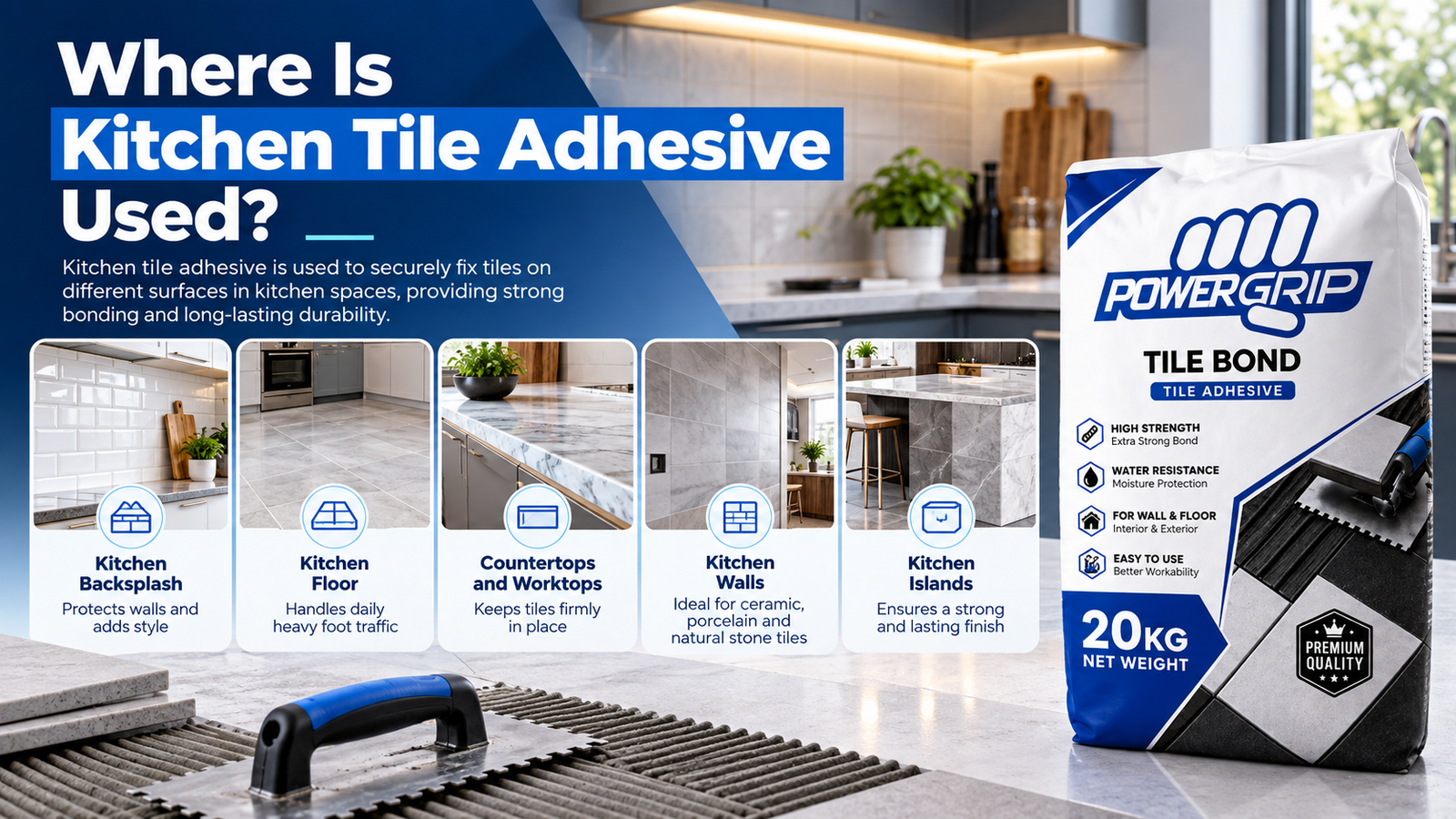
Where Is Kitchen Tile Adhesive Used?
Depending on the product’s application and the surface condition, kitchen tile adhesive can be applied to several areas.
The common areas in which they are used are kitchen backsplashes, wall tiles, floor tiles, sinks, and other tiled surfaces. The adhesive needs to be compatible with the tile and the substrate.
For instance, an adhesive to hold a small ceramic backsplash tile in place may differ from the one needed for a large porcelain floor tile. Installation can vary based on the size, weight, porosity, and location of the tile.
Why Is the Right Adhesive Important?
The quality of the tile in and of itself is not enough for a tile installation. The bond between the tile and the base material is created by the adhesive.
Tiles can become loose or uneven when the adhesive used is not the right one, or it is used the wrong way. Even if a suitable adhesive has been chosen, it can be a weak bond if the surface is not prepared well.
An appropriately chosen tile adhesive can produce more uniform installation and ease the process for contractors and tile fixers.
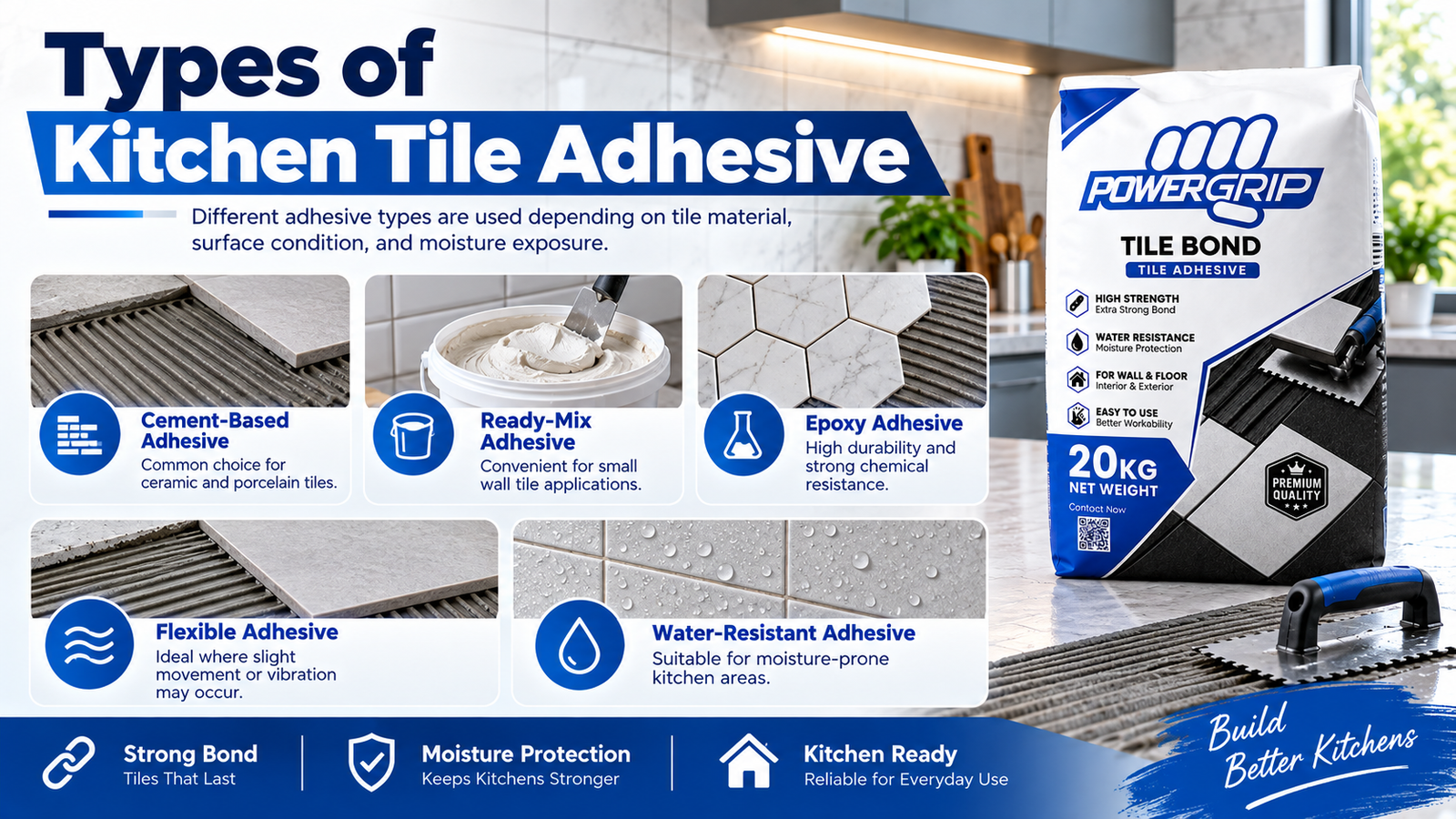
Types of Kitchen Tile Adhesive
The properties of the adhesive may vary depending upon the type of tile installation.
Cement-based tile adhesives and ready-mixed adhesives are the most common options; however, it will depend on the formulation of the product and the manufacturer’s guidelines.
Cement Based Tile Adhesive
Most cement-based tile adhesives are packaged as a powder and are mixed with water prior to application.
It may be appropriate for many types of ceramic and porcelain tile installations when used in the intended application.
They are typically applied to walls and floors and may be provided as various formulations for various tile sizes and installation situations.
Ready Mixed Tile Adhesive
Ready-mixed adhesive comes in a prepared form and generally does not need to be watered before it is used. Sometimes it is convenient for some indoor wall tile applications.
But ready-mixed items are not necessarily compatible with all kitchen surfaces and types of tiles. Prior to use, review the product’s stated application areas.
Polymer Modified Adhesive
Some tile adhesives have polymers included to enhance properties like bond and flexibility. The products could be beneficial for installations where the adhesive requires improved performance.
The actual performance will vary from one formulation to another; consult the manufacturer’s technical information rather than assuming all polymer-modified adhesives will have the same properties.
Kitchen Wall Tile Adhesive vs Floor Tile Adhesive
Wall and floor installations can have different requirements. Kitchen wall tiles are generally affected by gravity, while floor tiles must also handle regular foot traffic and other loads.
Factor | Kitchen Wall Tiles | Kitchen Floor Tiles |
Main concern | Secure wall bonding | Bonding and load resistance |
Common tile types | Ceramic, mosaic, some porcelain | Ceramic, porcelain and other suitable floor tiles |
Surface | Plaster, cement board or prepared wall | Concrete, screed or other suitable substrate |
Moisture exposure | Sink and backsplash areas may face moisture | Mopping and spills can increase moisture exposure |
Key consideration | Adhesion and workability | Adhesion, suitability for traffic and substrate |
Installation check | Tile weight and surface condition | Tile type, surface condition and expected use |
The same adhesive should not automatically be used for every kitchen installation. Product instructions should determine where the adhesive can be used.
How to Choose Kitchen Tile Adhesive
First, the installation conditions are considered when selecting an adhesive. Take into account the tile, surface, location, moisture exposure, and installation method before buying.
Check the Tile Type
The walls of a kitchen are often installed with ceramic tiles, which are available in various sizes and designs.
If porcelain is being installed, the water absorption and density of porcelain will be lower, and the glaze used for the porcelain should be able to be used for porcelain.
Another factor that may need careful application of mosaic tiles is their small dimensions, which result in numerous joints. Always refer to the adhesive manufacturer’s guidelines for the type of tile.
Consider Tile Size
The requirements for an adhesive bond with large format tiles may differ from those with small-format tiles.
This may also involve a more focused effort to ensure that the surface is flat and that adhesive is applied properly on large tiles.
Please don’t choose an adhesive just because the tile looks nice. Ensure they are suitable for the size and type of the tile.
Examine the Surface
The substrate should be clean, stable, and correctly prepared. Dust, loose material, grease, paint, or other contaminating materials may interfere with adhesion.
Grease may be a major issue in the kitchen. A clean-looking surface can still have some residues which must be cleaned prior to tiling.
Think About Moisture
Water may come into contact with kitchen areas around sinks and other wet areas over and over again. The adhesive should be appropriate for the wetness of the installation.
Water resistance of the adhesive does not mean that the entire tiled system is waterproof.
Where the installation involves these, it may require appropriate joints, preparation of the substrate, and appropriate waterproofing measures.
Check the Manufacturer’s Instructions
Product packaging and technical information can be invaluable sources of information about appropriate surfaces, mixing, layer thickness, working time, curing time, and tile compatibility.
These instructions should be adhered to in addition to general instructions about installation.
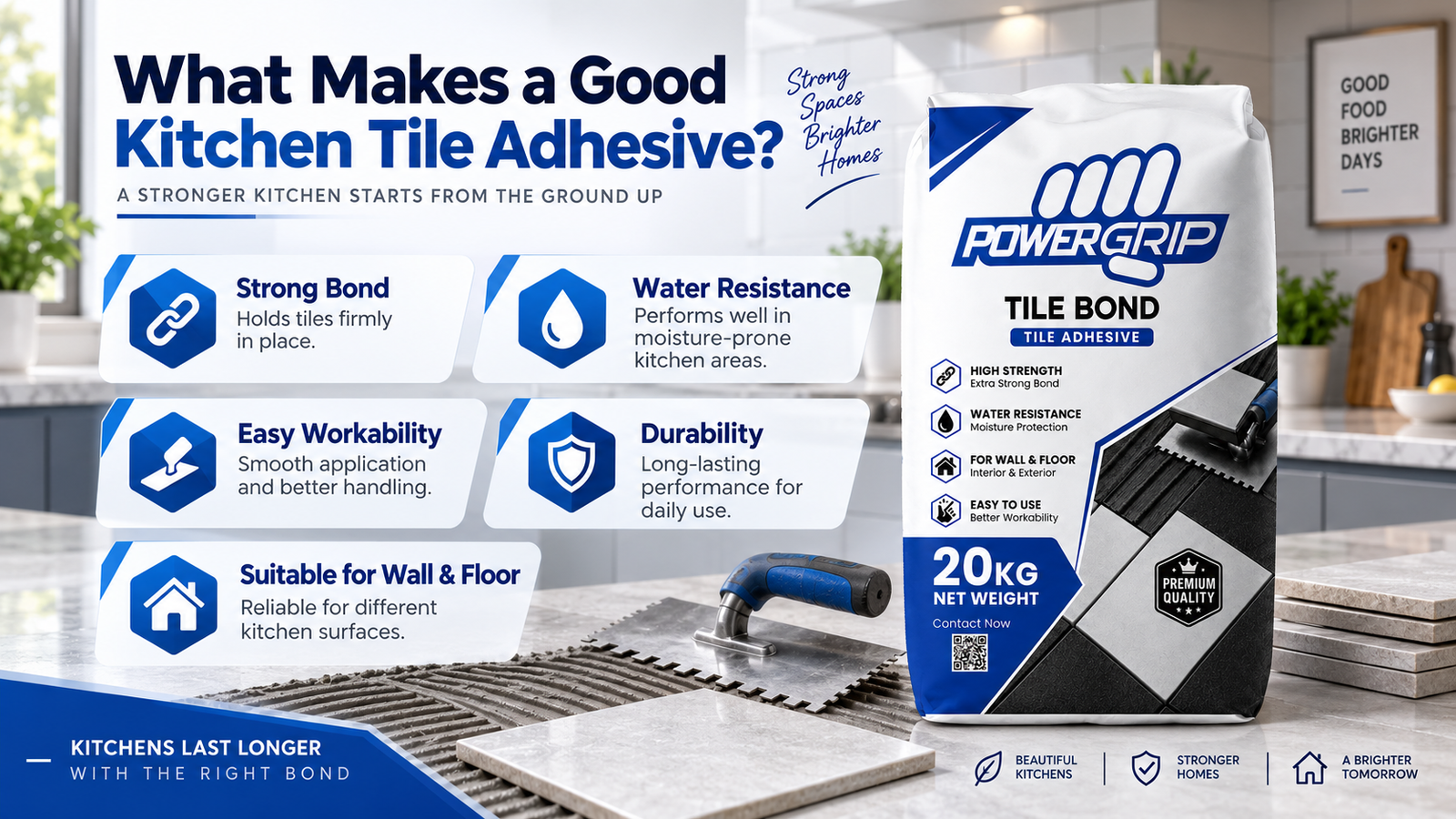
What Makes a Good Kitchen Tile Adhesive?
A good tile adhesive should ensure proper adhesion for the job at hand and enable the installer to place the tiles for proper positioning.
These can encompass factors such as adhesion to the tile, working time, consistency, and compatibility with the tile and substrate. Some applications may also require flexibility and moisture resistance.
No one single adhesive is always appropriate for all kitchens. The characteristics that are most important depend on the installation conditions.
Common Mistakes When Using Tile Adhesive
Many tile issues are not the fault of the tile, but rather due to installation mistakes. Failure to use the correct product, inadequate preparation, or incorrect mixing of the adhesive can impact the final product.
Here are some tips on what not to do:
- The use of glue on dusty, greasy, weak, or unstable surfaces.
- Installing a product which is not formulated for the chosen tile or substrate.
- Use of incorrect amounts of water in the mixing of cement-based adhesive.
- Using more glaze than would fit into the working time of the adhesive.
- Not achieving sufficient adhesive coverage when installing tile.
- Failure to follow the mixing and curing directions.
- Standing on newly installed floor tiles prior to complete adhesive curing.
- Assuming the tile adhesive is laying a waterproof layer.
Not considering movement or substrate movement joints where they are needed.
The key to a successful preparation is as critical as the selection of the adhesive.
How Is Tile Adhesive Applied?
The exact method is dependent on the product and installation. Typically, the substrate will be prepared, and the adhesive will be mixed per the manufacturer’s directions during the cement-based installation.
The specified notched trowel is then used to spread the adhesive on the appropriate surface. The tile is then inserted into the adhesive and levelled for good contact.
Installers should give extra consideration to coverage and substrate levels for larger tiles. It is not desirable to let the adhesive dry before the tile is mounted.
This adhesive should allow enough cure time before the normal use of the surface.
Kitchen Tile Adhesive in Karachi
Installations in the kitchen could be subject to heat, moisture, dust, and other conditions that require regular cleaning.
Proper surface preparation and product selection are important in these conditions.
When choosing an adhesive for a kitchen renovation in Karachi, it is essential for both the homeowner and the contractor to keep practical factors like the type of tile, the type of substrate, the level of moisture exposure, and tile size in mind, as well as the use of the tile.
When buying the tile adhesive in Karachi, it is better to look at the product’s suggested applications, and not just go by the product name or price.
If they satisfy the needs of the particular installation, products like PowerGrip tile adhesive can be used.
The product packaging and technical information should always be checked for the intended application.
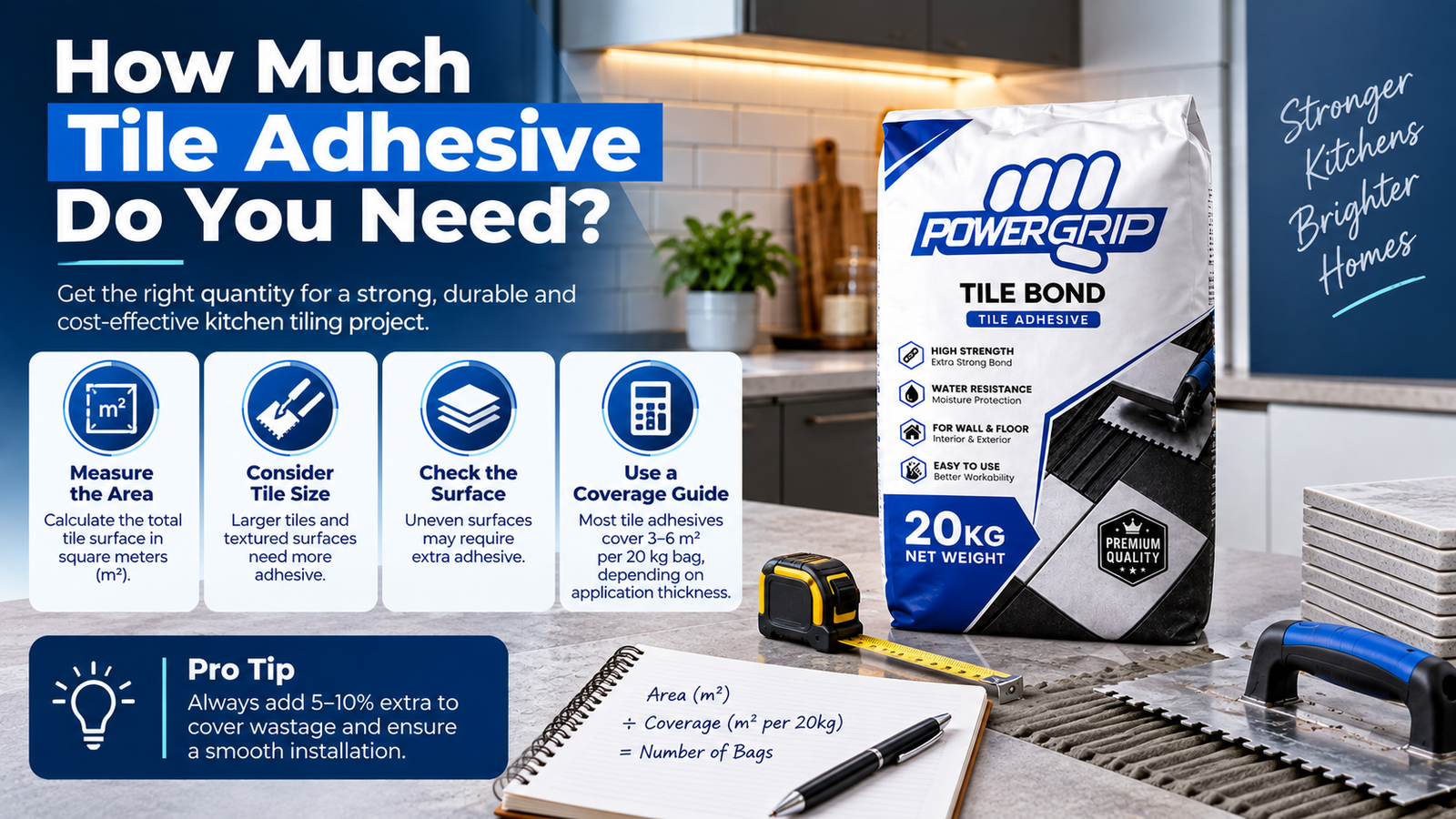
How Much Tile Adhesive Do You Need?
This will depend on the size of the area to be tiled, the size of the tiles, how flat the surface is, how thick the layer of adhesive will be, and the method used for applying the adhesive.
A flat surface might need more than an uneven surface. Larger tiles may also need other methods of application.
Rather than trying to guess from the quantity of tile boxes used, determine the square footage and then compare the manufacturer’s stated coverage for the adhesive to the surface area.
How Can You Get Better Tile Adhesive Coverage?
Good coverage is required for a better and more uniform tile application. Installer to use the correct trowel and apply adhesive as per the manufacturer’s instructions.
Lift a tile periodically as it’s being installed to monitor for proper contact in larger tiles. In accordance with the installation and standards, the required coverage varies.
The other requirement of the substrate is that it’s relatively flat. Using too much adhesive on major surface irregularities may cause installation difficulties.
When Should You Ask a Professional Tile Installer?
If you’re installing large format tiles, on an irregular or unusual surface, if you’re working in areas that are exposed to moisture, if you have significant surface irregularities, or if you are undertaking a major renovation, professional advice can be helpful.
A professional tile installer will be able to perform a preliminary inspection of the surface, type of tile, pattern, and installation conditions before installation.
This can help make sure the problem is recognized that may not be apparent to a homeowner.
If you are going for a simple backsplash, the installation can be relatively simple. The more challenging installations on floors or walls require more planning.
How to Store Tile Adhesive
Moisture is a concern with cement-based powder products since it can cause damage to the product before it is mixed.
Store unopened bags in a dry place, away from rain, damp ground, and damp walls.
Store according to the manufacturer’s directions, and inspect the product for condition before use.
Avoid using material that has hardened or formed lumps due to moisture unless the manufacturer states that it is OK to use.
How to Maintain Kitchen Tiles After Installation
Cleaning the obvious tile surface is not the only aspect of tile maintenance.
Any grout, loose tiles, and cracked joints that are damaged should be checked when they become visible.
If grease and dirt are allowed to accumulate around kitchen tiles then you will need to clean them regularly to prevent this.
Harsh cleaners should only be used if they are not damaging to the tile, grout, and surrounding surfaces.
Loose tiles can easily be repaired by applying adhesive on the edges, unless the tile is badly damaged.The underlying cause should be found prior to reinstating the tile.
Frequently Asked Questions
What is the best adhesive for kitchen tiles?
The suitable adhesive depends on the tile type, substrate, tile size, and installation location. Ceramic, porcelain, mosaic, wall, and floor installations may have different requirements. Check the manufacturer’s recommendations before selecting a product.
Can tile adhesive be used around a kitchen sink?
Some tile adhesives can be used in kitchen areas exposed to moisture, but suitability depends on the specific product and installation. Areas around sinks should also have appropriate joints and substrate protection where needed.
Is kitchen tile adhesive waterproof?
Not necessarily. Some adhesives have resistance to moisture, but tile adhesive should not automatically be treated as a complete waterproofing system. Waterproofing requirements depend on the substrate and location.
Can I use the same adhesive for kitchen wall and floor tiles?
Not always. Wall and floor installations can have different requirements. The adhesive should be approved for the specific tile, substrate, location, and expected load.
How long does tile adhesive take to dry?
The curing or drying time depends on the adhesive type, temperature, humidity, substrate, tile, and product formulation. Follow the manufacturer’s stated curing time rather than relying on a fixed number of hours.
Can tile adhesive be used for porcelain tiles?
Some tile adhesives are specifically suitable for porcelain tiles. Because porcelain has low water absorption, the adhesive must be appropriate for that type of tile and the intended installation.
How do I calculate the amount of tile adhesive needed?
Start with the total tiled area, then use the adhesive manufacturer’s coverage information. Actual consumption can vary with tile size, trowel size, substrate flatness, and application technique.
Can PowerGrip tile adhesive be used in a kitchen?
PowerGrip products should be used according to their specific application instructions. Before installation, check the product information to confirm compatibility with the selected tile, substrate, and kitchen application.
Conclusion
When choosing the right kitchen tile adhesive, it’s not just about picking a product from the hardware store.
The type of tile, its size, the kind of substrate it is used on, exposure to moisture, surface preparation (including bonding), and the installation technique are all factors that have an impact on the final installation.
As far as homeowners, contractors, and tile fixers in Karachi are concerned, the most useful method is to determine the needs for installation first before choosing an adhesive that suits the situation.
If there is a match in the product specifications, PowerGrip can be included as one of the tile adhesives available.
Good surface preparation, the right adhesive, proper application, and sufficient curing time can all help to make the kitchen tile installation more durable and neat.