

Vitrified tile adhesive Pakistan is commonly used for installing dense, low absorption tiles on suitable walls and floors.
Since vitrified tile adhesive pakistan absorb very little water, choosing an adhesive made for this type of tile can help create a stronger and more reliable bond than using a conventional fixing method without checking compatibility.
The adhesive is only one part of a successful tile installation.
A clean and stable surface, correct mixing, proper trowel application, good adhesive coverage, and enough curing time are equally important.
Vitrified tiles are widely used in homes, offices, shops, kitchens, bathrooms, and commercial buildings across Pakistan. In Karachi, installers may also need to consider heat, humidity, dust, outdoor exposure, and differences in substrate quality.
This guide explains how vitrified tile adhesive works, what to look for when buying it, how to apply it correctly, common installation mistakes, and how to choose a product for different project conditions.
What Is Vitrified Tile Adhesive?
Vitrified tile adhesive is a bonding material designed to fix vitrified and other suitable low absorption tiles to prepared surfaces.
It creates a controlled bonding layer between the tile and substrate instead of relying only on a traditional sand and cement mixture.
Vitrified tiles have a dense body and very low water absorption.
This makes them durable and resistant to moisture, but their smooth surface can require a suitable bonding system.
Most cement based tile adhesives are supplied as dry powder.
They are mixed with a specified amount of water before application. Depending on the formulation, a product may be intended for ceramic tiles, porcelain tiles, vitrified tiles, large format tiles, walls, floors, indoor areas, or exterior applications.
The key point is simple: not every tile adhesive is suitable for every vitrified tile or surface.
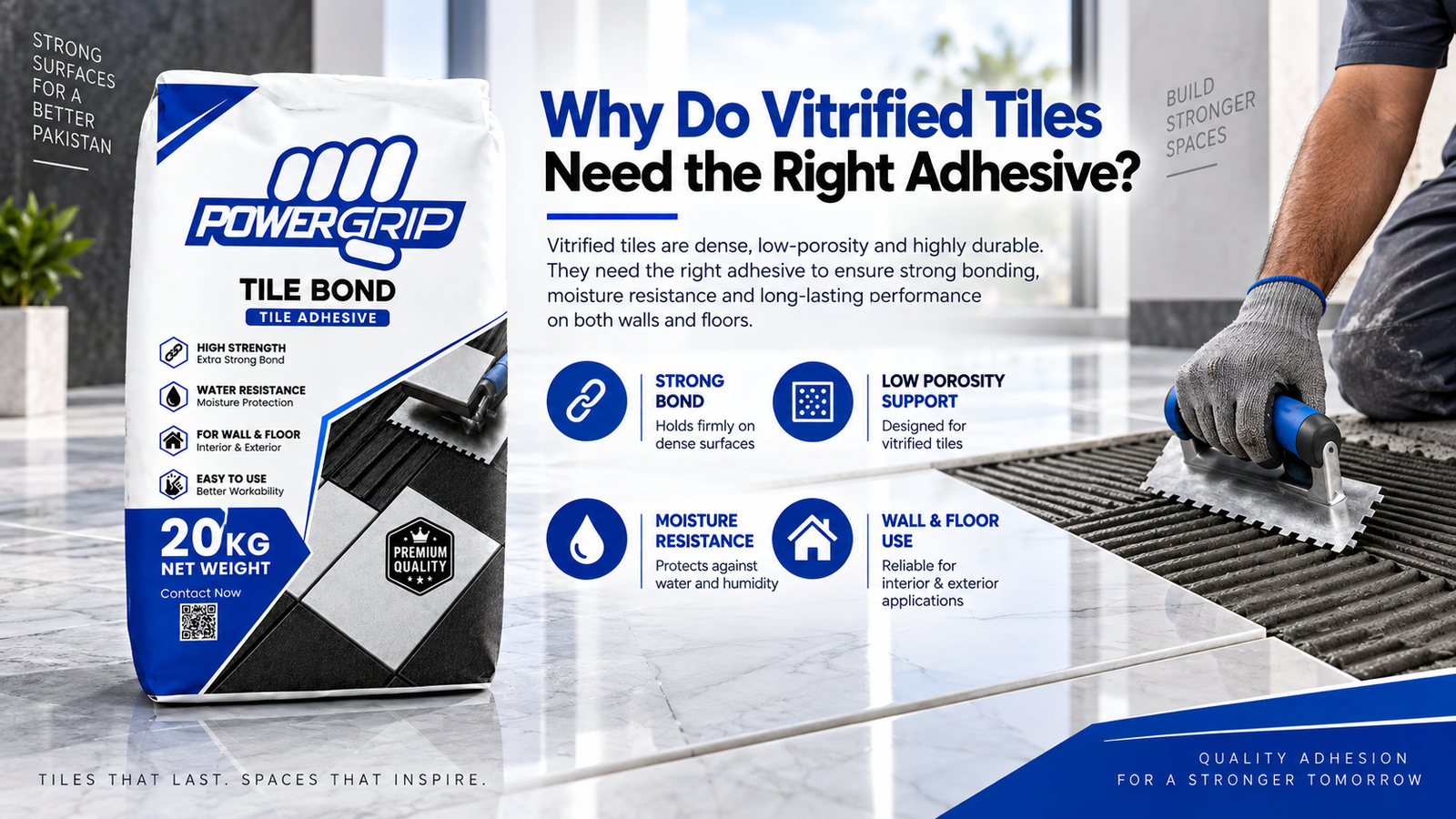
Why Do Vitrified Tiles Need the Right Adhesive?
The low absorption of vitrified tiles means that the bonding material cannot be selected only because it is labelled as a general tile adhesive.
A suitable adhesive is designed to develop adhesion between the tile and prepared substrate. It can also make installation more consistent by allowing the installer to control the thickness and coverage of the bonding layer.
However, a good adhesive cannot fix a poor substrate. Dust, oil, loose concrete, excessive moisture, uneven surfaces, incorrect mixing, and poor adhesive coverage can all lead to tile failure.
For this reason, product selection and installation technique should be considered together.
How Does Vitrified Tile Adhesive Work?
The adhesive forms a bonding layer between the tile and the substrate. After mixing, it remains workable for a specified period so the installer can spread it, position the tile, and make minor adjustments.
Once installed correctly, the adhesive develops its designed bond as it cures.
Its actual performance depends on several factors, including:
- Tile type and absorption
- Substrate condition
- Adhesive formulation
- Mixing ratio
- Trowel size
- Adhesive coverage
- Temperature and moisture conditions
- Open time and curing
- Installation technique
For dense vitrified tiles, adequate coverage is particularly important. Large areas without adhesive contact can create weak points beneath the tile.
Vitrified Tile Adhesive vs Cement Mortar
Cement and sand mortar is still used for many tile installations in Pakistan. However, it is not automatically the best fixing method for every type of tile.
A manufactured tile adhesive provides defined application characteristics and can be selected according to the tile and substrate. Traditional mortar depends more heavily on site mixing, thickness, workmanship, and the chosen installation method.
Factor | Vitrified Tile Adhesive | Traditional Cement Mortar |
Tile compatibility | Can be designed for low absorption tiles | Depends heavily on installation method |
Application | Usually applied in a controlled layer | Commonly used as a thicker bedding layer |
Thickness | Easier to control | Depends on site workmanship |
Consistency | Factory controlled formulation | Can vary with site mixing |
Surface preparation | Requires a suitable prepared surface | Also requires proper preparation |
Large tiles | Product selection and coverage are important | Requires careful bedding and installation |
Installation skill | Correct troweling is important | Correct mortar preparation and bedding are important |
Neither method should be selected in isolation. The tile, substrate, location, and manufacturer’s instructions should determine the appropriate system.
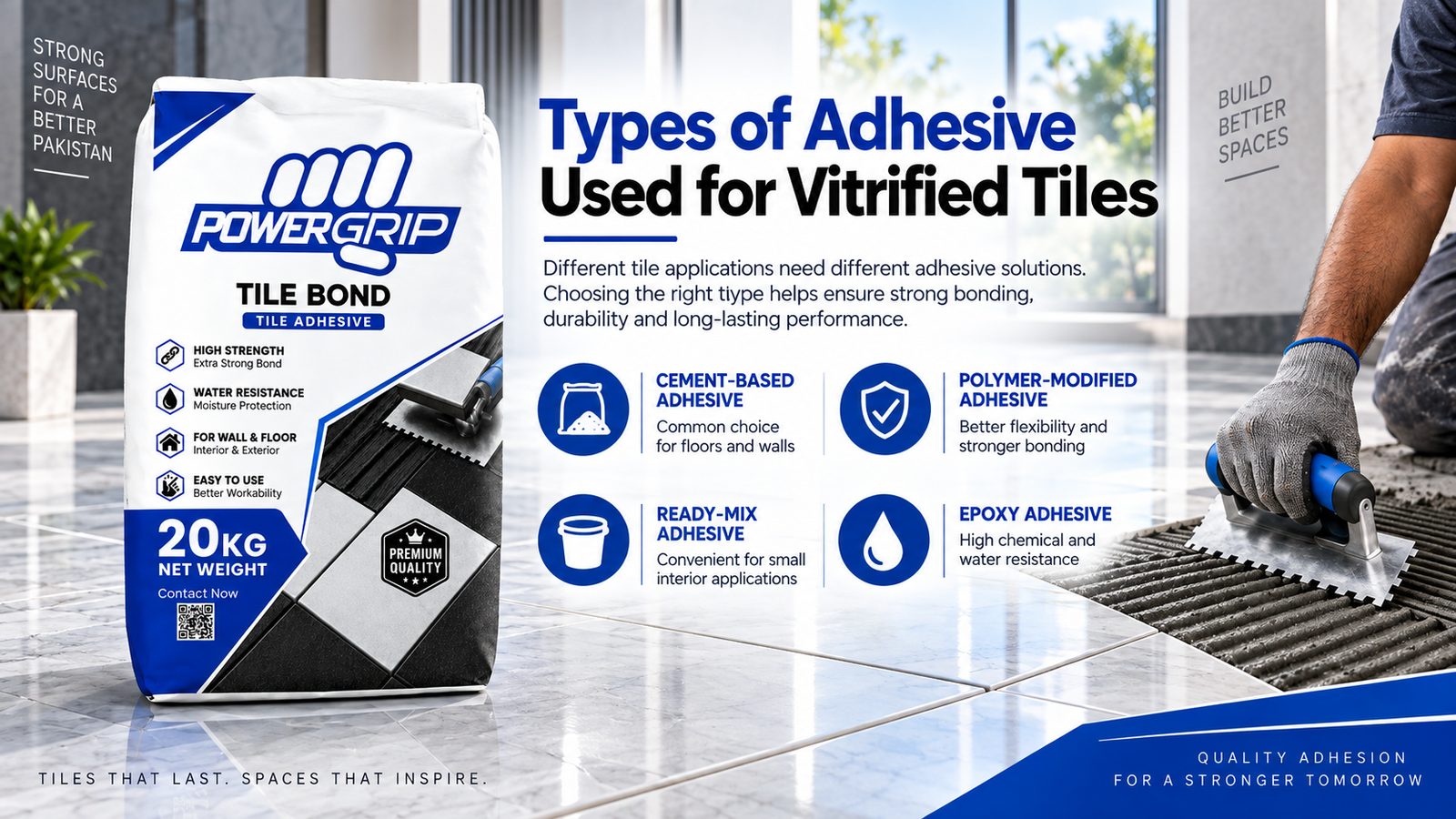
Types of Adhesive Used for Vitrified Tiles
Different tile projects can require different adhesive characteristics. The most suitable option depends on the tile, surface, location, and expected conditions.
Cement Based Tile Adhesive
Cement based adhesive is supplied as a dry powder and mixed with water before use. Different products can be formulated for different tile types and substrates.
For vitrified tiles, check the product information to confirm that it is specifically suitable for low absorption surfaces.
Polymer Modified Adhesive
Polymer modified adhesives contain additives that can improve properties such as adhesion, flexibility, and workability.
They can be useful for installations where stronger bonding or improved flexibility is required. However, the actual suitability still depends on the manufacturer’s specifications.
Flexible Tile Adhesive
Flexible adhesives are designed for installations where the bonding system may experience some movement or stress.
They can be relevant for certain large format tiles, temperature exposed areas, or substrates where movement needs to be considered.
Specialized or Heavy Duty Adhesive
Some projects have more demanding requirements, such as heavy tiles, exterior exposure, commercial areas, or unusual substrates.
In these situations, the product should be chosen based on its technical specifications rather than simply relying on terms such as “heavy duty.”
What to Check Before Buying Vitrified Tile Adhesive in Pakistan
Before buying a product, start with the project rather than the brand name.
First, identify the tile. Vitrified, porcelain, ceramic, and natural stone tiles can have different installation requirements.
Next, look at the substrate. Concrete, cement plaster, screed, existing tiles, and other surfaces may require different preparation or adhesive characteristics.
The location is also important. A bedroom wall, bathroom floor, kitchen, balcony, and outdoor surface do not necessarily have the same requirements.
Before purchasing, check the product packaging or technical information for:
- Compatible tile types
- Suitable substrates
- Wall or floor applications
- Indoor or outdoor use
- Water and moisture exposure
- Mixing instructions
- Open time
- Adjustment time
- Coverage information
- Curing requirements
- Storage conditions
- Product limitations
These details are more useful than choosing a product simply because it has a low price or a general “for tiles” label.
Vitrified Tile Adhesive for Karachi Projects
Karachi’s climate and construction conditions can affect how tile installation is planned. Heat, humidity, dust, and outdoor exposure may influence working conditions, although they do not automatically determine which adhesive should be used.
For example, installing tiles inside an air conditioned room is different from installing them on an exposed balcony. Similarly, a bathroom floor has different requirements from a bedroom wall.
The substrate should be stable and properly prepared before adhesive application. Where an area needs waterproofing, that should be handled as part of the complete installation system.
Tile adhesive should not be considered a replacement for waterproofing.
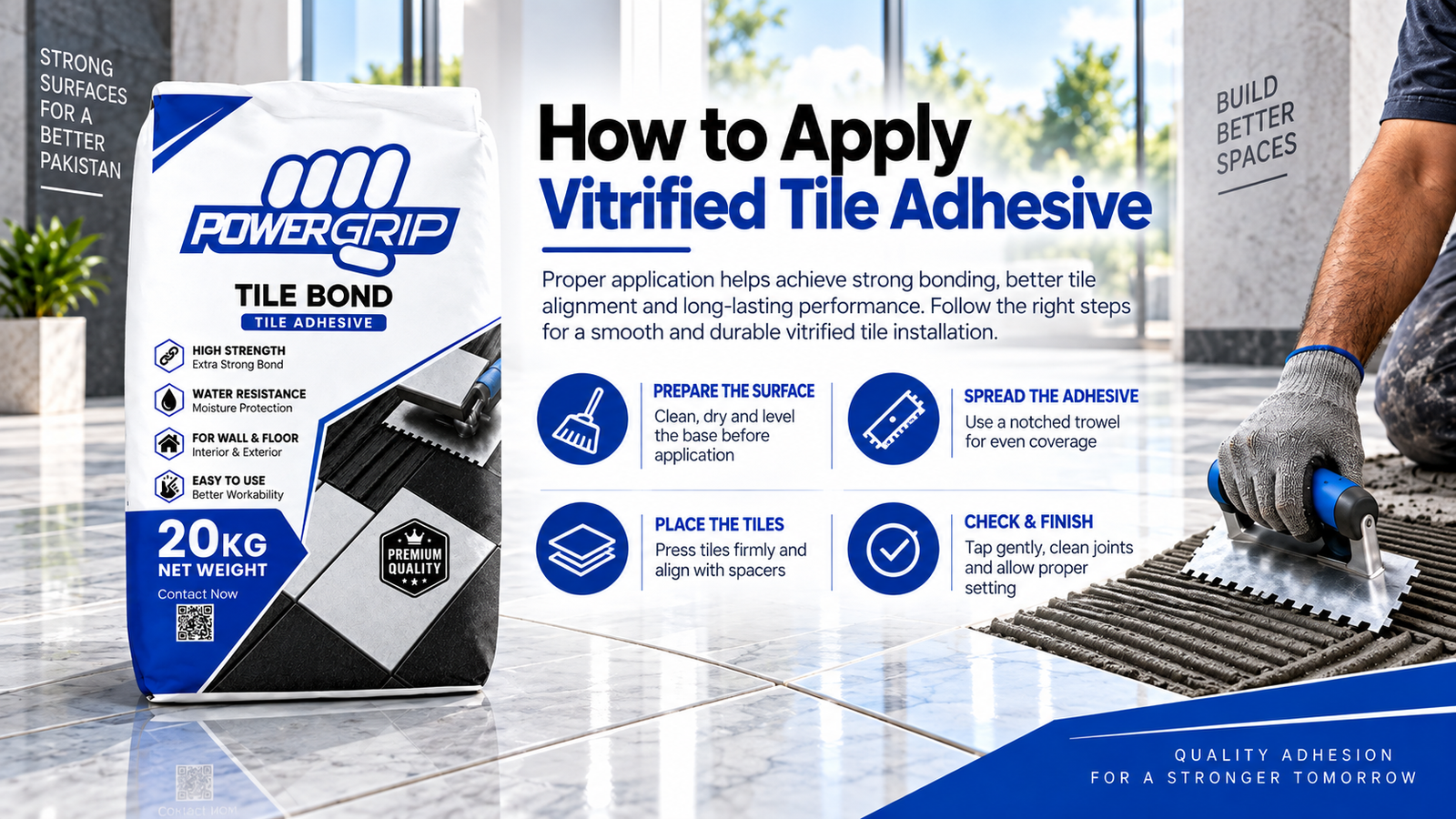
How to Apply Vitrified Tile Adhesive
Good installation starts with surface preparation.
Remove dust, oil, loose particles, paint, and other contaminants that may interfere with bonding. If the surface has major cracks, weak areas, or significant unevenness, these issues should be addressed before applying the adhesive.
1. Prepare the Surface
Make sure the substrate is sound, clean, and suitable for tile installation. Do not use adhesive simply to compensate for a seriously uneven surface.
2. Mix the Adhesive Correctly
Follow the manufacturer’s recommended water ratio. Adding extra water may make the mixture easier to spread, but it can also affect its designed properties.
Use the specified mixing procedure and allow the material to rest or remix if the product instructions require it.
3. Use the Right Trowel
Spread the adhesive with a suitable notched trowel. The size and shape of the trowel should match the tile size and installation requirements.
Avoid applying random spots or isolated blobs of adhesive when the recommended method requires a continuous layer.
4. Aim for Proper Coverage
Large or demanding tiles may require careful attention to coverage on both the substrate and tile back.
The goal is to achieve adequate contact between the tile and adhesive while avoiding unnecessary thickness.
5. Place the Tiles Within the Open Time
Do not spread more adhesive than can be covered within the product’s specified open time.
If the adhesive begins to form a skin before the tile is placed, bonding may be affected.
6. Allow Proper Curing
Avoid unnecessary movement or heavy traffic until the adhesive has cured according to the manufacturer’s instructions.
Common Vitrified Tile Installation Mistakes
Many tile problems are caused by installation errors rather than the adhesive alone.
Common mistakes include:
- Applying adhesive over dusty or contaminated surfaces
- Using the wrong water ratio
- Poor mixing
- Using adhesive beyond its usable working period
- Spreading too much adhesive at once
- Leaving inadequate adhesive coverage
- Choosing a product without checking tile compatibility
- Installing over a weak or unstable substrate
- Ignoring waterproofing requirements
- Allowing traffic before the adhesive has properly cured
These issues can contribute to loose tiles, hollow areas, movement, cracked grout joints, and debonding.
How to Improve Adhesion Under Vitrified Tiles
Strong tile bonding starts with preparation.
The substrate should be clean and stable, while the tile back should be free from dirt or contaminants that could interfere with adhesion.
Mix the adhesive consistently and follow the manufacturer’s instructions for water quantity, mixing time, resting period, and remixing.
Trowel selection also matters. Larger tiles generally require more attention to adhesive coverage than small tiles.
During installation, occasionally remove a freshly placed tile and inspect the underside. This can help the installer check whether the desired coverage is being achieved.
If the adhesive is drying or skinning over before tiles are placed, reduce the working area and consider the site conditions.
What Happens When the Wrong Adhesive Is Used?
An unsuitable adhesive can increase the risk of poor bonding and tile failure.
Possible problems include:
- Loose tiles
- Hollow areas
- Tile movement
- Cracked grout joints
- Debonding
- Poor long term performance
The risk depends on the application. An adhesive suitable for a normal indoor wall may not have the characteristics required for an exterior floor or a substrate that experiences movement.
This is why adhesive selection should be based on actual project requirements rather than price alone.
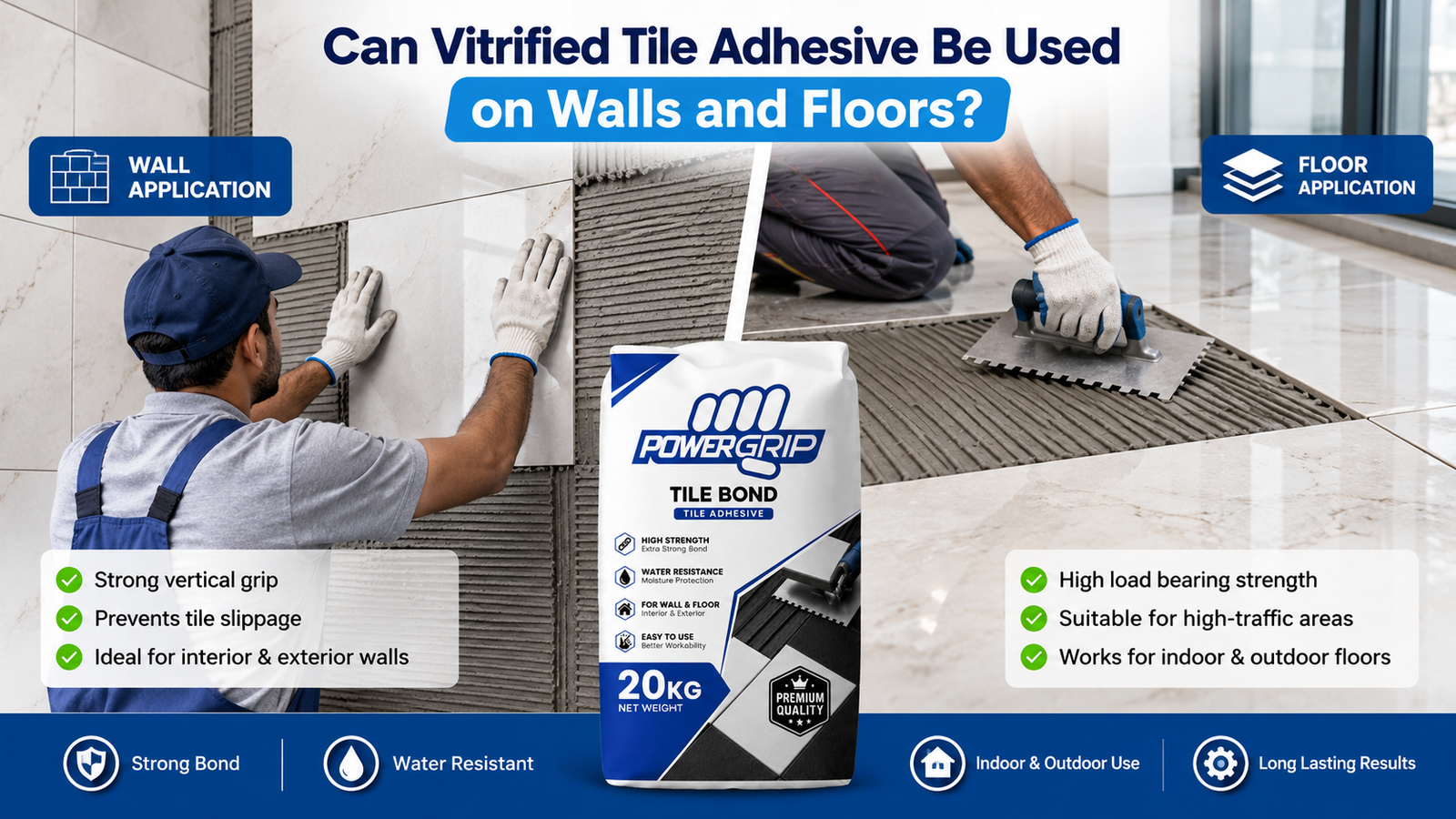
Can Vitrified Tile Adhesive Be Used on Walls and Floors?
Yes, but only when the specific product is designed for the intended application.
Wall installation requires attention to tile weight, tile size, vertical bonding, substrate condition, and adhesive working characteristics.
Floor installations also need consideration of traffic, loading, tile size, substrate movement, and moisture exposure.
For unusually large tiles, exterior applications, demanding commercial projects, or unusual substrates, check the manufacturer’s technical guidance before starting the installation.
How Much Vitrified Tile Adhesive Is Required?
There is no single coverage figure that applies to every project.
Material consumption depends on:
- Tile size
- Substrate flatness
- Trowel size
- Adhesive layer thickness
- Installation technique
- Required coverage
- Surface condition
A poorly prepared or uneven substrate can increase adhesive consumption.
The manufacturer’s coverage information should therefore be used when estimating the required quantity. If significant surface levelling is needed, that should normally be treated as a separate preparation task.
How to Choose Vitrified Tile Adhesive in Pakistan
When comparing vitrified tile adhesive products in Pakistan, look at technical suitability rather than packaging or price alone.
Consider the tile type and size, substrate, installation location, moisture exposure, expected traffic, and possible temperature or movement conditions.
For customers looking at products available through Power Grip, the manufacturer’s product information should be checked to identify the adhesive intended for the particular tile and application.
The installer should also have clear instructions covering mixing, application, coverage, curing, and storage. Good installation documentation can make the work easier and help reduce avoidable site errors.
Practical Checklist Before Installation
Before starting the project, confirm the following:
- The adhesive is suitable for vitrified or intended low-absorption tiles.
- The product is compatible with the substrate.
- The application is suitable for the planned wall or floor.
- Indoor or outdoor use is confirmed.
- The surface is clean, sound, and properly prepared.
- The correct water ratio is being followed.
- The appropriate trowel is being used.
- Adequate adhesive coverage is being achieved.
- The open time is being observed.
- The required curing period is followed.
- Waterproofing is provided separately where required.
Storage and Handling of Tile Adhesive
Proper storage is important, particularly for dry powder adhesives.
Keep unopened bags in a dry location and protect them from rain, standing water, and moisture. Follow the storage conditions and shelf life stated by the manufacturer.
Do not assume that damp, hardened, or damaged material will perform normally.
On construction sites, keeping adhesive bags raised from wet floors and protected from weather can help maintain product quality until installation.
When Should You Get Technical Advice?
Some tile installations have requirements that are difficult to judge from the product label alone.
Technical advice can be useful for:
- Very large format tiles
- Exterior installations
- Commercial areas
- Unusual substrates
- Existing tile surfaces
- Areas with significant movement
- High moisture environments
- Heavy or demanding applications
An experienced installer can also identify substrate problems before installation begins.
If the surface is weak, unstable, contaminated, or seriously uneven, correcting that problem may be more important than changing the adhesive.
Frequently Asked Questions
What is vitrified tile adhesive?
Vitrified tile adhesive is a bonding material designed for vitrified and other suitable tiles. Because vitrified tiles have low water absorption, the adhesive should be compatible with both the tile and the prepared substrate.
Is vitrified tile adhesive better than cement?
They are different installation systems. Tile adhesive provides a manufactured bonding material with specified properties, while cement mortar relies more heavily on site mixing, bedding thickness, and installation technique. The appropriate system depends on the project requirements.
Can vitrified tile adhesive be used on walls?
Yes, if the product is specifically suitable for wall applications and compatible with the tile and substrate. Large or heavy tiles require particular attention to coverage and product suitability.
Can vitrified tile adhesive be used in bathrooms?
A suitable adhesive can be used for bathroom tiles, but it does not replace waterproofing. The complete installation should address substrate preparation, waterproofing where required, tile fixing, drainage, and grout joints.
How do I choose tile adhesive in Pakistan?
Check the tile type, tile size, substrate, location, moisture exposure, and expected loading. Then compare these requirements with the manufacturer’s technical information before buying.
Why do vitrified tiles become loose?
Loose tiles can result from poor surface preparation, inadequate adhesive coverage, incorrect mixing, unsuitable adhesive selection, substrate movement, contamination, or installation outside the product’s recommended conditions.
Can the same adhesive be used for ceramic and vitrified tiles?
Not always. Some adhesives are suitable for several tile types, while others are designed for specific applications. Always check the manufacturer’s stated compatibility.
Does Karachi’s climate affect tile adhesive selection?
Heat, humidity, outdoor exposure, and site conditions can affect installation planning. The adhesive should be selected according to the product’s stated application and the actual conditions of the project.
Conclusion
Choosing vitrified tile adhesive products in Pakistan involves more than picking a product labelled for tiles.
Vitrified tiles have very low water absorption, so the adhesive needs to be compatible with the tile, substrate, and installation environment.
For projects in Karachi and other parts of Pakistan, proper surface preparation, accurate mixing, suitable trowel application, good adhesive coverage, and correct curing are all important parts of the installation.
Products available from suppliers such as Power Grip can be reviewed according to their stated specifications and intended applications.
The final product selection should always match the actual requirements of the project.
A successful tile installation is a complete system. The tile, adhesive, substrate, waterproofing where needed, installation method, and curing process all have a role in achieving a durable result.