

Outdoor tiles face conditions that indoor tiles usually do not. Sunlight, rain, moisture, temperature changes, dust, and surface movement can all affect a tiled area.
That is why choosing the right outdoor tile adhesive is essential for contractors and shop owners working on terraces, balconies, patios, exterior walls, walkways, and other exposed areas.
A suitable adhesive helps tiles bond properly with the substrate and reduces the risk of loose, cracked, or displaced tiles.
However, the adhesive should not be selected by price alone. Tile type, substrate, exposure to water, weather conditions, tile size, and installation method all matter.
For contractors and building material retailers in Karachi, these factors are particularly useful when recommending tile fixing products for outdoor projects.
This guide explains the main types of outdoor adhesives, where they are used, how to select one, common installation mistakes, and what to check before purchasing a product such as those available through Powergrip.pk.
What Is Outdoor Tile Adhesive?
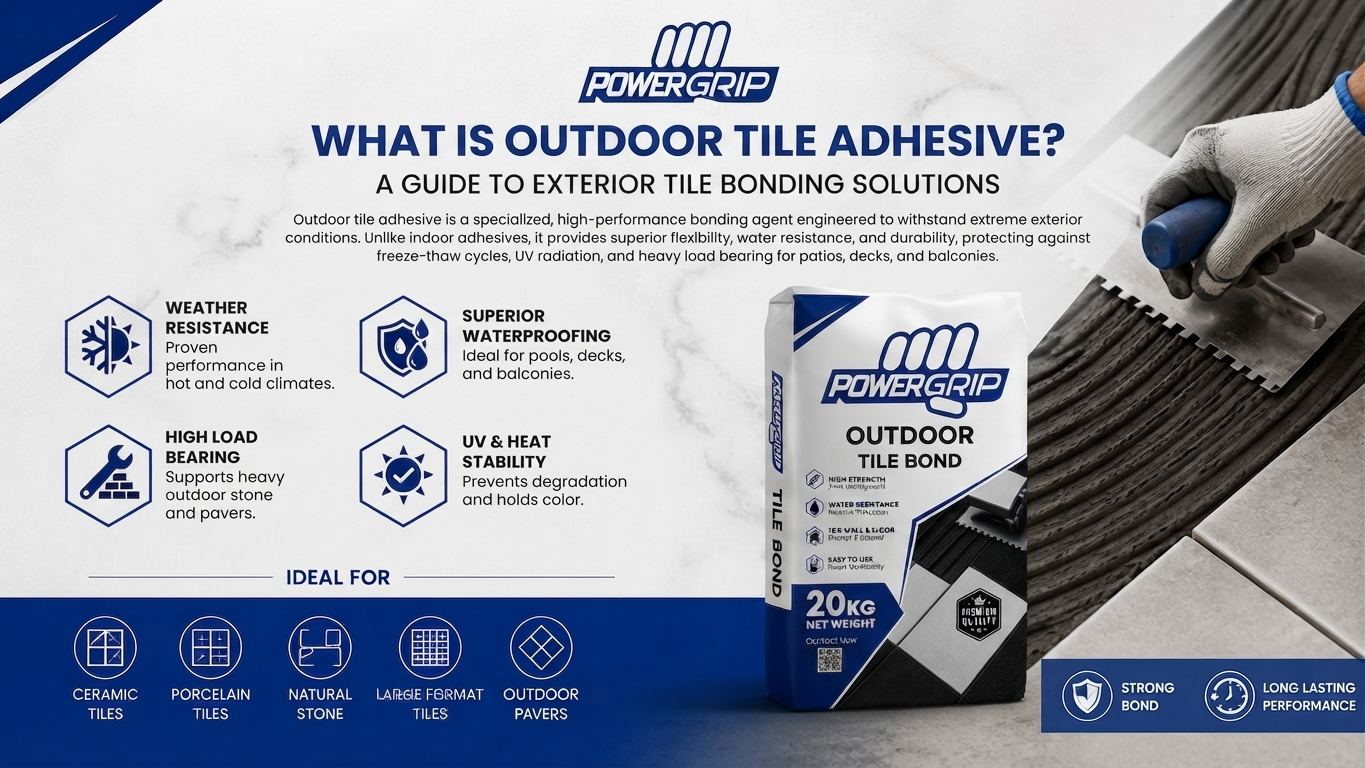
Outdoor tile adhesive is a cement-based or specialized tile bonding material designed to fix tiles to exterior surfaces where they may be exposed to moisture, sunlight, temperature changes, and mechanical stress.
Unlike a basic indoor tile adhesive, an exterior-grade product needs to provide reliable adhesion under more demanding conditions.
The correct product also needs to be compatible with the tile and substrate being used.
Outdoor tile adhesive may be used for ceramic, porcelain, stone, and other suitable exterior tiles, depending on the manufacturer’s specifications.
The product should always be selected according to the tile material, surface, location, and expected exposure.
Why Is the Right Adhesive Important for Outdoor Tiles?
Outdoor tiles are exposed to conditions that can gradually put stress on the tile installation.
For example, a terrace can become very hot during the day and cool considerably at night. Rain can also introduce moisture into the installation.
If the adhesive is unsuitable or applied incorrectly, several problems can develop.
Tiles may become hollow underneath, lose their bond, crack, shift, or eventually come away from the surface.
A suitable exterior tile adhesive supports a stronger installation by providing appropriate bonding and allowing the tile system to perform under the conditions for which it was designed.
Where Can Outdoor Tile Adhesive Be Used?
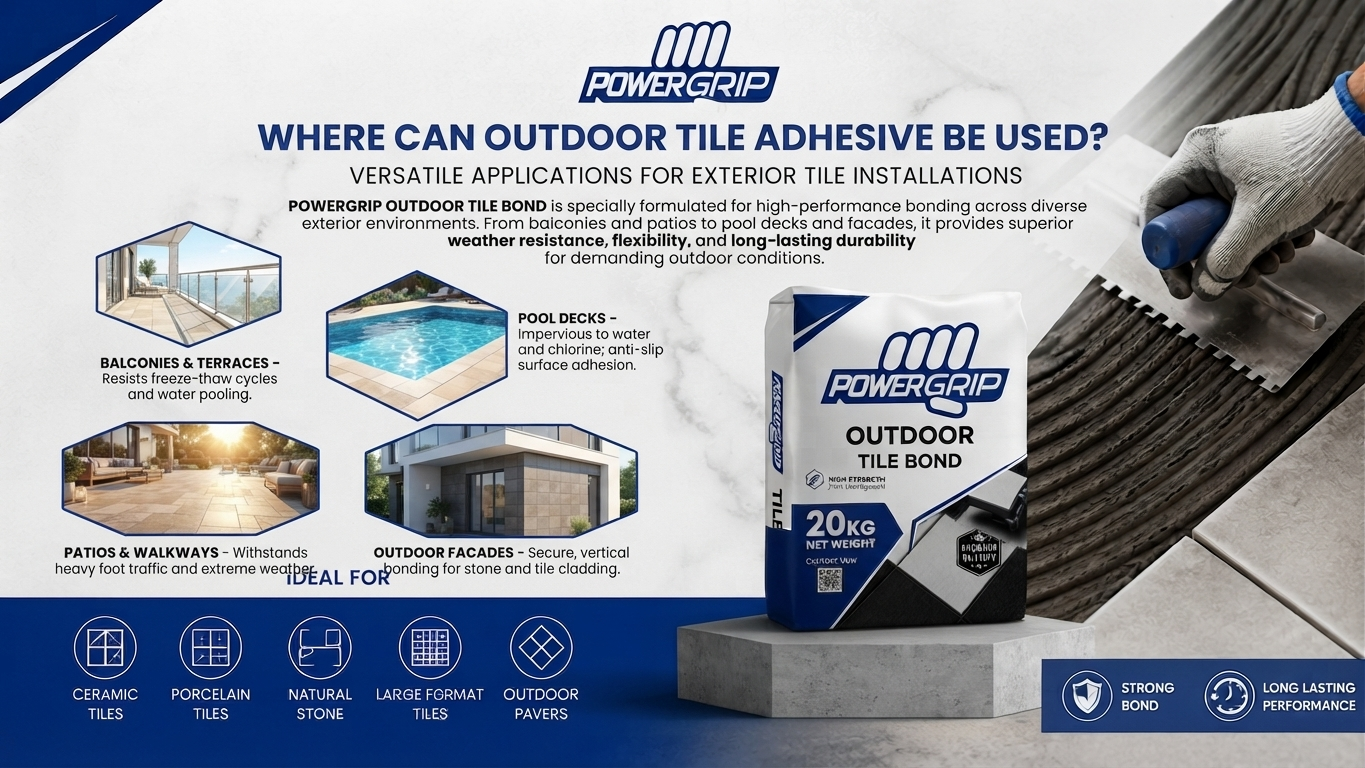
The appropriate adhesive depends on the specific application. Common exterior applications include:
- Outdoor terraces and rooftops
- Balconies
- Patios
- Exterior stairs
- Garden areas
- Outdoor walkways
- Building entrances
- Exterior walls
- Pool surrounds and other moisture-exposed areas where the adhesive is specifically suitable
Not every exterior location has the same requirements.
A covered balcony, an exposed rooftop, and a wet area can experience very different levels of moisture and temperature stress.
Outdoor Terraces and Rooftops
Terraces and rooftops are among the more demanding areas for tile installation because they can receive direct sunlight and rain.
The substrate may also expand and contract with temperature changes.
The adhesive should therefore be selected specifically for exterior use and compatible with the tiles and substrate.
Balconies
Balconies may experience rain, sunlight, and regular foot traffic. Proper surface preparation and appropriate adhesive selection are important for maintaining a stable installation.
Exterior Walls
Exterior wall tiles need an adhesive that is appropriate for vertical installation and the tile’s weight and size.
Larger or heavier tiles may require additional installation considerations.
What Types of Tile Adhesive Are Suitable for Outdoor Use?
There is no single adhesive that is ideal for every outdoor project.
Different products are designed for different levels of performance and applications.
Standard Cement-Based Adhesive
Cement-based tile adhesives are widely used for tile installation.
They are generally mixed with water before application.
For exterior projects, the product should specifically state that it is suitable for outdoor or exterior applications.
A basic adhesive designed only for interior use should not automatically be assumed to work outdoors.
Flexible Tile Adhesive
Flexible adhesives are designed to accommodate some movement within the tile installation.
This can be useful in areas where temperature changes or substrate movement may create additional stress.
For demanding outdoor applications, flexibility can be an important selection factor, but the actual suitability depends on the product’s technical specifications.
High Performance Adhesive
Some outdoor projects require higher performance than a basic tile installation.
Large format tiles, porcelain tiles, demanding substrates, and areas exposed to moisture may require a more specialized adhesive.
The correct choice should be based on the manufacturer’s stated application range rather than simply choosing the most expensive product.
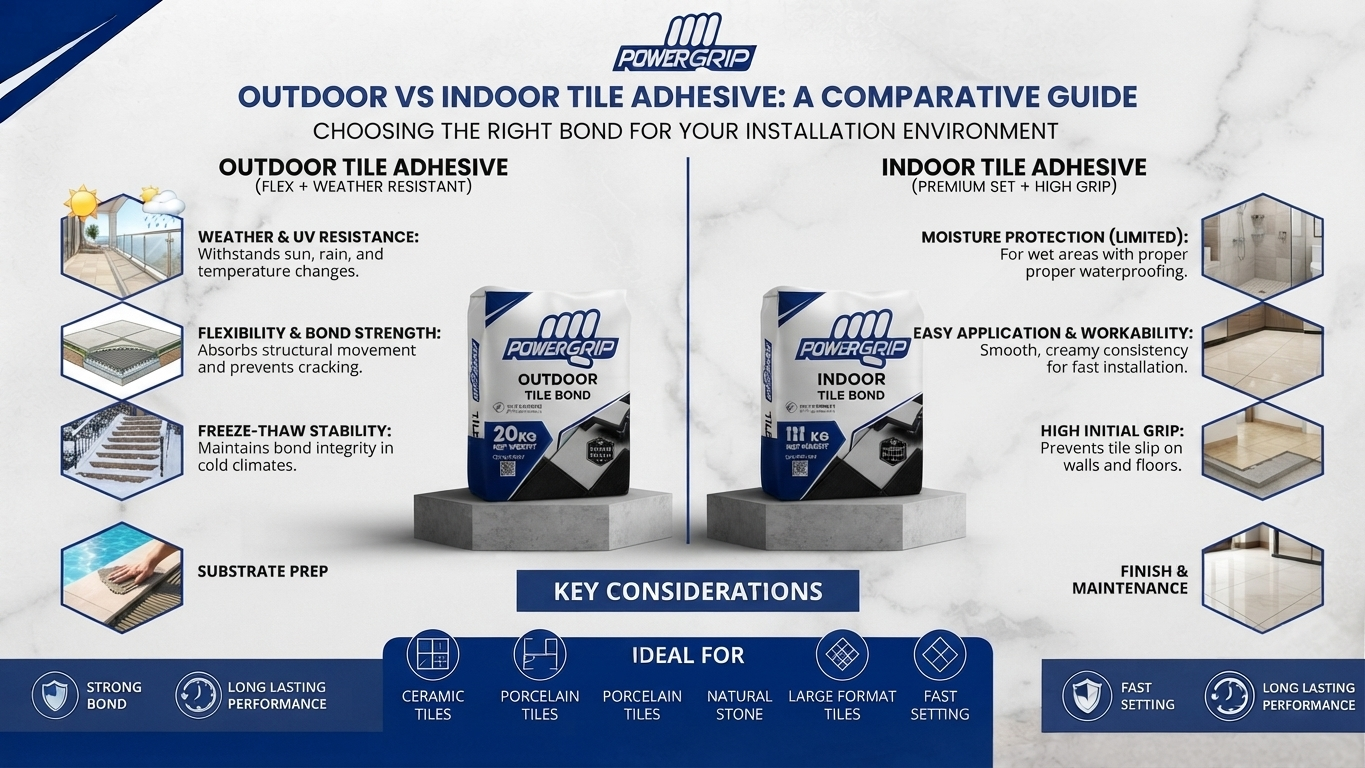
Outdoor Tile Adhesive vs Indoor Tile Adhesive
The main difference is the environmental conditions the adhesive is expected to handle.
Factor | Indoor Tile Adhesive | Outdoor Tile Adhesive |
Typical exposure | Mostly protected | Sun, rain, and temperature changes |
Moisture exposure | Usually lower | Can be significantly higher |
Thermal movement | Generally lower | Can be more significant |
Flexibility needs | Depends on surface | Often more important |
Suitable applications | Rooms and interior areas | Terraces, balconies and exterior areas |
Selection priority | Tile and substrate | Tile, substrate and environmental exposure |
This does not mean every outdoor project automatically needs the same type of adhesive.
Product specifications and project conditions should always be checked.
What Are the Benefits of Using a Suitable Outdoor Adhesive?
A properly selected adhesive can provide several practical advantages.
Better Tile Bonding
The primary purpose of tile adhesive is to create a bond between the tile and substrate.
An adhesive selected for the application helps reduce the possibility of premature bond failure.
Better Performance in Exterior Conditions
Outdoor installations experience weather exposure that indoor installations may not.
A suitable exterior product is designed with those conditions in mind.
Suitable for Different Tile Types
Different tiles have different characteristics. Porcelain, ceramic, natural stone, and large format tiles may require different adhesive considerations.
Improved Installation Quality
Using the correct adhesive is only one part of a successful installation, but it can contribute to better overall performance when combined with proper surface preparation, mixing, application, grouting, and curing.
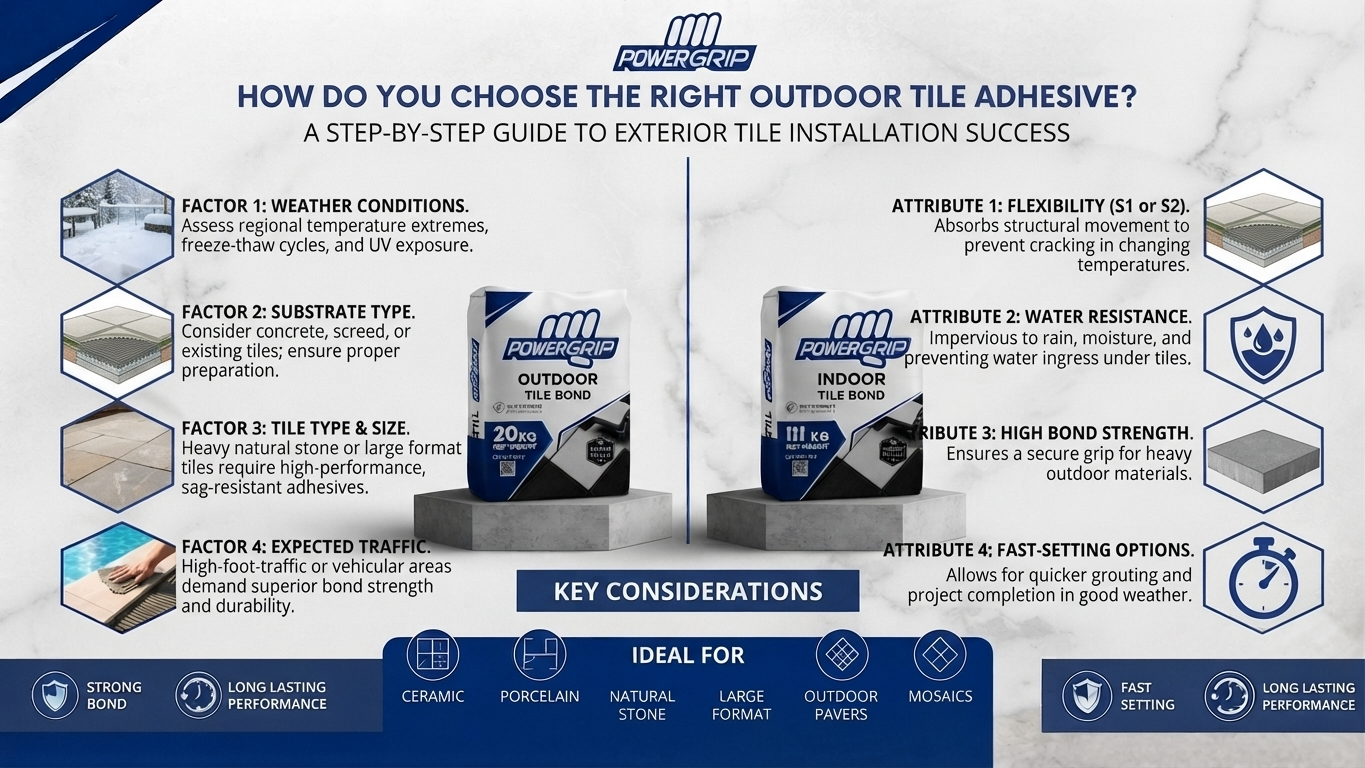
How Do You Choose the Right Outdoor Tile Adhesive?
Choosing an adhesive should start with the project rather than the product name.
1. Check the Tile Type
First identify the tile. Ceramic and porcelain tiles have different characteristics, and natural stone may have additional requirements.
For large format or low absorption tiles, check whether the adhesive is specifically suitable for that application.
2. Check the Substrate
The surface beneath the tile is equally important. It could be concrete, cement plaster, screed, masonry, an existing tiled surface, or another material.
A product suitable for one substrate may not be suitable for another.
3. Consider Water Exposure
An outdoor area exposed to heavy rain needs different consideration from a covered exterior area.
If the location remains wet for long periods, check the adhesive’s suitability for that environment.
4. Consider Temperature and Sun Exposure
In Karachi, exterior surfaces can experience strong sunlight and significant heating.
A rooftop or exposed terrace can therefore place greater thermal stress on the tile installation.
Choose a product whose technical information supports the intended exterior application.
5. Consider Tile Size
Large format tiles can require more careful adhesive selection and installation.
Coverage beneath the tile becomes particularly important because empty areas can increase the risk of problems.
6. Follow the Manufacturer’s Instructions
Always check the technical data sheet, recommended substrate, mixing instructions, application thickness, open time, curing requirements, and other stated limitations.
For contractors, this step is especially important because product specifications can differ between adhesive formulations.
How Is Outdoor Tile Adhesive Applied?
A good adhesive cannot compensate for poor surface preparation. Installation quality plays a major role in the final performance of the tile system.
The basic process usually includes surface preparation, mixing, application, tile placement, adjustment, and curing.
Prepare the Surface
The substrate should be suitable for tile installation and free from loose material, excessive dust, grease, and other contaminants that could interfere with bonding.
Major cracks, weak areas, or structural problems should be addressed before tile installation.
Mix Correctly
If the adhesive is supplied as a powder, mix it with the specified amount of clean water according to the manufacturer’s instructions.
Adding too much water can change the material’s consistency and performance.
Contractors should avoid estimating water quantities casually on site.
Apply the Adhesive Properly
A suitable notched trowel is commonly used to create an even adhesive bed.
The objective is to achieve appropriate contact between the adhesive and tile.
For larger tiles, the installation method may require additional attention to coverage.
Place the Tiles
Place each tile into the adhesive while it is within the product’s recommended working time.
Press and adjust the tile appropriately rather than allowing the adhesive to dry before placement.
Allow Proper Curing
Avoid putting unnecessary load or traffic on newly installed tiles until the adhesive has developed sufficient strength according to the manufacturer’s instructions.
Common Mistakes Contractors Should Avoid
Even a good adhesive can perform poorly when installation practices are incorrect.
Some common problems include using an interior adhesive outdoors, mixing with excessive water, applying over a dusty surface, and ignoring the manufacturer’s coverage or curing instructions.
Another frequent mistake is selecting adhesive only according to the tile price or adhesive price.
A cheaper product may not be economical if tile failure leads to removal, replacement, labor costs, and project delays.
Contractors should also avoid assuming that all outdoor surfaces are identical.
A rooftop, balcony, exterior wall, and pool surround can have different technical requirements.
What Should Shop Owners Check Before Recommending an Adhesive?
Shop owners often help contractors and homeowners choose construction materials.
Instead of recommending a product only because it is popular or inexpensive, ask a few basic questions about the project.
Useful questions include:
- Where will the tiles be installed?
- Is the area exposed to rain or direct sunlight?
- What type of tile is being used?
- What is the tile size?
- What type of substrate is underneath?
- Is the surface new or an existing tiled surface?
- Is the area subject to heavy traffic or moisture?
These details can help narrow the product selection and reduce the chance of recommending an unsuitable adhesive.
For businesses sourcing tile fixing materials in Pakistan, Powergrip.pk can also be considered when reviewing available adhesive products and product information.
Always check the specific product documentation to confirm whether it matches the intended outdoor application.
Outdoor Tile Adhesive Selection: Quick Comparison
Project condition | What to prioritize |
Covered balcony | Exterior suitability and tile compatibility |
Open terrace | Exterior suitability, moisture resistance and movement considerations |
Large porcelain tiles | Product compatibility, coverage and installation method |
Exterior wall tiles | Bond strength, tile weight and vertical application suitability |
High moisture area | Moisture exposure suitability and correct substrate preparation |
Heavy traffic outdoor area | Appropriate adhesive, substrate preparation and installation quality |
The table is a starting point rather than a substitute for product technical documentation.
How Does Karachi’s Climate Affect Outdoor Tile Installation?
Karachi’s coastal environment and hot weather make exterior tile installation a practical concern for contractors and building material suppliers.
Outdoor surfaces can experience strong sunlight, heat, dust, humidity, and seasonal rain.
This means product selection should account for the actual environment rather than treating an exterior installation like an indoor floor.
For example, an exposed rooftop may experience much more heat and moisture than a shaded veranda.
Contractors should therefore assess the location before selecting the adhesive and follow the product manufacturer’s application requirements.
How Can You Improve Outdoor Tile Installation Quality?
The adhesive is only one part of the complete tile system.
The substrate, tile, adhesive, grout, joints, drainage, and installation technique all influence performance.
Good drainage is particularly important for exterior areas.
Water should not be allowed to remain unnecessarily on the tiled surface or enter areas where it can cause damage.
Movement joints should also be considered in appropriate exterior installations because large surfaces can experience movement caused by temperature changes and other factors.
When a project has unusual substrate conditions, large format tiles, heavy exposure, or significant moisture, professional technical guidance can help determine the appropriate installation system.
Key Things to Check Before Buying
Before purchasing an exterior tile adhesive, check the following:
- Confirm that the product is specifically suitable for the intended outdoor application.
- Check compatibility with the tile and substrate.
- Review the manufacturer’s mixing, application, coverage, and curing instructions.
- Consider rain, sunlight, temperature changes, and expected traffic.
- For large or technically demanding tiles, verify that the adhesive is suitable for the application.
- Buy according to technical requirements rather than price alone.
Frequently Asked Questions
What is the best adhesive for outdoor tiles?
There is no single best adhesive for every outdoor project.
The right choice depends on the tile, substrate, moisture exposure, tile size, temperature conditions, and manufacturer’s application recommendations.
An adhesive specifically rated for exterior use is generally more appropriate than a product intended only for indoor applications.
Can normal tile adhesive be used outdoors?
Only if the manufacturer specifically states that the product is suitable for exterior use.
Indoor adhesive should not automatically be used outdoors because exterior installations can experience greater moisture, temperature changes, and movement.
Is flexible adhesive better for outdoor tiles?
A flexible adhesive can be useful where the installation may experience movement or thermal stress.
However, flexibility alone does not determine suitability.
The adhesive should also be compatible with the tile, substrate, moisture conditions, and intended application.
Can outdoor tile adhesive be used for porcelain tiles?
Some outdoor adhesives are suitable for porcelain tiles, but this should be confirmed from the product specifications.
Porcelain generally has low water absorption, so choosing an adhesive designed for the specific tile and installation conditions is important.
How long does outdoor tile adhesive take to cure?
Curing time varies according to the adhesive formulation, temperature, humidity, substrate, tile type, and manufacturer’s instructions.
Contractors should follow the curing and traffic recommendations supplied with the specific product rather than relying on a universal time.
Can outdoor tiles be installed directly after rain?
The surface and substrate need to meet the adhesive manufacturer’s requirements before installation.
Excess moisture, standing water, or an unsuitable substrate condition can affect bonding.
The installer should assess the surface before starting work.
What adhesive should I use for outdoor terrace tiles?
For terrace tiles, choose a product specifically suitable for exterior floor applications and compatible with the tile and substrate.
Exposure to rain, sunlight, temperature changes, and foot traffic should all be considered before selecting the product.
Where can I find outdoor tile adhesive in Karachi?
Building material suppliers and construction product retailers in Karachi commonly stock tile fixing materials.
Buyers should compare the product’s intended applications, technical information, packaging instructions, and suitability for their specific project.
Powergrip.pk is one source that can be reviewed when looking for tile adhesive products in Pakistan.
Conclusion
Choosing the right outdoor tile adhesive is an important part of creating a durable exterior tile installation.
Contractors should consider the tile type, substrate, tile size, moisture exposure, sunlight, temperature changes, traffic, and installation method before selecting a product.
For shop owners, asking customers about the project location and tile type can lead to more suitable product recommendations.
In Karachi, outdoor conditions make it especially useful to select an adhesive designed for exterior applications rather than assuming that a standard indoor product will perform the same way.
Products from suppliers such ashttps://powergrip.pk/ can be evaluated based on their stated technical specifications and intended applications.
The final choice should always match the requirements of the particular project.