

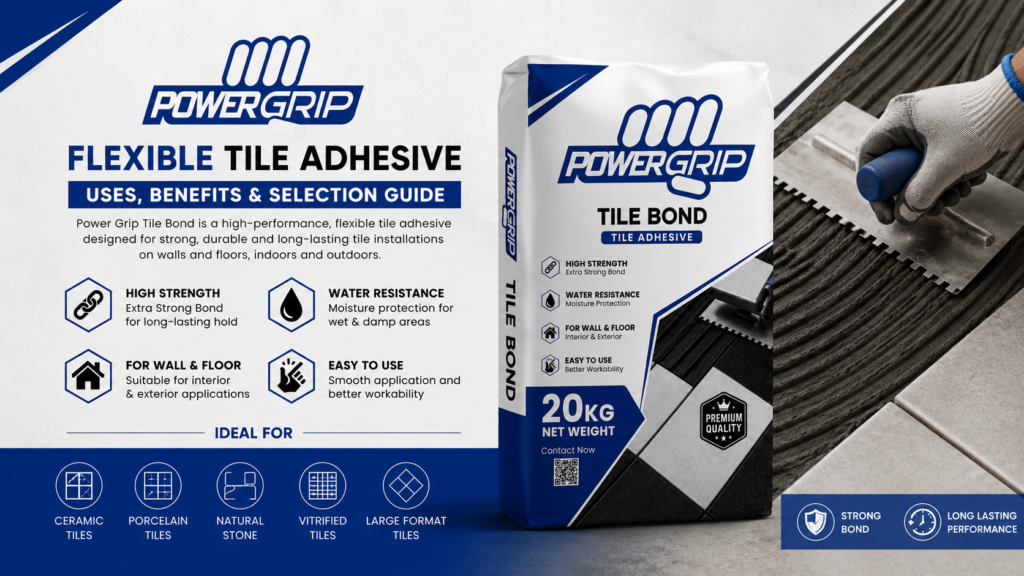
Flexible tile adhesive is a bonding material formulated to secure tiles while accommodating limited movement and stress between the tile and the underlying surface.
Compared with basic rigid bonding methods, a suitable flexible adhesive can be useful for porcelain tiles, large-format tiles, exterior surfaces, wet areas, and substrates exposed to temperature changes or minor movement.
The word “flexible” does not mean the adhesive remains soft after curing. Instead, it generally refers to the adhesive’s ability to deform to a specified degree without losing its bond. Under EN 12004 classifications, for example, deformable cementitious adhesives may carry an S1 classification, while products with greater deformability may be classified S2.
For construction and renovation projects in Karachi, adhesive selection deserves particular attention because tile type, substrate condition, exterior heat exposure, moisture, tile dimensions, and installation location can all affect the finished system.
This guide explains what flexible tile adhesive is, how it works, where it can be used, how it differs from conventional tile bonding methods, and what to check before selecting and applying a product.
What Is Flexible Tile Adhesive?
Flexible tile adhesive is an adhesive designed to bond tiles to a prepared substrate while tolerating a degree of deformation caused by temperature changes, substrate movement, loading, or differences in movement between the tile and its base.
Its exact performance depends on its formulation and tested classification.
Many modern flexible adhesives are cement-based and polymer-modified, although other adhesive technologies are also available for specialized applications.
Once properly mixed and applied, cementitious adhesive forms a bonding layer between the substrate and tile.
The formulation is designed to provide the adhesion and application characteristics required for its intended use.
Flexibility becomes particularly relevant when the tile and substrate do not behave identically.
Exterior tiles, for example, can heat up in sunlight and cool later.
Different materials may expand and contract at different rates, creating stresses within the tile assembly.
A suitable deformable adhesive can help accommodate some of these stresses.
It should not, however, be treated as a solution for structural instability, excessive substrate movement, missing movement joints, serious cracks, or poor surface preparation.
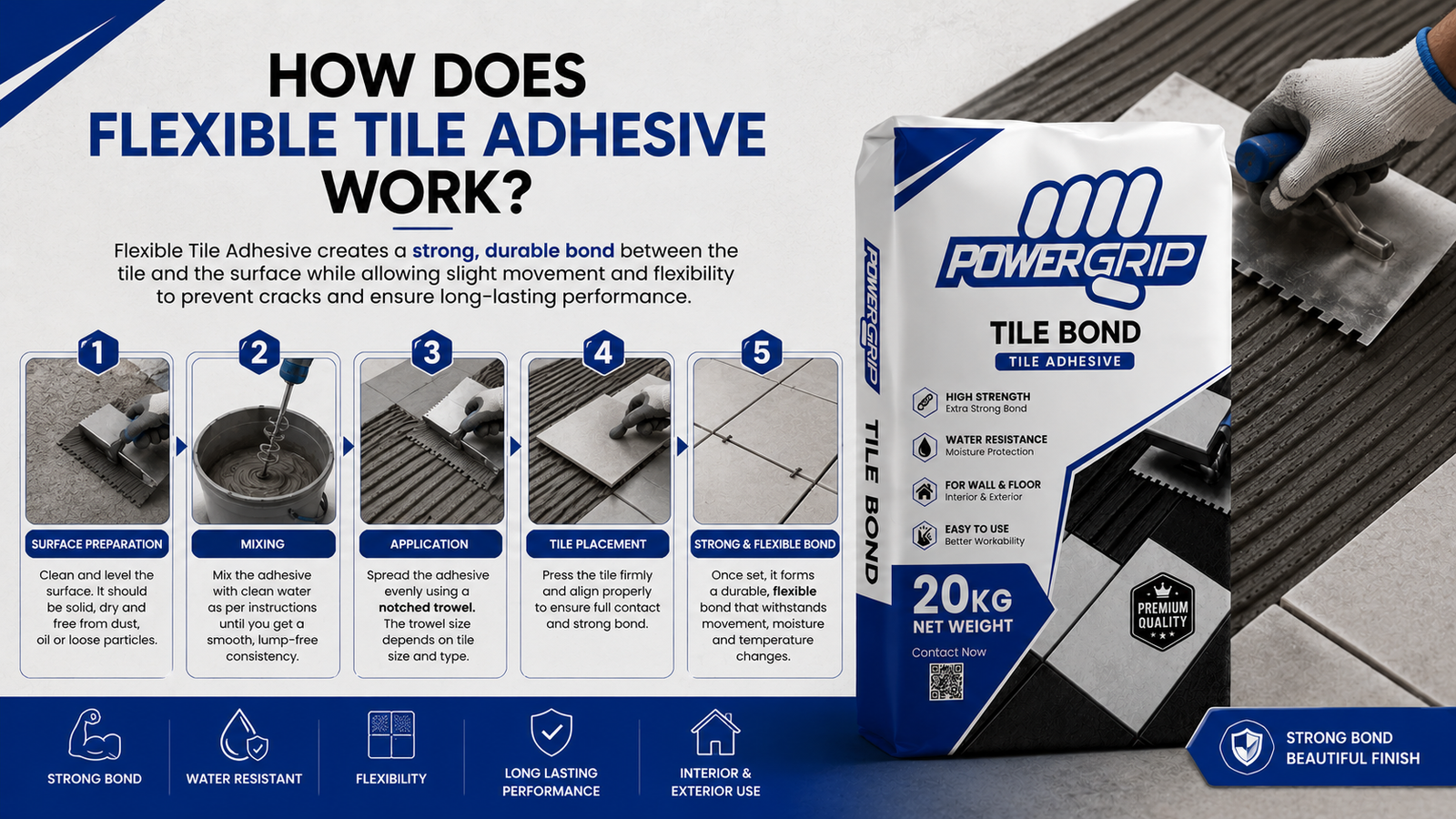
How Does Flexible Tile Adhesive Work?
Flexible tile adhesive creates a continuous bonding layer between the tile and prepared substrate.
Polymer modification and other formulation characteristics can improve adhesion and allow certain products to accommodate deformation after curing, helping the tiled system deal with stresses that a less deformable bonding material may not tolerate as effectively.
The adhesive is normally spread over the prepared surface with an appropriate notched trowel.
Tile size, substrate flatness, tile backing and installation requirements influence the appropriate trowel and application technique.
For larger tiles, back-buttering or double-spreading may be recommended to improve adhesive contact.
Sika, for example, recommends double spreading for tiles larger than 900 cm² in guidance for one of its S1 flexible adhesives.
Correct coverage matters because large empty areas behind a tile can reduce support.
Simply using a product labelled “flexible” cannot compensate for poor application.
Why Is Flexibility Important in Tile Installation?
Tiles are rigid finishes, but the building surfaces underneath them are not always completely static.
Temperature changes can cause materials to expand and contract. Concrete, screed, waterproofing systems, façades, balconies, and other substrates may experience different stresses over time.
Large tiles can introduce additional installation challenges because of their dimensions and the contact area required behind them.
Exterior surfaces deserve particular consideration. Solar exposure can heat tile finishes significantly, and the amount of thermal movement can vary with factors such as orientation and tile colour.
Technical guidance for façade systems therefore emphasizes adhesive deformability when differential movement creates stresses in the assembly.
Flexible adhesive is only one part of the solution.
Correct substrate preparation, suitable grout, movement joints, waterproofing where necessary, proper adhesive coverage, and good workmanship remain important.
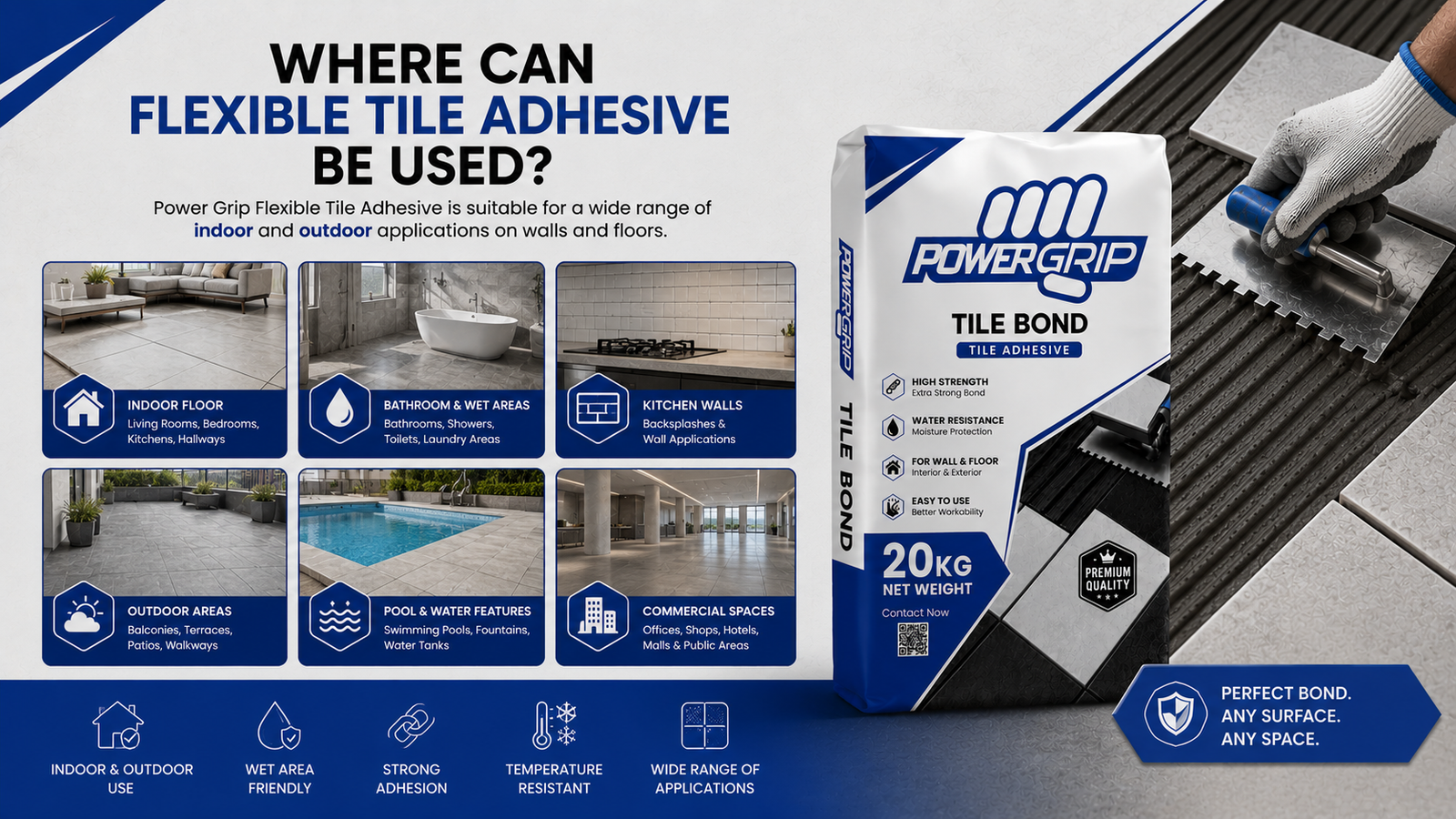
Where Can Flexible Tile Adhesive Be Used?
The appropriate applications depend on the individual product rather than the words “flexible tile adhesive” alone.
Always check the manufacturer’s current technical data sheet before installation.
Depending on its formulation and classification, a flexible adhesive may be considered for ceramic or porcelain tiles, floors and walls, larger tile formats, wet areas, balconies, terraces, exterior installations, and certain compatible waterproofed surfaces.
Some flexible products are specifically designed for demanding tile installations. Industry manufacturers offer deformable cementitious adhesives for applications involving large-format tiles, porcelain, exterior areas, façades, and other situations where greater performance may be required.
This does not mean every flexible adhesive is suitable for every one of these applications.
Natural stone, swimming pools, façades, tile-over-tile work, waterproofing membranes, heated floors, and unusual substrates can have specific compatibility requirements.
Flexible Tile Adhesive vs Standard Tile Adhesive
The most useful comparison is based on tested product performance rather than marketing terminology.
Two bags carrying different brand names can have substantially different characteristics even if both are described as tile adhesive.
Factor | Standard / Basic Tile Adhesive | Flexible / Deformable Tile Adhesive |
Primary purpose | General tile bonding within stated applications | Tile bonding where additional deformability may be required |
Ability to accommodate movement | Depends on formulation and classification | Designed to provide a defined or enhanced level of deformability |
Large-format tiles | Product-specific | Often available in formulations intended for larger tiles |
Exterior use | Only when specifically approved | Many products are designed for exterior applications, but approval must be checked |
Porcelain tiles | Depends on adhesion classification | Higher-performance products are commonly available for low-absorption porcelain |
Wet areas | Product-specific | May be suitable when approved by the manufacturer |
Selection | Based on tile, substrate and environment | Based on the same factors plus required deformability |
A flexible adhesive is therefore not automatically “better” for every project.
The correct product is the one whose tested properties and manufacturer-approved applications match the installation.
What Do C1, C2, S1 and S2 Mean?
EN 12004 classifications provide a more meaningful way to evaluate cementitious tile adhesives than relying only on words such as “strong” or “flexible.”
In this system, C identifies cementitious adhesive, C1 and C2 distinguish adhesion performance categories, while S1 and S2 indicate levels of deformability.
For deformability, EN 12004-based technical documentation describes S1 as deformable and S2 as highly deformable.
One technical guide explains S1 as transverse deformation from 2.5 mm to 5 mm and S2 as deformation greater than 5 mm under the applicable test method.
You may also encounter additional letters. For example, “T” can indicate reduced slip and “E” extended open time.
A product classified C2TE S1 therefore communicates considerably more about tested characteristics than the generic description “flexible adhesive.”
The classification needed for a project should be determined from the tile type, dimensions, substrate, location, environmental exposure, and system requirements.
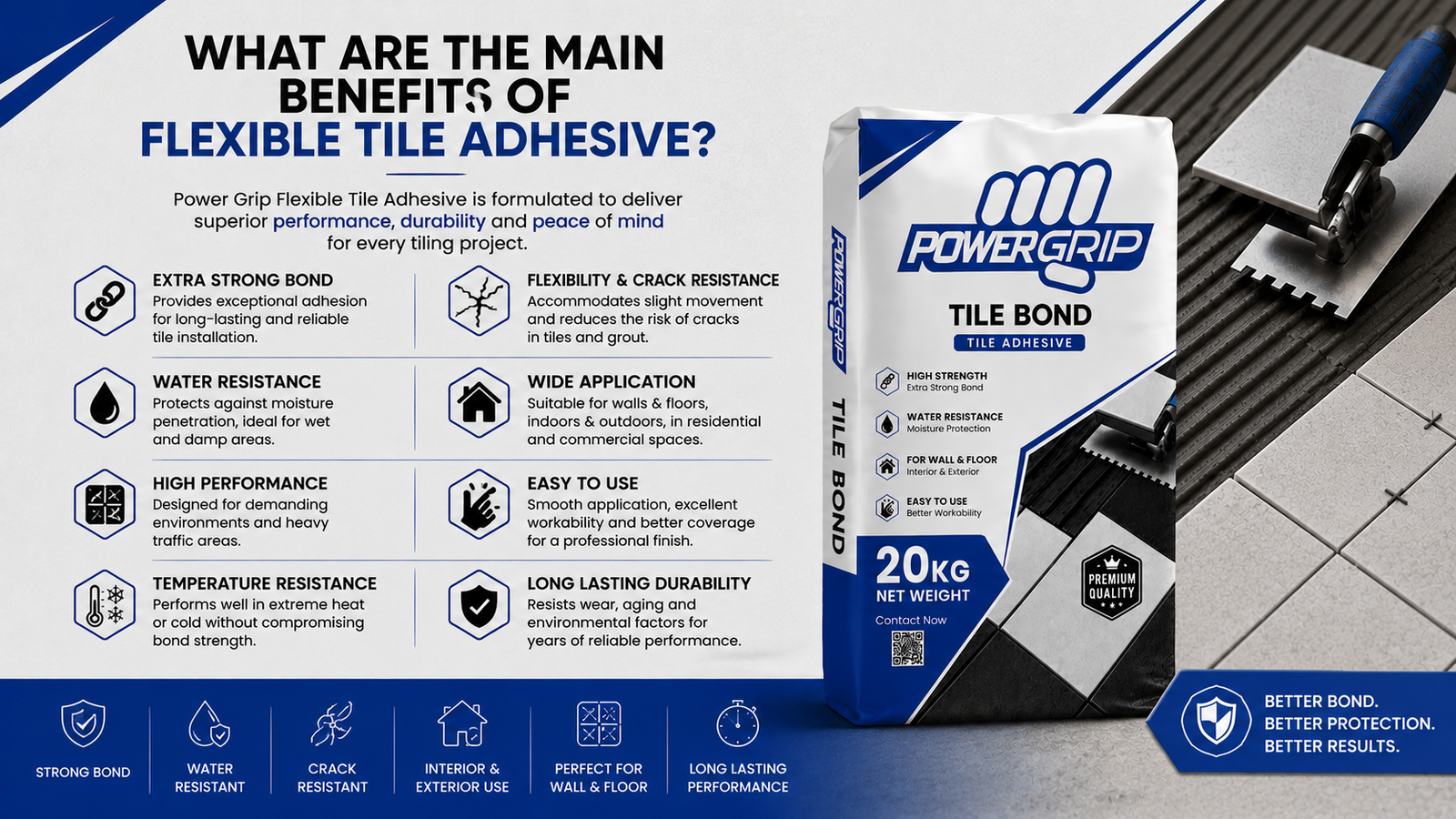
What Are the Main Benefits of Flexible Tile Adhesive?
When correctly specified, flexible tile adhesive can improve the reliability of demanding tile installations.
Its practical benefits depend on the product and application.
Key potential advantages include:
- Accommodation of limited movement: Deformable formulations can better tolerate certain stresses between tiles and substrates.
- Suitability for demanding tile types: Higher-performance adhesives are commonly formulated for dense, low-absorption materials such as porcelain.
- Support for large-format installation: Products intended for large tiles can provide appropriate bonding characteristics when combined with correct troweling and coverage.
- Indoor and outdoor options: Certain flexible adhesives are designed for both interior and exterior applications.
- Compatibility with specialized systems: Depending on the product, flexible adhesives may form part of systems involving waterproofing membranes, wet areas, balconies, façades or other demanding installations.
These advantages depend on correct product selection and application. “Flexible” should never be interpreted as permission to ignore substrate condition or installation instructions.
Is Flexible Adhesive Better for Porcelain and Large-Format Tiles?
Flexible or high-performance polymer-modified adhesives are often appropriate for porcelain and large-format tiles, but selection should be based on the manufacturer’s approved tile sizes, substrate and application.
Dense porcelain absorbs very little water, while larger tiles make full adhesive contact and substrate flatness especially important.
Porcelain’s low absorption is one reason appropriate adhesive performance matters. Sika’s tile-system guidance, for example, describes polymer-modified adhesive systems for non-absorbent porcelain materials and higher-stress installations.
Large-format tiles create another issue: coverage. The larger the tile becomes, the more important it is to achieve suitable adhesive contact and avoid unsupported areas.
For this reason, double-spreading or back-buttering is frequently specified for larger formats.
The precise technique, trowel size, adhesive bed and coverage requirement should follow the tile and adhesive manufacturer’s instructions.
Surface Preparation Matters as Much as Adhesive Selection
Even a high-performance adhesive can fail when installed over an unsuitable surface.
The substrate generally needs to be sound, sufficiently stable, clean, and prepared according to the adhesive system requirements.
Dust, oil, grease, loose material, old coatings, or other bond-breaking contamination can interfere with adhesion.
Flatness is particularly important with larger tiles.
Trying to correct substantial surface irregularities by simply adding excessive adhesive during installation can produce inconsistent bedding and poor results.
Cracks also require investigation.
A flexible adhesive is not a substitute for structural repair. If cracking is active, substantial, or related to movement in the structure, the underlying cause should be assessed before tiling begins.
Manufacturer guidance similarly emphasizes structurally sound, clean substrates and the correct provision of movement joints rather than relying on adhesive to handle unrestricted building movement.
How to Apply Flexible Tile Adhesive Correctly
Flexible tile adhesive should be applied to a clean, properly prepared substrate using the mixing ratio, notched trowel, bed thickness, working time, and curing instructions specified by its manufacturer.
Large-format installations may also require adhesive on the back of the tile to achieve adequate contact.
Although individual products differ, the installation process generally begins with substrate inspection and preparation.
Powder adhesives are then mixed with the specified amount of clean water or approved liquid component.
Avoid guessing the water ratio.
Too much or too little water can change workability and may affect the properties of the cured adhesive.
Spread the adhesive with the correct notched trowel and work only over an area that can be tiled within the product’s open time.
Tiles need to be embedded while the adhesive is still capable of achieving proper transfer.
For large tiles, inspect coverage during installation by occasionally lifting a tile.
This helps determine whether the troweling and bedding technique is achieving adequate contact.
Do not add water to adhesive that has already begun to set unless the manufacturer’s instructions specifically permit a particular remixing procedure.
Common Tile Adhesive Mistakes to Avoid
Many tile failures blamed on the adhesive are influenced by specification, substrate or workmanship.
Common problems include selecting adhesive only by price, installing over dusty or contaminated surfaces, ignoring the manufacturer’s mixing ratio, using an unsuitable trowel, allowing adhesive to skin before placing tiles, and failing to obtain sufficient contact behind large-format tiles.
Other mistakes include treating flexible adhesive as crack repair, ignoring movement joints, tiling before a substrate has reached the required condition, and assuming one product can be used on every substrate.
Waterproofing is another area where confusion occurs.
A tile adhesive should not automatically be assumed to function as a waterproofing membrane. In bathrooms, balconies, pools and other water-exposed environments, waterproofing and tile bonding may be separate components of the complete installation system.
Flexible Tile Adhesive for Karachi Construction Projects
Karachi projects can include apartments, houses, commercial buildings, façades, terraces, bathrooms, kitchens and other tiled areas with very different installation conditions.
Exterior tile work can experience substantial sunlight and temperature variation.
Indoor installations may involve porcelain tiles, increasingly large tile formats, wet areas or renovation surfaces.
These factors make product selection more important than simply choosing a generic tile bonding material.
For a project in Karachi, consider the complete system:
tile material and dimensions, wall or floor location, indoor or outdoor exposure, substrate, waterproofing requirements, movement joints and expected environmental conditions.
Products available through suppliers such as Power Grip should be assessed using their current product documentation and technical recommendations.
Before using a Power Grip product for a specific application, confirm its stated tile compatibility, suitable substrates, mixing instructions, coverage, application limitations, and curing requirements rather than assuming performance from the product category alone.
How Do You Choose the Right Flexible Tile Adhesive?
Choose flexible tile adhesive by matching the product’s tested performance and approved applications with your tile, substrate, tile dimensions, and installation environment. For demanding applications, classification, deformability, open time, slip resistance, and manufacturer-approved uses provide more useful information than marketing descriptions alone.
Start with the tile. Ceramic, porcelain, glass mosaic, and natural stone can have different bonding requirements.
Large-format porcelain requires different installation considerations from a small ceramic wall tile.
Next, examine the substrate. Concrete, cement screed, rendered masonry, waterproofing membranes, existing tile, and other surfaces cannot automatically be treated the same way.
Finally, consider exposure. Ask whether the installation is indoors or outdoors, dry or wet, exposed to direct sunlight, subject to temperature changes, or expected to experience significant movement or loading.
For unusual substrates, exterior façades, swimming pools, very large tiles, or technically demanding projects, consulting the adhesive manufacturer, architect, engineer, or experienced tile-installation professional can reduce the risk of specifying an unsuitable system.
Does Flexible Tile Adhesive Prevent Tiles From Cracking?
Flexible adhesive can accommodate a limited amount of deformation, but it cannot guarantee that tiles will never crack.
Tile cracking may originate from substrate cracking, structural movement, impact, inadequate movement joints, poor installation, unsupported areas beneath tiles, or other causes.
Adhesive is only one component of the tiled assembly.
Where significant cracks or movement already exist, identifying and correcting the underlying problem is more important than simply changing adhesive.
Frequently Asked Questions
Is flexible tile adhesive stronger than normal tile adhesive?
Not necessarily in every sense. Flexible adhesive is formulated to provide particular bonding and deformation characteristics. Compare tested classifications and intended applications rather than assuming “flexible” automatically means stronger.
Can flexible tile adhesive be used outdoors?
Some flexible adhesives are specifically approved for exterior use. Check the technical data sheet because outdoor suitability varies by product, substrate, tile and exposure conditions.
Is flexible tile adhesive suitable for porcelain tiles?
Many polymer-modified flexible adhesives are designed for porcelain and other low-absorption tiles. Confirm that the specific product lists porcelain as an approved tile type.
Can I use flexible tile adhesive for large tiles?
Many flexible adhesives are formulated for large-format tiles. Large tiles may also require a specific trowel, substrate flatness, and back-buttering or double-spreading technique.
Is flexible tile adhesive waterproof?
Do not assume it is. Some products tolerate wet environments, but tile adhesive does not automatically replace a dedicated waterproofing membrane or complete waterproofing system.
What is S1 flexible tile adhesive?
S1 is a deformability classification under EN 12004-related testing. It identifies a cementitious adhesive capable of a defined level of transverse deformation.
What is the difference between S1 and S2 adhesive?
S1 adhesives are classified as deformable, while S2 adhesives provide a higher level of deformability under the relevant EN 12004 test method. The required class depends on the installation system and expected stresses.
Can flexible adhesive fix a cracked floor?
It should not be treated as a general repair for an unstable or structurally cracked substrate. The cause and condition of the crack should be evaluated and the surface appropriately repaired or treated before tile installation.
Conclusion
Flexible tile adhesive can be an important part of a reliable tile installation when the project involves porcelain, large-format tiles, exterior exposure, temperature changes or substrates where additional deformability is required.
Its value comes from choosing the correct performance class and using it as part of a properly designed tile system.
For projects in Karachi, consider more than the adhesive label.
Tile size and material, substrate preparation, environmental exposure, waterproofing, movement joints, adhesive coverage, and installation technique all affect long-term performance.
When evaluating products from Power Grip or another manufacturer, check the current technical data for the exact product and match it to the intended application.
Correct specification and workmanship are ultimately more important than simply choosing an adhesive described as “flexible.”