
Choosing the right tile adhesive can have a major impact on the strength, durability, and appearance of a tiled surface.
Polymer Modified Tile Adhesive is designed to provide stronger bonding and improved flexibility compared with many conventional cement-based adhesives.
It can be used for a range of ceramic and porcelain tile applications when the product and installation method match the surface conditions.
In Pakistan, including Karachi, tile installations may face heat, humidity, moisture, temperature changes, and different substrate conditions.
These factors make adhesive selection especially important for floors, walls, kitchens, bathrooms, balconies, and other tiled areas.
This guide explains what polymer-modified tile adhesive is, how it works, where it is used, its advantages and limitations, how to select the right product, and what mistakes to avoid.
What Is Polymer Modified Tile Adhesive?
Polymer modified tile adhesive is a cement-based adhesive enhanced with polymer additives that improve properties such as adhesion, flexibility, workability, water resistance, and durability.
The polymers help the adhesive maintain a stronger bond between the tile and substrate under conditions where ordinary cement-based bonding materials may be less suitable.
The exact performance depends on the formulation, tile type, substrate, application method, curing conditions, and manufacturer’s instructions.
Instead of relying only on cement and mineral components, polymer modified formulations use additives that modify the adhesive’s bonding and flexibility characteristics.
How Does Polymer Modification Improve Tile Adhesive?
Polymer additives can improve several important characteristics of a tile adhesive.
They may help the adhesive:
- Bond more effectively to suitable substrates
- Accommodate limited movement between surfaces
- Improve workability during installation
- Reduce the risk of weak bonding when correctly applied
- Perform better in selected damp or demanding applications
- Provide better adhesion for certain ceramic and porcelain tiles
This does not mean every polymer modified adhesive is suitable for every installation. Product classification, technical specifications, substrate preparation, and installation conditions still matter.
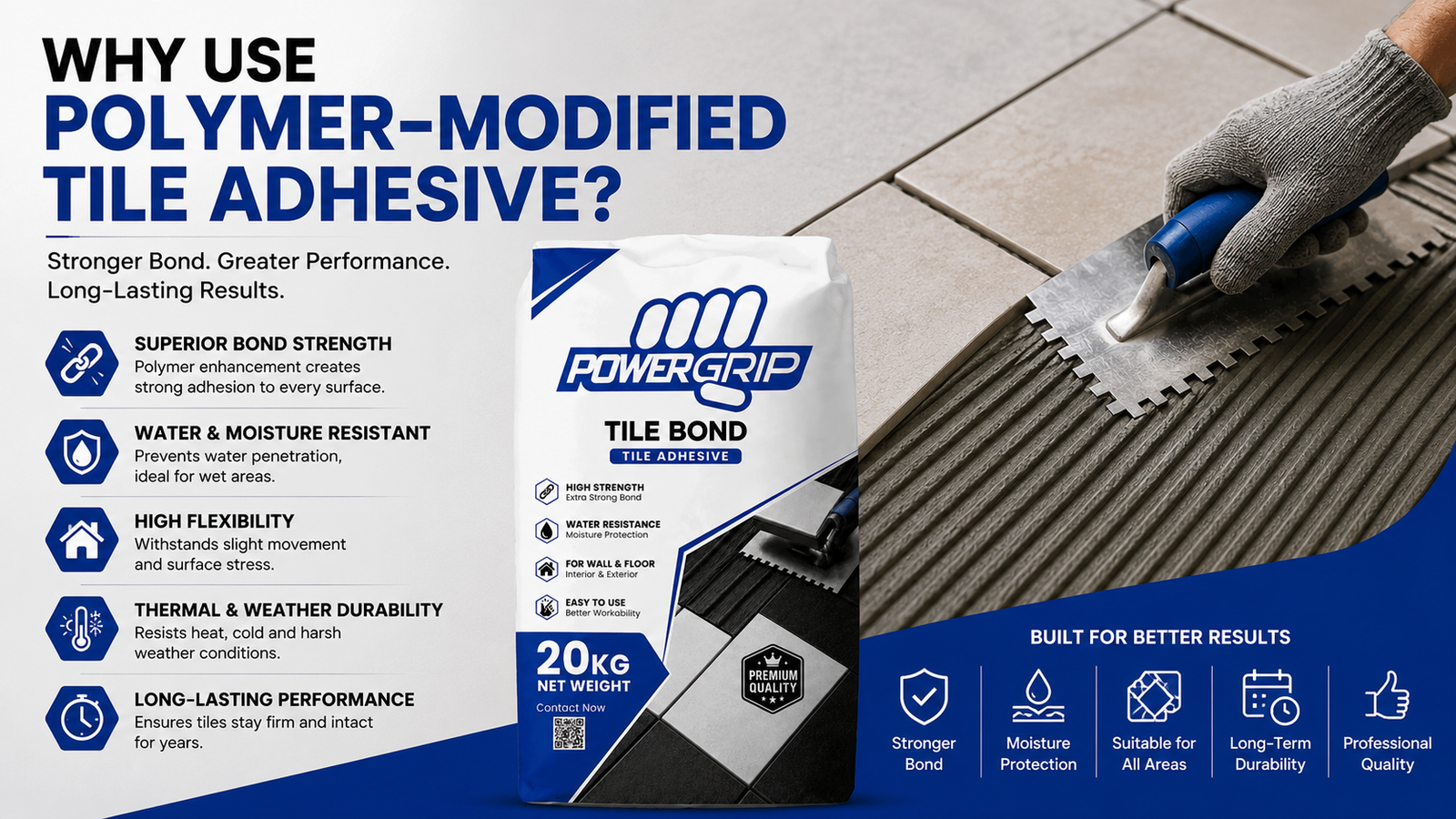
Why Use Polymer-Modified Tile Adhesive?
Tile surfaces are exposed to different stresses depending on where they are installed. A residential floor, bathroom wall, kitchen backsplash, balcony, and commercial floor may all require different adhesive characteristics.
A polymer modified formulation can be useful when an installation requires better adhesion and some degree of flexibility than a basic cement-based adhesive may provide.
For example, porcelain tiles generally have low water absorption. This can make achieving a reliable bond more demanding than bonding some traditional ceramic tiles.
A suitable polymer modified adhesive can provide the bonding characteristics needed for the particular tile and substrate.
Where Is Polymer Modified Tile Adhesive Used?
Polymer modified tile adhesives can be used in many residential and commercial applications, provided the selected adhesive is rated for the intended conditions.
Common applications include:
Floor Tiles
A Polymer Modified Tile Adhesive for Floor Tiles can be suitable where the adhesive needs to provide reliable bonding between tiles and a properly prepared floor substrate.
Floor installations can experience regular foot traffic, vibration, temperature changes, and mechanical stress.
The adhesive should therefore be selected according to the tile size, substrate, location, and expected traffic.
Ceramic Tiles
Ceramic tiles are commonly installed on floors and walls. A suitable polymer modified adhesive can provide a practical bonding solution for many ceramic tile installations.
The adhesive should still be selected according to the tile manufacturer’s recommendations and the surface being tiled.
Porcelain Tiles
Porcelain tiles have low porosity and are often heavier and denser than conventional ceramic tiles. Because of this, the adhesive needs to provide appropriate bonding performance.
A Flexible Tile Adhesive for Ceramic & Porcelain Tiles may be considered where the product specifications support these applications.
Bathrooms and Wet Areas
Bathrooms require careful consideration because water exposure can affect the overall installation.
A Waterproof Polymer Modified Tile Adhesive may be appropriate for specific applications if the product is actually rated for wet conditions.
However, tile adhesive alone should not automatically be treated as a complete waterproofing system.
In wet areas, waterproofing behind or beneath the tiled surface may also be necessary, depending on the construction and application.
Kitchens
Kitchens may experience moisture, heat, cleaning, and regular use. A suitable adhesive can help provide a durable tile installation when the substrate is properly prepared.
Balconies and Outdoor Areas
Outdoor tiling can experience heat, rain, moisture, and temperature changes. Adhesive selection becomes particularly important in these environments.
Not every polymer modified adhesive is intended for exterior use, so the product’s technical documentation should be checked before installation.
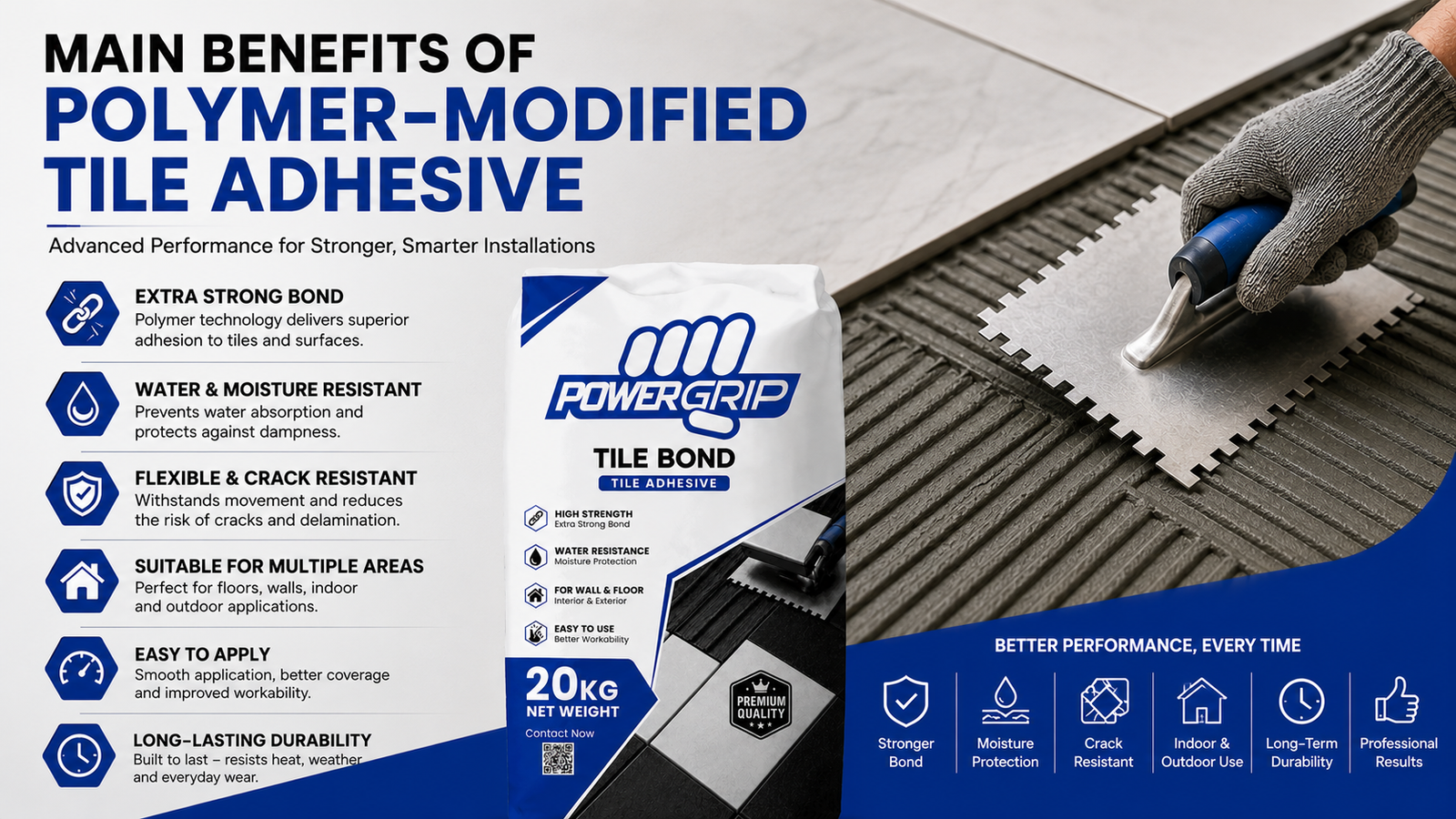
Main Benefits of Polymer-Modified Tile Adhesive
Polymer-modified formulations offer several potential benefits when the right product is selected and installed correctly.
Better Adhesion
One of the main reasons to use polymer modified adhesive is improved bonding performance. The polymer component can help create stronger adhesion between compatible tiles and substrates.
This can be particularly useful for dense tile materials and demanding installation conditions.
Improved Flexibility
Some polymer modified adhesives can accommodate limited movement in the tile assembly better than rigid traditional cement-based materials.
This characteristic can be useful where minor movement or thermal changes are expected.
However, flexibility does not mean that the adhesive can compensate for major structural movement or an unstable substrate.
Better Workability
Polymer additives can improve how the adhesive spreads and handles during installation.
Good workability can help installers achieve more consistent coverage when the adhesive is mixed and applied according to the manufacturer’s instructions.
Suitable for Many Tile Types
Depending on its formulation and classification, a polymer modified adhesive may work with ceramic, porcelain, and other compatible tile materials.
Always check the manufacturer’s stated applications before choosing a product.
Better Performance in Demanding Applications
Certain polymer-modified products are designed for applications where stronger adhesion, flexibility, moisture resistance, or improved performance is needed.
The important point is to match the adhesive specification with the actual installation environment.
High-Strength Polymer Tile Adhesive: Is It Always Better?
A High Strength Polymer Tile Adhesive can sound attractive, but strength should not be the only factor when selecting tile adhesive.
A successful installation depends on several factors, including:
- Tile material
- Tile dimensions and weight
- Substrate type
- Surface preparation
- Indoor or outdoor location
- Moisture exposure
- Expected traffic
- Temperature conditions
- Adhesive classification
- Correct mixing and application
An adhesive with high bonding strength may still be unsuitable if it is not designed for the particular tile or substrate.
For example, an adhesive intended for standard indoor ceramic tiles may not necessarily be the right choice for a large-format porcelain installation or an exterior application.
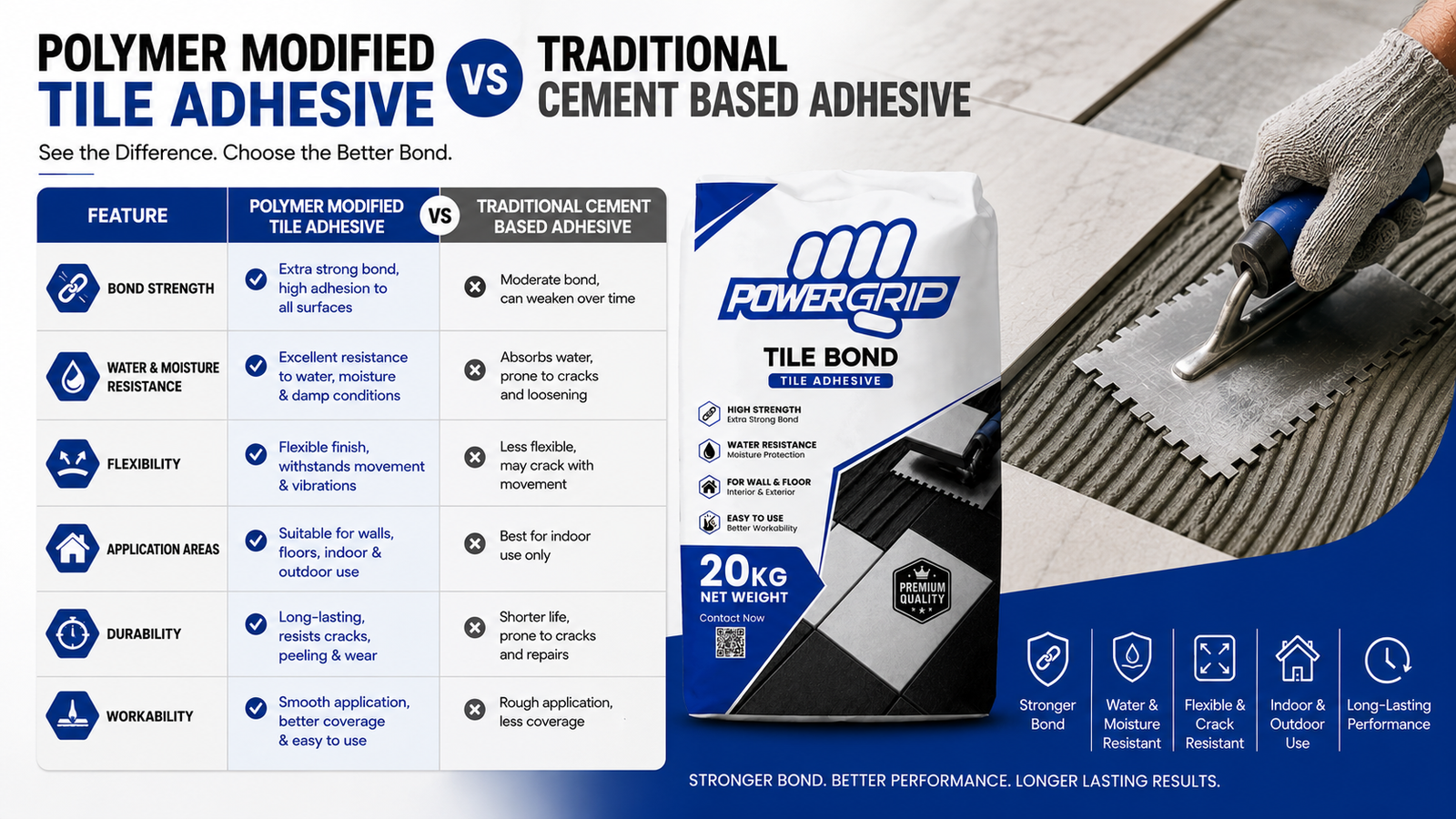
Polymer Modified Tile Adhesive vs Traditional Cement-Based Adhesive
The two options can serve different installation requirements. The right choice depends on the project rather than simply assuming one material is always better.
Factor | Polymer Modified Adhesive | Basic Cement-Based Adhesive |
Bonding performance | Generally enhanced by polymer additives | Primarily relies on cement-based bonding |
Flexibility | Can offer improved flexibility depending on formulation | Usually more limited |
Dense tiles | Some products are suitable for porcelain and dense tiles | Suitability varies |
Workability | Often improved through additives | Depends on formulation |
Demanding applications | Certain products are designed for demanding conditions | Maybe more limited |
Cost | Can be higher depending on formulation | Often more economical |
Best choice | Depends on tile, substrate, and environment | Suitable where specifications allow |
This comparison is general. Product performance varies, so technical documentation should always take priority over assumptions based on product category alone.
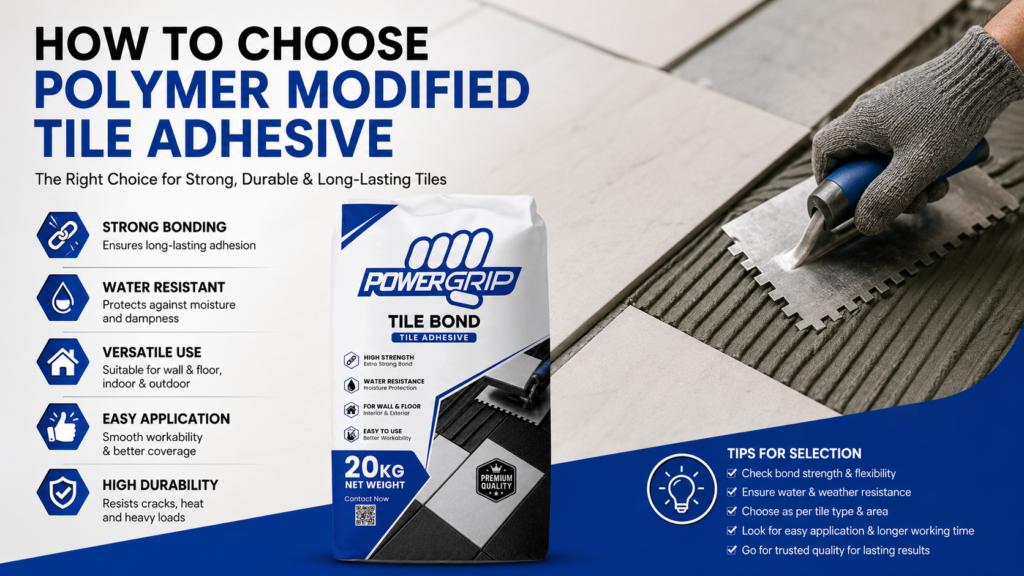
How to Choose the Best Polymer-Modified Tile Adhesive
The Best Polymer Modified Tile Adhesive is not necessarily the most expensive product. It is the one whose properties match the requirements of your specific installation.
1. Consider the Tile Type
First, identify whether you are installing ceramic, porcelain, natural stone, mosaic, or another tile material.
Porcelain and other low absorption tiles may require an adhesive specifically designed for them.
2. Check the Tile Size
Large-format tiles can have different installation requirements from smaller tiles.
As tile dimensions increase, proper adhesive selection and installation technique become increasingly important.
3. Identify the Substrate
The surface beneath the tile may be concrete, cement screed, plaster, existing tile, cement board, or another material.
The adhesive must be compatible with the substrate.
4. Consider Moisture Exposure
A bathroom, kitchen, balcony, and dry bedroom floor do not have identical environmental conditions.
For areas exposed to water, select a product whose technical information specifically supports the intended application.
5. Consider Movement
Some surfaces experience thermal or minor dimensional movement. In such situations, flexibility can become an important selection factor.
6. Check Product Instructions
Before buying or applying an adhesive, check:
- Recommended tile types
- Suitable substrates
- Indoor or outdoor suitability
- Water exposure limitations
- Mixing instructions
- Application thickness
- Open time
- Pot life
- Curing requirements
- Coverage guidance
- Storage conditions
These details are more useful than choosing a product based only on marketing language.
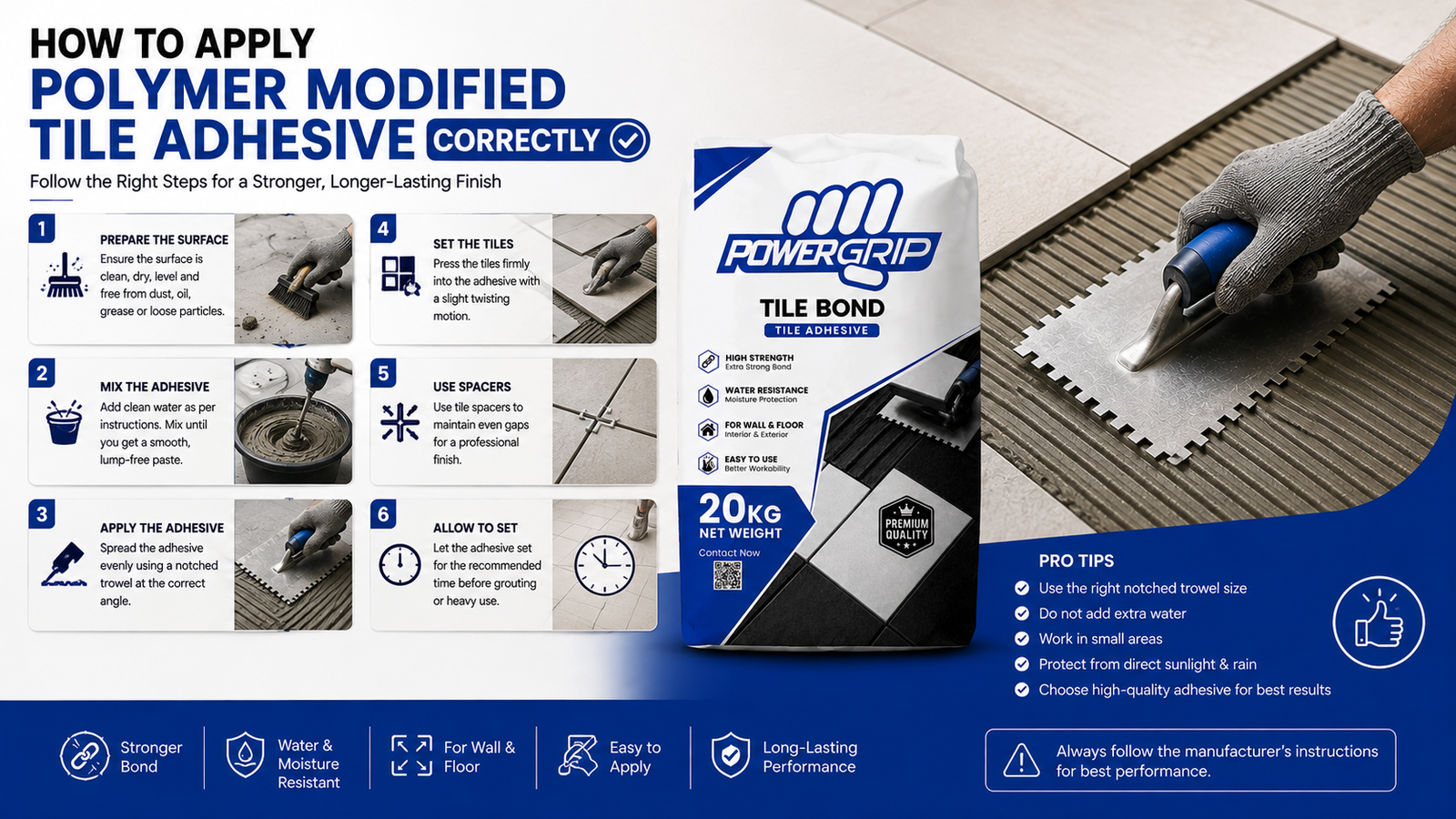
How to Apply Polymer Modified Tile Adhesive Correctly
Even a high-quality adhesive can perform poorly when installation is incorrect.
Prepare the Surface
The substrate should be sound, clean, and suitable for tiling. Dust, loose particles, oil, paint, weak material, and other contaminants can interfere with bonding.
Uneven surfaces may also require suitable preparation before adhesive application.
Mix According to Instructions
Use the manufacturer’s specified amount of clean water and mixing procedure.
Adding excessive water may alter the adhesive’s performance. Likewise, adding extra powder without following the specified proportions can produce inconsistent results.
Apply With the Correct Trowel
The appropriate notched trowel helps distribute adhesive across the surface.
The correct trowel size depends on the tile size, surface, adhesive, and installation requirements.
Ensure Proper Coverage
Tiles should have adequate adhesive contact with the substrate. Large tiles and demanding installations may require additional installation techniques, such as applying adhesive to the back of the tile when specified.
Avoid leaving large unsupported areas beneath tiles.
Allow Proper Curing
Do not expose a newly tiled surface to heavy traffic, excessive water, or other stresses before the adhesive has had sufficient time to cure according to the manufacturer’s instructions.
Common Mistakes to Avoid
Poor preparation and incorrect application can undermine an otherwise suitable adhesive.
Applying Adhesive Over a Dirty Surface
Dust and contaminants can weaken adhesion. Cleaning and preparing the substrate should never be treated as an optional step.
Adding Too Much Water
More water does not necessarily make an adhesive better or easier to use. Follow the specified mixing ratio.
Choosing Adhesive Only by Price
The cheapest option may not be suitable for porcelain tiles, wet areas, large-format tiles, or exterior applications.
Compare the adhesive requirements with the project instead.
Ignoring Tile Size
Tile dimensions can influence adhesive selection, trowel size, coverage, and installation method.
Assuming Waterproof Means Complete Waterproofing
A water-resistant or waterproof adhesive does not automatically create a waterproof building assembly.
Wet areas may require a dedicated waterproofing system beneath the tile installation.
Using the Wrong Adhesive for Outdoor Areas
Outdoor surfaces can experience environmental exposure and movement. Always confirm that the selected product is rated for exterior use.
Polymer Modified Tile Adhesive in Karachi and Pakistan
Tile installations in Karachi and other parts of Pakistan can involve environmental factors such as high temperatures, humidity, moisture, and variable construction conditions.
For this reason, adhesive selection should consider the actual installation environment rather than relying only on the tile type.
For example, a dry indoor bedroom floor may have very different requirements from a bathroom, rooftop terrace, balcony, kitchen, or exterior wall.
When comparing products available in Pakistan, buyers can review options from suppliers such as Powergrip.pk while checking the technical information and intended applications of the specific adhesive.
The key is not simply finding a product described as “polymer modified.” The product should be appropriate for the tile, substrate, location, and installation method.
Practical Checklist Before Buying Tile Adhesive
Before purchasing a polymer modified adhesive, check these factors:
- Is it compatible with your tile?
- Is it suitable for the substrate?
- Is it rated for the intended indoor or outdoor application?
- Can it be used in areas exposed to moisture?
- Is it suitable for porcelain if porcelain tiles are being installed?
- Does the tile size require a particular adhesive or application method?
- What mixing ratio does the manufacturer specify?
- What curing time is required?
- Is the product within its usable shelf life?
- Does the technical documentation match your project?
This checklist can prevent many common installation problems.
Frequently Asked Questions
What is polymer modified tile adhesive used for?
Polymer modified tile adhesive is used to bond compatible tiles to suitable substrates.
Depending on its formulation, it can be used for ceramic and porcelain tiles, floors, walls, kitchens, bathrooms, and other applications. Always verify the product’s technical specifications for the intended installation.
Is polymer modified adhesive suitable for porcelain tiles?
Some polymer modified adhesives are specifically suitable for porcelain tiles because their formulation provides appropriate bonding for low absorption tile surfaces.
However, not every polymer-modified adhesive is automatically suitable for porcelain, so the product’s stated applications should be checked.
Is polymer-modified tile adhesive waterproof?
Some products are designed to provide improved water resistance or to perform in damp environments, but this does not necessarily mean they replace a dedicated waterproofing system.
For bathrooms and other wet areas, consider the complete waterproofing and tiling system.
Is polymer modified adhesive good for floor tiles?
It can be suitable for floor tiles when the product is compatible with the tile, substrate, expected traffic, and installation conditions.
For floors, proper substrate preparation, adhesive coverage, and curing are just as important as adhesive selection.
Is polymer modified adhesive better than ordinary cement adhesive?
Polymer-modified adhesive can provide enhanced adhesion, workability, and flexibility compared with some basic cement-based adhesives.
However, “better” depends on the project. A suitable adhesive should be selected according to tile type, substrate, environment, and manufacturer’s specifications.
Can polymer-modified tile adhesive be used outdoors?
Some formulations are designed for exterior applications, while others are intended only for interior use.
Always verify exterior suitability before using an adhesive on balconies, terraces, exterior walls, or other outdoor surfaces.
How do I choose the right tile adhesive in Pakistan?
Start by identifying the tile material, tile size, substrate, location, moisture exposure, and expected use.
Then compare these requirements with the manufacturer’s technical information. Price should be considered, but suitability and installation performance are more important.
Conclusion
Polymer Modified Tile Adhesive can provide a strong and practical bonding solution for many ceramic and porcelain tile installations when the product is correctly matched to the project.
Its polymer additives can improve adhesion, flexibility, workability, and performance for selected applications.
However, choosing the right adhesive is only one part of a successful tile installation. Surface preparation, tile compatibility, correct mixing, proper adhesive coverage, suitable tools, and adequate curing all affect the final result.
For projects in Karachi and across Pakistan, compare products based on their actual technical requirements rather than relying only on terms such as “high strength” or “waterproof.”
When evaluating options from suppliers such as Powergrip.pk, check the product information carefully and select an adhesive designed for your tile, substrate, and installation environment.