

Choosing the right adhesive is one of the most important steps in achieving a durable tile installation.
Whether you are working on a residential floor, commercial building, bathroom, kitchen, outdoor area, or industrial space, ordinary adhesive may not always provide the strength required for demanding applications.
Heavy Duty Tile Adhesive is designed for tile installations where strong bonding, durability, moisture resistance, and long term performance are important.
In Pakistan, where buildings can experience high temperatures, humidity, dust, and heavy foot traffic, selecting a suitable tile adhesive can make a significant difference.
A good quality High Strength Tile Adhesive can provide better grip between the tile and the surface while reducing the chances of loose, cracked, or displaced tiles. Products such as Power Grip can also be considered when selecting a strong tile bonding solution, provided the product grade is suitable for the tile type and application.
This guide explains what heavy duty tile adhesive is, where it should be used, how to select the right product, and what factors should be considered before installation.
What Is Heavy Duty Tile Adhesive?
Heavy duty tile adhesive is a high performance bonding material used to fix tiles securely to surfaces such as concrete, cement plaster, screed, masonry, and other suitable substrates.
Compared with basic tile adhesives, a heavy-duty formulation is generally selected for applications where tiles are exposed to greater loads, moisture, temperature changes, or frequent use.
The exact performance depends on the adhesive formulation and manufacturer’s specifications.
Therefore, buyers should always check the technical information and recommended applications before purchasing.
A Strong Tile Bond Adhesive may be suitable for areas where ordinary cement-based fixing methods do not provide the required performance.
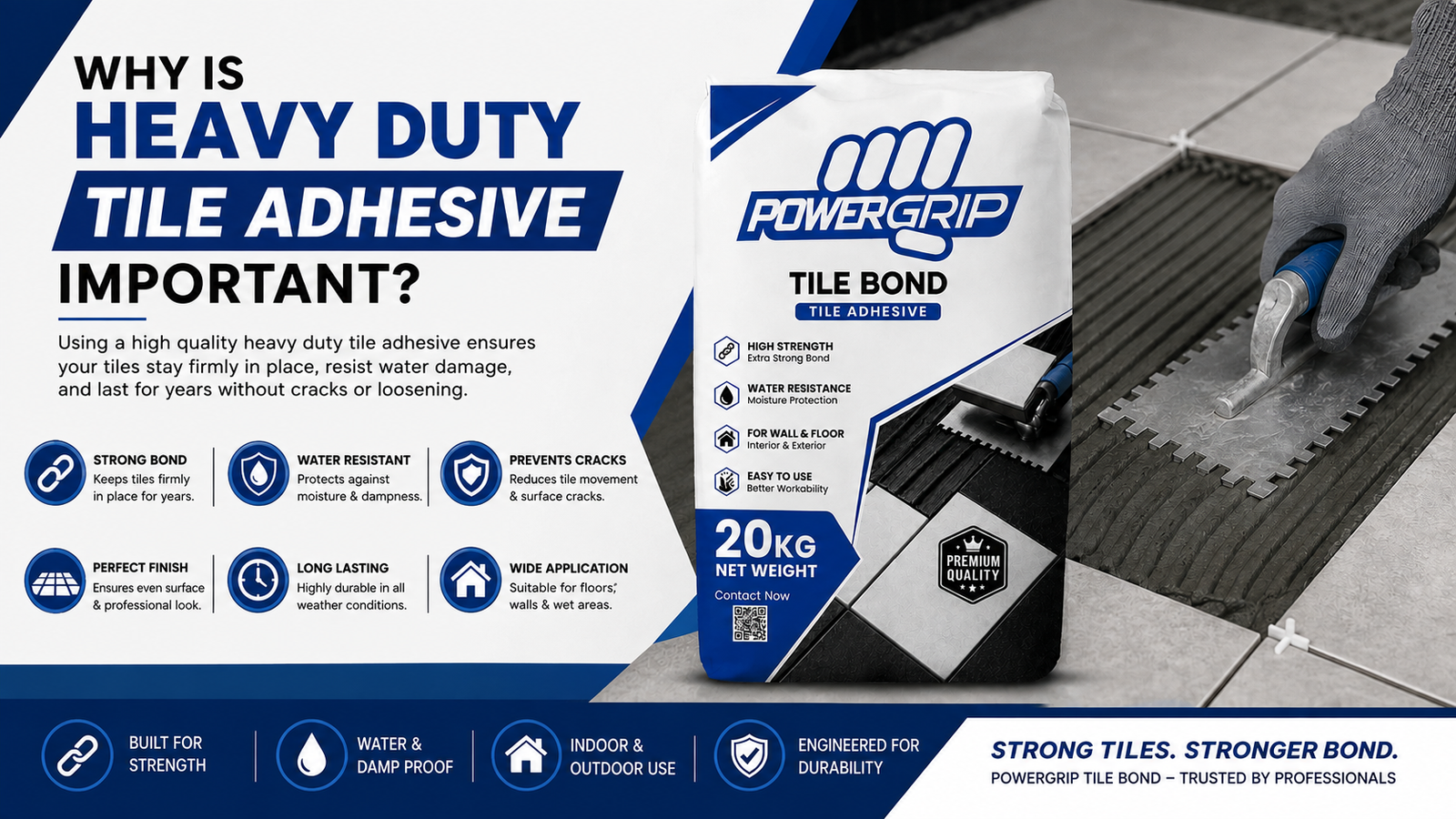
Why Is Heavy Duty Tile Adhesive Important?
Tiles may look strong, but a tile installation is only as reliable as the bond beneath it.
If the adhesive does not properly connect the tile with the substrate, several problems can develop over time.
Loose tiles, hollow sounds, cracks, broken edges, and tile movement can result from poor surface preparation, unsuitable adhesive, incorrect mixing, or inappropriate application.
A suitable heavy duty adhesive helps create a stable connection between the tile and substrate.
This becomes especially important in:
- High traffic floors
- Commercial buildings
- Shopping areas
- Kitchens
- Bathrooms
- Industrial environments
- Outdoor tile installations
- Large-format tile applications
- Areas exposed to regular moisture
For Pakistan’s construction market, choosing a suitable adhesive according to the tile and location is particularly important because installation conditions can vary significantly between indoor and outdoor projects.
What Are the Main Benefits of High-Strength Tile Adhesive?
A properly selected High Strength Tile Adhesive can offer several practical advantages over unsuitable or low-grade bonding materials.
Strong Tile Bonding
The primary purpose of tile adhesive is to create a secure connection between the tile and substrate.
A suitable high-strength product can provide reliable adhesion when mixed and applied according to the manufacturer’s instructions.
Better Performance Under Heavy Traffic
Floors in shops, offices, restaurants, hospitals, warehouses, and commercial buildings may experience continuous foot traffic.
A suitable heavy duty adhesive can help maintain tile stability in these demanding environments.
Improved Moisture Resistance
Bathrooms, kitchens, laundry areas, and other wet spaces require careful adhesive selection. Water exposure can affect unsuitable bonding materials over time.
For these applications, check whether the adhesive is specifically recommended for wet areas.
Suitable for Different Tile Types
Different tiles have different characteristics. Ceramic, porcelain, stone, and large format tiles may require different adhesive properties.
The adhesive should always be selected according to the tile manufacturer’s recommendations and the substrate.
Long-Term Installation Performance
The objective is not simply to attach a tile today.
A quality installation should remain stable for years when the correct adhesive, substrate preparation, tile selection, and installation technique are used together.
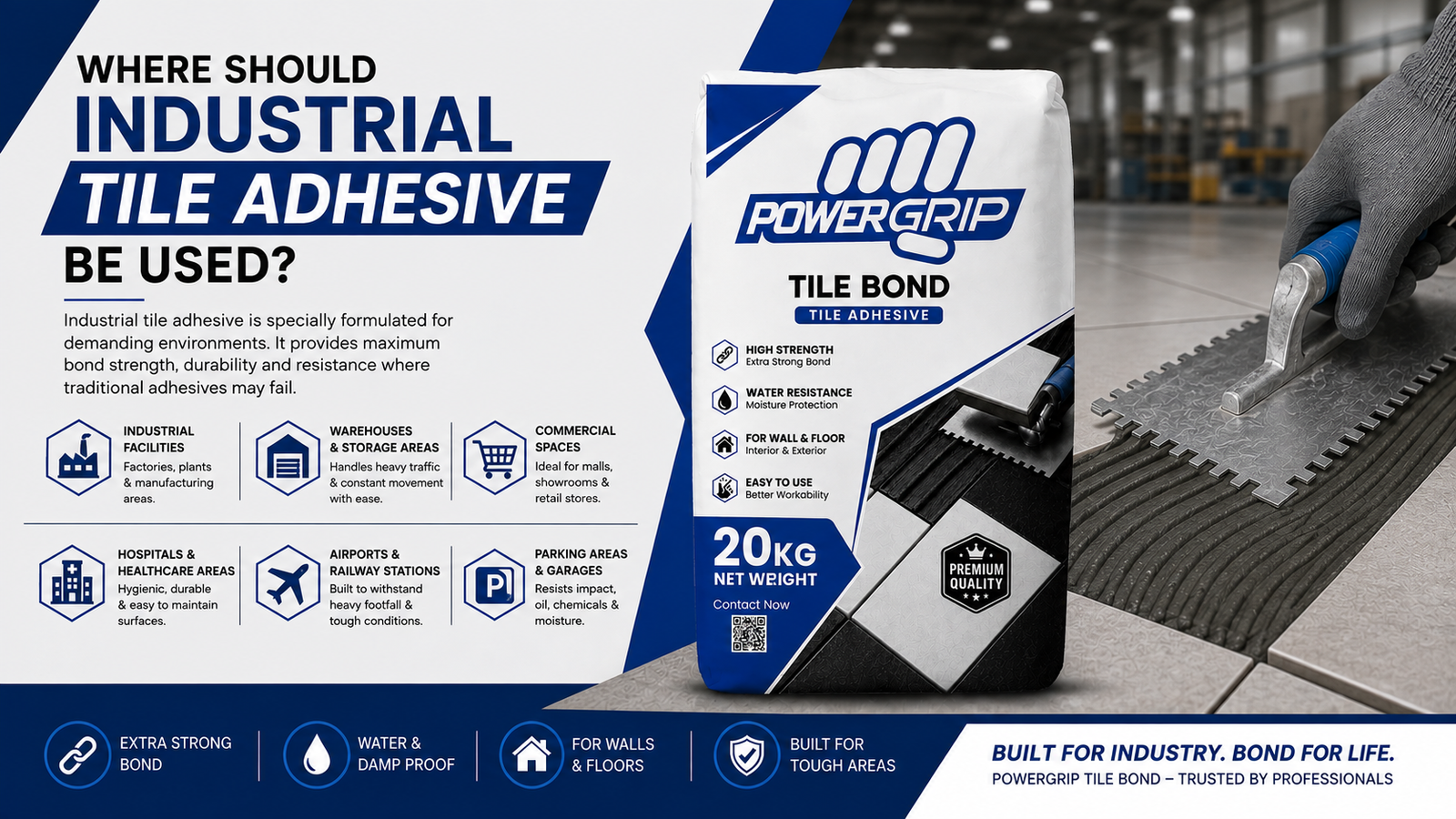
Where Should Industrial Tile Adhesive Be Used?
Industrial Tile Adhesive is generally intended for demanding environments where durability and strong bonding are important.
It may be considered for commercial and industrial projects such as warehouses, workshops, factories, retail spaces, commercial kitchens, and other high-use areas.
However, “industrial” does not automatically mean that one adhesive is suitable for every project.
For example, an adhesive designed for a standard indoor floor may not be appropriate for an exterior area exposed to weather.
Similarly, a normal adhesive may not be the right choice for large porcelain tiles.
Before buying, check:
- Recommended tile type
- Suitable substrate
- Indoor or outdoor application
- Water exposure requirements
- Tile size and weight
- Recommended adhesive thickness
- Open time and working time
- Manufacturer’s technical specifications
Heavy Duty Tile Adhesive vs Ordinary Tile Adhesive
The difference is not simply about using more adhesive.
The important factor is whether the adhesive has been formulated and tested for the intended application.
Feature | Standard Tile Adhesive | Heavy Duty Tile Adhesive |
Typical use | Light to moderate applications | Demanding applications |
Bonding requirement | General | Higher performance |
Traffic areas | Suitable for selected residential uses | Better suited to high traffic applications |
Large tiles | Depends on product | Often available in suitable grades |
Moisture exposure | Product dependent | Specific moisture resistant grades available |
Commercial projects | Selected applications | Often preferred where higher performance is required |
Outdoor use | Only if specified | Suitable only when product is rated for exterior use |
Selection priority | Basic compatibility | Tile, substrate, environment, and performance requirements |
The table shows why product selection should be based on the project rather than simply choosing the strongest sounding product.
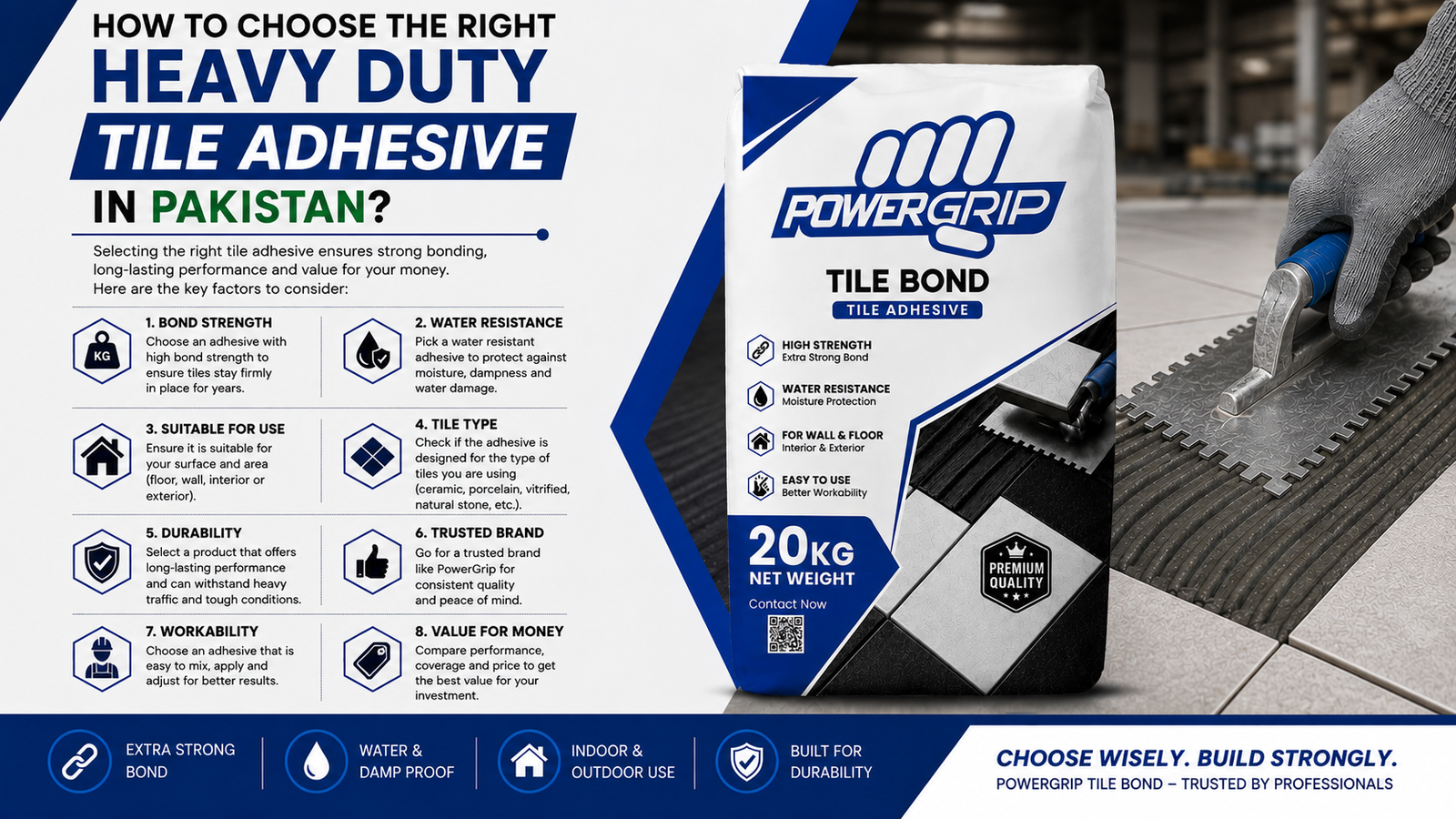
How to Choose the Right Heavy Duty Tile Adhesive in Pakistan?
The best adhesive depends on the actual installation conditions.
A product that works well for a bathroom wall may not necessarily be the best choice for an outdoor floor or industrial facility.
Consider the Tile Type
Ceramic tiles and porcelain tiles have different absorption characteristics.
Porcelain is generally less porous, which means the adhesive needs to provide suitable bonding performance.
Always check whether the product is recommended for porcelain.
For heavy ceramic applications, a Heavy Duty Ceramic Tile Glue can be considered when its technical specifications match the project requirements.
Check the Surface
The substrate should be stable, clean, and appropriately prepared.
Dust, oil, grease, loose particles, paint, and other contaminants can reduce bonding performance.
Consider Tile Size
Large-format tiles require more careful installation than small tiles.
The adhesive should be suitable for the tile dimensions and weight.
For large tiles, proper coverage is particularly important because empty areas beneath the tile can create weak points.
Consider the Location
Ask where the tiles will be installed.
Is it:
- A bedroom?
- A kitchen?
- A bathroom?
- A balcony?
- A commercial shop?
- A warehouse?
- An outdoor floor?
The answer can change which adhesive is appropriate.
Check the Product Specifications
Don’t choose an adhesive based only on marketing claims.
Look for information about recommended applications, compatible surfaces, coverage, mixing instructions, curing time, water resistance, and other technical characteristics.
Is Power Grip a Good Option for Tile Installation?
Power Grip can be considered among the tile adhesive options available to customers looking for strong bonding performance in Pakistan.
For a project requiring a heavy-duty solution, the important point is not simply the product name.
Buyers should select the appropriate Power Grip grade or formulation according to the tile type, substrate, location, and manufacturer’s recommended application.
For example, a product suitable for standard ceramic tiles may not automatically be the right choice for large-format porcelain tiles or demanding outdoor applications.
Therefore, when considering Power Grip as a Strong Tile Bond Adhesive, compare its technical specifications with the requirements of your project.
This approach is more reliable than choosing any adhesive simply because it is advertised as “heavy duty.”
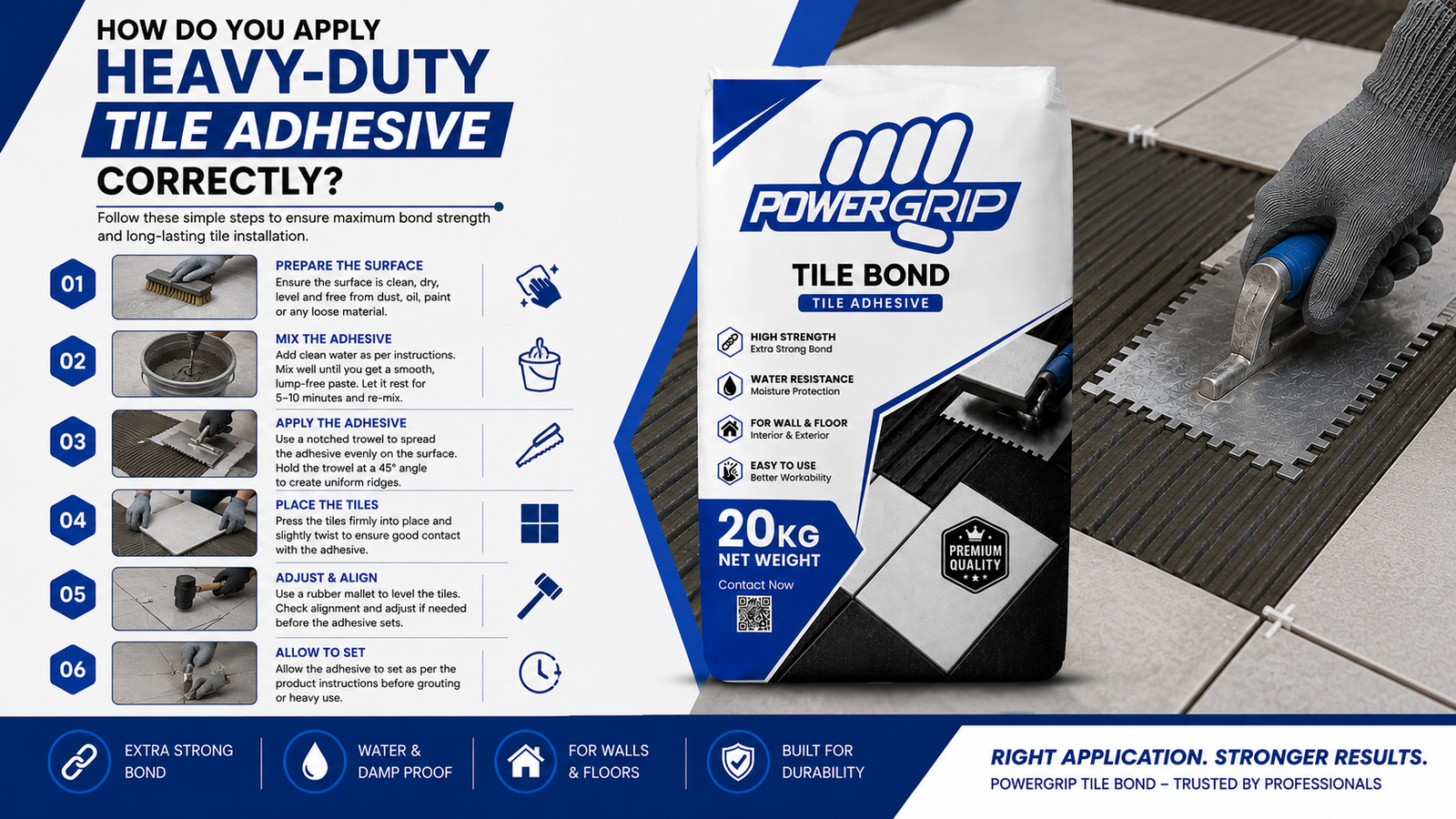
How Do You Apply Heavy-Duty Tile Adhesive Correctly?
Even a high-quality adhesive can perform poorly if it is installed incorrectly.
The installation process generally involves several important steps.
1. Prepare the Surface
Remove dust, dirt, oil, loose material, and other contaminants.
The surface should be structurally sound and appropriately prepared according to the adhesive manufacturer’s instructions.
2. Mix the Adhesive Properly
Use the recommended amount of clean water and adhesive.
Avoid adding excessive water because changing the specified mixture can affect the adhesive’s final performance.
Follow the manufacturer’s mixing instructions carefully.
3. Apply the Adhesive
Spread the adhesive evenly using the appropriate notched trowel.
The trowel size should correspond to the tile size and installation requirements.
4. Place the Tile
Press the tile firmly into the adhesive and move it slightly where appropriate to improve contact.
For larger tiles, additional installation techniques may be required depending on the adhesive and project.
5. Maintain Proper Coverage
Good coverage beneath the tile is essential.
Large-format tiles and demanding applications require particular attention to coverage because voids under tiles can contribute to movement or breakage.
6. Allow Proper Curing
Do not rush the installation.
Allow the adhesive to cure according to the manufacturer’s instructions before exposing the area to heavy traffic, water, or other stresses.
What Common Mistakes Reduce Tile Adhesive Performance?
Many tile failures are caused not by the adhesive itself but by installation problems.
One common mistake is applying adhesive over a dusty or contaminated surface.
Even a strong adhesive cannot form a reliable bond with loose dust.
Another mistake is adding too much water during mixing. Installers may sometimes try to make adhesive easier to spread, but altering the recommended mixture can affect performance.
Applying too little adhesive is another problem.
If large areas beneath the tile remain unsupported, the tile may be more vulnerable to cracking or movement.
Using an adhesive outside its recommended application is also risky.
A product intended for indoor ceramic tiles should not automatically be assumed suitable for exterior porcelain, stone, or industrial environments.
How Can You Get Better Results From Strong Tile Bond Adhesive?
The following practices can help improve the quality of a tile installation:
- Choose adhesive according to the tile and substrate.
- Prepare the surface before application.
- Follow the manufacturer’s water ratio.
- Use the correct notched trowel.
- Ensure adequate adhesive coverage.
- Avoid installing over loose or contaminated surfaces.
- Observe the recommended working and curing times.
- Select moisture-suitable products for wet areas.
- Confirm outdoor suitability before exterior installation.
- Do not rely only on the word “heavy duty” on packaging.
These steps are simple, but they can have a major impact on the final result.
What Is Heavy Duty Ceramic Tile Glue Used For?
Heavy Duty Ceramic Tile Glue is used when ceramic tiles require reliable bonding in applications that may experience greater use or environmental stress.
It can be considered for floors, walls, kitchens, bathrooms, commercial areas, and other suitable surfaces, depending on the product specifications.
However, ceramic tile glue should not be selected solely because it has high bonding strength.
The adhesive must also be compatible with the substrate, tile size, moisture conditions, and location.
For example, a bathroom installation may require different properties from a dry indoor wall.
An exterior floor may have additional requirements because of weather and temperature changes.
Can Heavy Duty Tile Adhesive Be Used Outdoors?
It depends on the specific product.
Not every heavy duty adhesive is designed for exterior applications.
Outdoor tiles may experience rain, heat, temperature changes, and moisture exposure.
If you are installing tiles outdoors, choose an adhesive that specifically states it is suitable for exterior use.
For Pakistan’s climate, this consideration can be particularly important in areas exposed to strong sunlight and seasonal weather changes.
What Should You Avoid When Buying Tile Adhesive?
Price should not be the only factor when choosing an adhesive.
A cheaper product may appear attractive initially, but replacing loose tiles or repairing a failed installation can cost much more later.
Avoid selecting a product without checking its recommended applications.
You should also avoid purchasing an adhesive based only on claims such as “strongest” or “number one” unless there is reliable technical information supporting the claim.
Instead, compare:
- Product specifications
- Tile compatibility
- Substrate compatibility
- Application area
- Moisture resistance
- Indoor or outdoor suitability
- Coverage requirements
- Manufacturer instructions
- Professional installer recommendations
How Much Tile Adhesive Do You Need?
The quantity required depends on several factors, including tile size, substrate condition, trowel size, adhesive thickness, and installation technique.
A smooth, properly prepared surface can generally provide more consistent coverage than an uneven substrate.
Large-format tiles may require more adhesive than small tiles because they need greater coverage and careful application.
For an accurate estimate, check the product’s coverage information and calculate the total installation area.
If the project is large, it is better to calculate material requirements before starting work so you can avoid interruptions caused by insufficient adhesive.
Frequently Asked Questions About
What is the strongest tile adhesive?
There is no single adhesive that is automatically the strongest for every project.
The right choice depends on the tile, substrate, environment, tile size, and application requirements.
Is heavy duty tile adhesive suitable for porcelain tiles?
Some heavy-duty adhesives are suitable for porcelain, but not all products are.
Always check the product specifications for porcelain compatibility before installation.
Is Power Grip suitable for heavy-duty tile installation?
Power Grip can be considered as a tile adhesive option where its specific product specifications match the installation requirements.
Check the recommended tile type, substrate, location, and application conditions before choosing it.
Can heavy-duty adhesive be used in bathrooms?
A suitable product can be used in bathrooms when it is recommended for wet or moisture exposed applications.
Surface preparation and correct installation are also important.
Can I use heavy duty tile adhesive outdoors?
Only use a product outdoors if the manufacturer specifically recommends it for exterior applications.
Outdoor installations can face moisture, temperature changes, and weather exposure.
Is more adhesive always better?
No. Using excessive adhesive does not automatically create a stronger installation.
Correct mixing, proper thickness, good coverage, and suitable surface preparation are more important.
Conclusion
A successful tile installation depends on more than simply selecting a product with a strong name.
Heavy Duty Tile Adhesive should be chosen according to the tile type, substrate, location, moisture exposure, tile size, and expected traffic.
For homeowners, contractors, builders, and commercial projects in Pakistan, a quality High Strength Tile Adhesive can provide a practical solution for demanding tile installations when it is correctly matched to the application.
Products such as Power Grip may be considered when looking for a strong tile bonding solution, but buyers should always review the specific product’s technical specifications rather than relying only on general marketing claims.
The most important rule is simple: choose the right adhesive for the right tile, prepare the surface properly, follow the manufacturer’s instructions, and ensure sufficient coverage.
When these factors are handled correctly, a strong adhesive system can contribute to a stable, durable, and professional-looking tile installation.