

A beautiful tile installation is not only about choosing premium tiles.
The real strength lies beneath the surface. Even the highest quality ceramic, porcelain, or natural stone tiles can loosen, crack, or detach if the wrong adhesive is used.
That is why Professional Tile Adhesive Pakistan has become the preferred choice for homeowners, contractors, architects, and builders who want reliable and long-lasting results.
Modern construction projects demand materials that deliver superior bonding strength, moisture resistance, and flexibility.
Traditional cement mortar often fails to meet these expectations, especially in high-traffic areas, bathrooms, kitchens, balconies, and commercial buildings.
Professional Tile Adhesive Pakistan solves these challenges by providing stronger adhesion, easier application, and greater durability.
Whether you are renovating your home, constructing a commercial property, or working on an industrial project, selecting the right tile adhesive directly impacts the quality and lifespan of your flooring and wall installations.
This guide explains everything you need to know, from adhesive types and applications to installation best practices, helping you make an informed decision for every project.
Why Is Professional Tile Adhesive Pakistan Better Than Traditional Cement Mortar?
For decades, cement mortar was the standard method for fixing tiles.
While it remains useful for some basic applications, today’s construction standards require stronger and more dependable bonding solutions.
Professional tile adhesive is a specially formulated construction chemical made with cement, graded sand, polymers, and performance-enhancing additives.
These ingredients work together to create exceptional adhesion while reducing installation problems.
Quick Answer
Professional tile adhesive offers:
- Superior bonding strength
- Better flexibility
- Improved moisture resistance
- Crack-resistant performance
- Faster installation
- Less material wastage
- Longer service life
Tile Adhesive vs Cement Mortar
Feature | Professional Tile Adhesive | Traditional Cement Mortar |
Bond Strength | Excellent | Moderate |
Flexibility | High | Low |
Water Resistance | Excellent | Limited |
Application Thickness | Thin | Thick |
Tile Slippage | Minimal | Higher |
Material Waste | Low | High |
Installation Speed | Faster | Slower |
Suitable for Large Tiles | Yes | Limited |
Long Term Durability | Excellent | Moderate |
Why More Professionals Prefer Tile Adhesives
Modern buildings experience constant movement due to temperature changes, moisture, and structural settling.
Polymer-modified tile adhesive can absorb these small movements without losing its bond.
This flexibility significantly reduces the chances of:
- Hollow-sounding tiles
- Loose flooring
- Cracked grout joints
- Water seepage
- Tile lifting
- Costly repairs
For this reason, professional contractors increasingly choose premium tile adhesive over conventional mortar for residential and commercial projects.
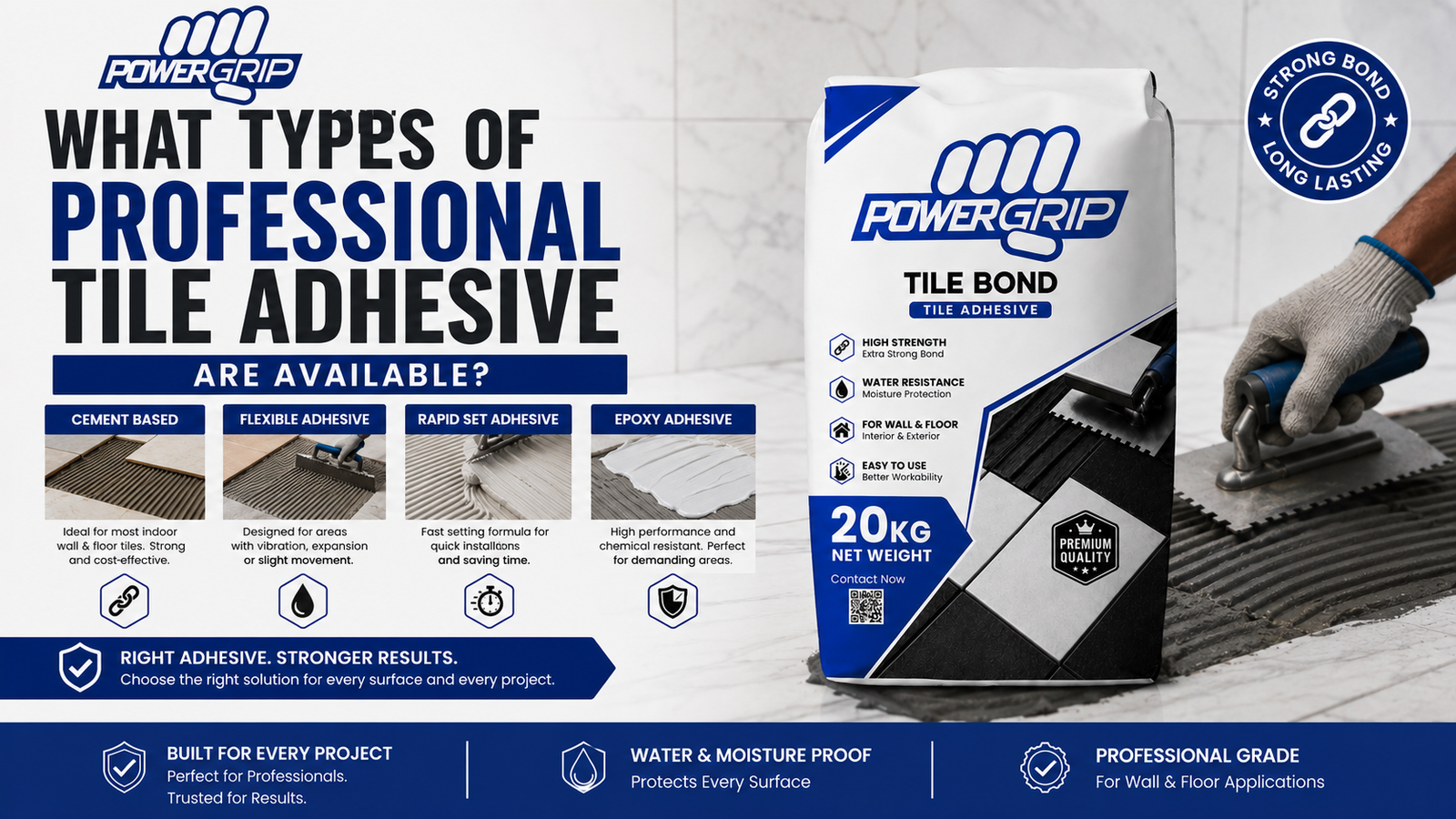
What Types of Professional Tile Adhesive Are Available?
Not every tile adhesive is designed for the same purpose.
The ideal choice depends on the tile material, installation area, environmental conditions, and expected load.
Here are the most common options used across Pakistan.
Cement-Based Tile Adhesive
Cement-based tile adhesive is the most widely used solution for residential construction.
It works well for:
- Ceramic tile adhesive
- Floor tile adhesive
- Wall tile adhesive
- Indoor installations
- Standard residential projects
Polymer Modified Tile Adhesive
Polymer-modified tile adhesive contains special additives that improve flexibility and bonding performance.
Recommended for:
- Porcelain tile adhesive
- Vitrified tile adhesive
- Large format tiles
- Exterior walls
- Balcony tile adhesive
- Bathroom tile adhesive
- Kitchen tile adhesive
Waterproof Tile Adhesive
Areas exposed to constant moisture require extra protection.
Ideal applications include:
- Swimming pool tile adhesive
- Bathroom walls
- Shower areas
- Kitchens
- Water tanks
- Laundry rooms
Waterproof formulations help reduce water penetration and improve long term durability.
Flexible Tile Adhesive
Flexible tile adhesive is designed for surfaces that may expand or contract due to changing temperatures.
Suitable for:
- Outdoor tile adhesive
- Heated floors
- Roof terraces
- Wall cladding adhesive
- Tile on tile adhesive
Heavy Duty Tile Adhesive
Commercial and industrial environments demand exceptional strength.
Common applications include:
- Shopping malls
- Hospitals
- Airports
- Hotels
- Warehouses
- Industrial flooring
Heavy-duty adhesives maintain strong bonding even under heavy foot traffic and equipment loads.
How Do You Choose the Right Tile Adhesive for Your Project?
Selecting the correct adhesive is one of the most important decisions during tile installation.
Choosing the wrong product can lead to expensive repairs and reduced tile life.
Consider the Tile Type
Different tiles have different absorption rates.
For example:
- Ceramic tiles generally work well with standard cementitious tile adhesive.
- Porcelain tiles require high-strength tile adhesive because they absorb very little water.
- Marble and granite often need premium polymer-enhanced adhesive to support their weight.
- Natural stone installations may require specialized stone tile adhesive.
Evaluate the Installation Area
The location plays a major role in adhesive selection.
Installation Area | Recommended Adhesive |
Living Room | Cement-based tile adhesive |
Bathroom | Waterproof tile adhesive |
Kitchen | Moisture-resistant tile adhesive |
Balcony | Flexible tile adhesive |
Swimming Pool | Waterproof polymer-modified adhesive |
Commercial Building | Heavy-duty tile adhesive |
Exterior Walls | Weather-resistant adhesive |
Check Environmental Conditions
Always consider:
- Moisture exposure
- Direct sunlight
- Heavy traffic
- Temperature fluctuations
- Structural movement
Choosing an adhesive that matches these conditions greatly improves installation performance.
Buy from Trusted Suppliers
Construction chemicals vary in quality. Purchasing from reputable tile adhesive manufacturers and trusted tile bond suppliers in Pakistan helps ensure consistent performance and product reliability.
Look for products that clearly mention:
- Coverage area
- Mixing ratio
- Drying time
- Suitable tile types
- Application instructions
- Performance specifications
Using certified products reduces installation risks and improves long term satisfaction.
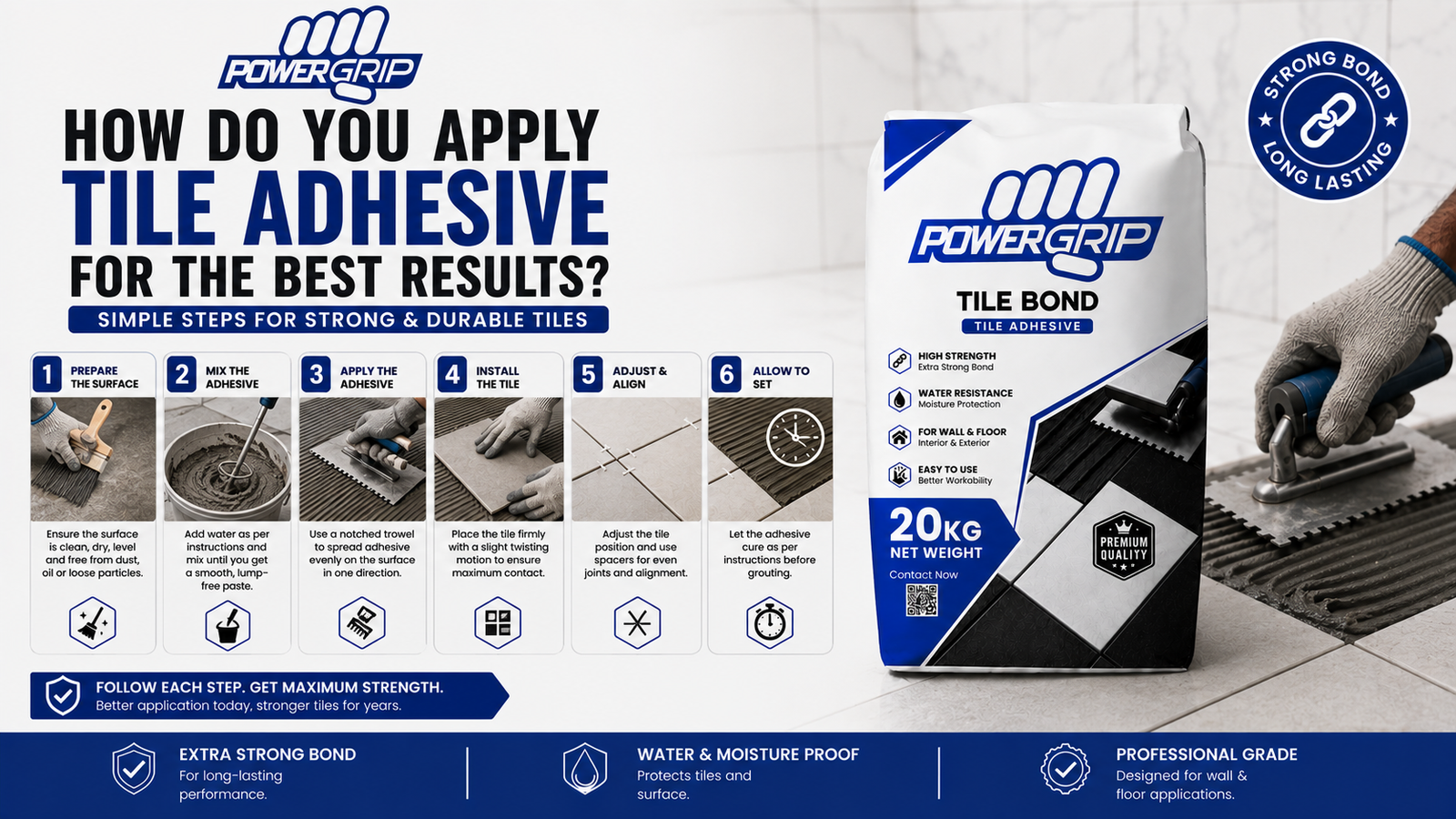
How Do You Apply Tile Adhesive for the Best Results?
Even the highest quality tile adhesive Pakistan products cannot perform well without proper installation. Professional installers follow a systematic process to achieve maximum bonding strength and long-lasting performance.
Step 1: Prepare the Surface
The surface should be:
- Clean and dust-free
- Dry unless the manufacturer recommends otherwise
- Level and structurally sound
- Free from grease, paint, or loose particles
A properly prepared surface improves adhesion and prevents future tile failures.
Step 2: Mix the Adhesive Correctly
The tile adhesive mixing ratio varies by manufacturer, so always read the product instructions.
General guidelines include:
- Add clean water first.
- Slowly add the adhesive powder.
- Mix with a mechanical mixer until smooth.
- Let the mixture rest for a few minutes.
- Remix briefly before application.
Avoid adding extra water after the adhesive has started to set, as this weakens its bonding strength.
Step 3: Spread the Adhesive
Use a notched trowel to spread the adhesive evenly.
The notch size depends on:
- Tile dimensions
- Tile thickness
- Surface condition
Larger tiles require larger notches to achieve proper coverage.
Step 4: Fix the Tiles
Press each tile firmly into the adhesive while applying slight twisting pressure.
This removes trapped air and creates a stronger bond.
Use tile spacers to maintain uniform grout joints.
Step 5: Allow Proper Curing
Avoid walking on newly installed floor tiles until the adhesive has cured according to the manufacturer’s recommendations.
Proper curing ensures maximum durability and prevents tile movement.
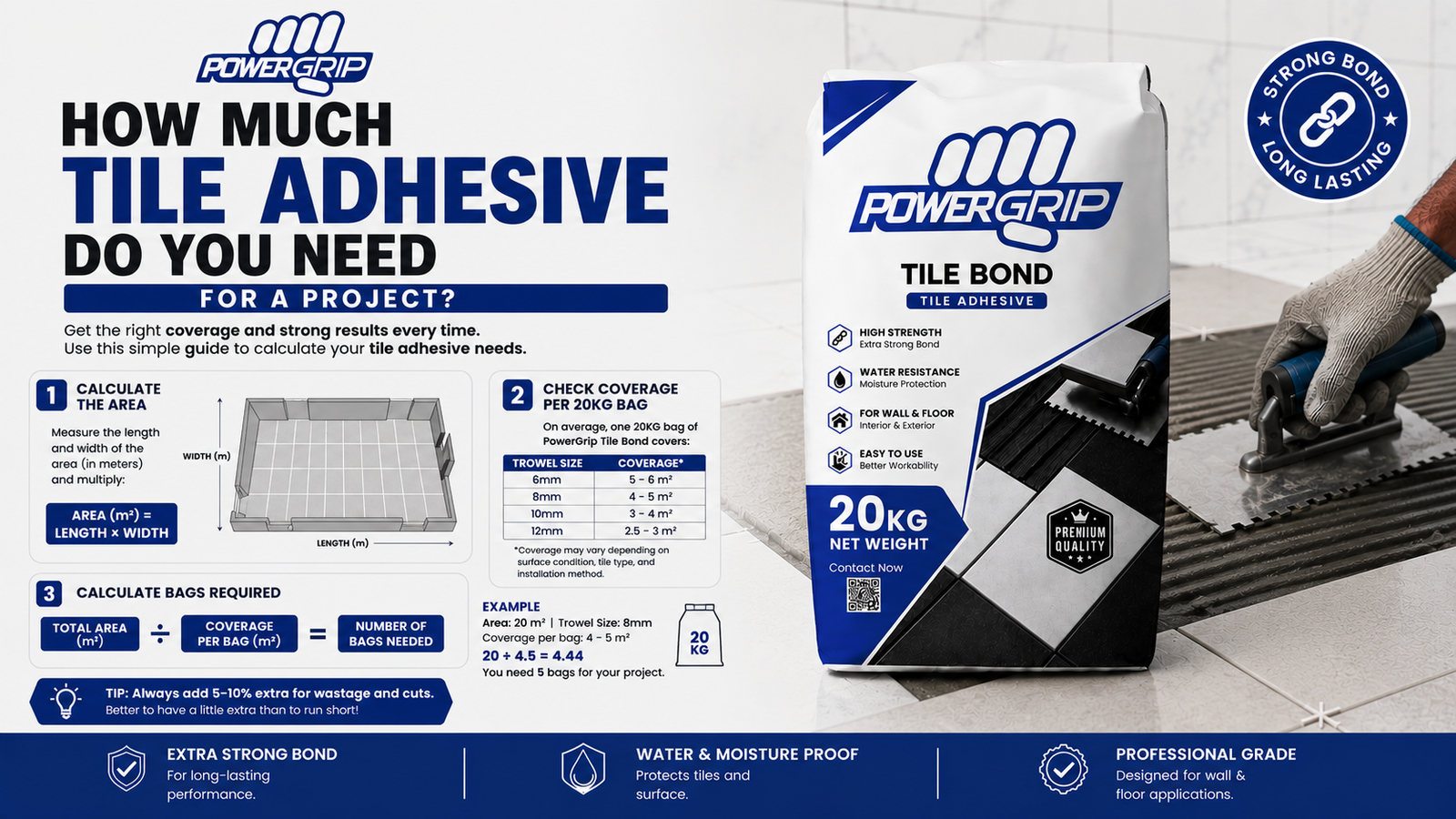
How Much Tile Adhesive Do You Need for a Project?
One of the most common questions during construction is how much adhesive to purchase.
The answer depends on several factors:
- Tile size
- Surface level
- Trowel notch size
- Adhesive thickness
- Installer experience
Average Tile Adhesive Coverage
Tile Size | Estimated Coverage (20 kg Bag) |
Small Ceramic Tiles | 7–8 m² |
Medium Floor Tiles | 5–6 m² |
Large Format Tiles | 4–5 m² |
Stone or Granite Tiles | 3–4 m² |
These figures are estimates. Uneven surfaces usually require more adhesive.
Buying slightly more than the calculated quantity helps avoid shortages during installation.
Which Tile Adhesive Works Best for Different Applications?
Every installation environment has unique requirements.
Selecting the appropriate adhesive improves both performance and durability.
Bathroom Tile Adhesive
Bathrooms experience constant moisture.
The ideal adhesive should provide:
- Waterproof performance
- Strong bonding
- Mold resistance
- Crack resistance
Polymer-modified waterproof tile adhesive is commonly recommended.
Kitchen Tile Adhesive
Kitchen floors and walls face:
- Heat
- Oil splashes
- Frequent cleaning
- Heavy appliances
A moisture-resistant and high-strength tile adhesive performs best in these conditions.
Outdoor Tile Adhesive
Outdoor installations are exposed to:
- Rain
- Sunlight
- Temperature changes
- Expansion and contraction
Flexible, weather-resistant tile adhesive reduces the risk of cracks and tile lifting.
Large Format Tile Adhesive
Large tiles have become increasingly popular in modern homes and commercial buildings.
Because they are heavier, they require:
- Superior bonding strength
- High coverage
- Slip-resistant performance
- Polymer-enhanced formulation
Professional installers often use back buttering techniques to improve adhesion for large-format tiles.
Tile on Tile Adhesive
Removing old tiles can be expensive and time-consuming.
Many renovation projects now use tile-on-tile adhesive, which allows new tiles to be installed directly over existing ones.
However, the old surface must be:
- Secure
- Clean
- Even
- Free from loose or damaged tiles
This approach saves time while reducing demolition costs.
What Are the Biggest Mistakes People Make During Tile Installation?
Many tile failures are caused by installation errors rather than poor-quality materials.
Here are some of the most common mistakes.
Using Cement Mortar Instead of Tile Adhesive
Traditional mortar often lacks the flexibility needed for modern porcelain and vitrified tiles.
Incorrect Mixing
Adding too much water reduces adhesive strength and increases shrinkage.
Poor Surface Preparation
Dust, dirt, grease, or uneven surfaces prevent proper bonding.
Choosing the Wrong Adhesive
Using indoor adhesive outdoors or standard adhesive for heavy stone tiles can lead to premature failure.
Skipping Expansion Joints
Buildings naturally expand and contract. Without movement joints, tiles may crack or lift.
Walking on Tiles Too Early
Allowing adequate drying time is essential for long-lasting performance.
What Is the Drying Time for Tile Adhesive?
Drying time depends on several factors:
- Product formulation
- Weather conditions
- Humidity
- Tile size
- Surface type
Typical curing stages are:
- Initial setting: 20 to 40 minutes
- Light foot traffic: 24 hours
- Grouting: 24 hours
- Full curing: Up to 7 days
Cold or humid environments may increase curing time.
Always follow the manufacturer’s recommendations for the best results.
Why Is Professional Tile Adhesive Becoming the Preferred Choice Across Pakistan?
Builders, contractors, and homeowners are increasingly replacing conventional mortar with advanced construction adhesives.
The reasons are clear:
- Better durability
- Reduced maintenance
- Faster installation
- Cleaner application
- Higher bonding performance
- Lower material waste
- Suitable for modern tile designs
- Excellent performance in residential and commercial projects
From tile adhesive Karachi suppliers to distributors in tile adhesive Lahore, tile adhesive Islamabad, tile adhesive Faisalabad, tile adhesive Multan, and tile adhesive Peshawar, the demand for premium construction chemicals continues to grow as more people recognize the value of professional installation systems.
Choosing the right adhesive today helps protect your investment for many years while delivering a clean, durable, and professional finish.
What Should You Check Before Buying Tile Adhesive?
Choosing the right product is just as important as selecting quality tiles. Before making a purchase, compare products based on performance rather than price alone.
Professional Buying Checklist
✔ Match the adhesive with your tile type (ceramic, porcelain, marble, granite, or stone)
✔ Confirm whether it is suitable for walls, floors, or both
✔ Check if it is designed for indoor or outdoor applications
✔ Review the coverage per bag
✔ Verify the recommended mixing ratio
✔ Check the open time and drying time
✔ Ensure it offers waterproof and crack-resistant properties if required
✔ Buy from a trusted tile bond supplier in Pakistan
✔ Read the manufacturer’s installation instructions carefully
Investing in a premium adhesive can reduce maintenance costs and extend the life of your tile installation.
What Are the Best Practices for Long Lasting Tile Installation?
Professional installers follow several best practices that improve both appearance and durability.
Expert Recommendations
- Store adhesive bags in a dry place before use.
- Use clean water for mixing.
- Prepare only the amount of adhesive that can be applied within the working time.
- Use the correct notched trowel for the tile size.
- Apply adhesive evenly to avoid hollow spots.
- Back butter large-format tiles for improved adhesion.
- Maintain consistent grout joint spacing.
- Allow the adhesive to cure fully before heavy use.
- Protect newly installed tiles from rain and excessive moisture during curing.
- Follow the manufacturer’s specifications for every project.
These simple steps help create a durable tile installation with fewer repairs over time.
How Is Tile Adhesive Technology Evolving?
Construction materials continue to improve as the industry focuses on stronger, faster, and more sustainable solutions.
Modern tile installation products now offer:
- Faster setting formulations for quicker project completion
- Improved polymer-enhanced adhesives with greater flexibility
- Low-dust products for cleaner work environments
- Higher bonding strength for large-format tiles
- Better moisture and weather resistance
- Eco-friendly formulations with lower environmental impact
As residential and commercial construction grows across Pakistan, advanced construction chemicals are becoming the preferred choice for builders who prioritize quality and efficiency.
Frequently Asked Questions
Which tile adhesive is best for porcelain tiles?
Porcelain tiles have very low water absorption, so a polymer-modified, high-strength tile adhesive is the best choice. It provides excellent bonding and helps prevent tile movement over time.
Can tile adhesive be used instead of cement mortar?
Yes. In most modern construction projects, tile adhesive is preferred because it offers stronger adhesion, better flexibility, reduced material waste, and faster installation compared with traditional cement mortar.
How long does tile adhesive take to dry?
Most tile adhesives allow light foot traffic after about 24 hours. Full curing may take up to seven days, depending on the product, temperature, humidity, and tile size.
Is waterproof tile adhesive necessary for bathrooms?
Yes. Bathrooms, showers, kitchens, and other wet areas benefit from waterproof tile adhesive because it improves moisture resistance and helps protect the installation from water related damage.
Can large-format tiles be installed with regular tile adhesive?
Large format tiles require a high performance adhesive with superior bonding strength and flexibility. Using an adhesive specifically designed for large tiles helps ensure proper support and long-term durability.
Conclusion
Choosing Professional Tile Adhesive Pakistan is one of the smartest decisions you can make for any residential, commercial, or industrial tiling project.
Compared with traditional cement mortar, modern tile adhesives provide stronger bonding, greater flexibility, improved moisture resistance, and longer service life.
Whether you are installing ceramic, porcelain, vitrified, marble, granite, or natural stone tiles, selecting the correct adhesive and following proper installation practices can significantly improve the final result.
Paying attention to surface preparation, mixing ratios, curing time, and product compatibility helps prevent common issues such as loose tiles, cracks, and water damage.
By investing in a high-quality tile adhesive and following expert recommendations, you can achieve a durable, professional finish that enhances the beauty and value of your property for years to come.